

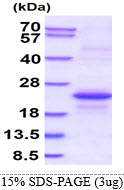

Human CD7 protein (Recombinant) (His-Tag) (STJP018393)
SPECIFICATIONS
HostE.coli
ImmunogenHuman
General Information
| Short Description | Recombinant-Human CD7-His-Tag protein was developed from e.coli and has a target region of His-Tag. For use in research applications. |
| Applications | SDS-PAGE/Denatured |
| Host | E.coli |
| Note | STRICTLY FOR FURTHER SCIENTIFIC RESEARCH USE ONLY (RUO). MUST NOT TO BE USED IN DIAGNOSTIC OR THERAPEUTIC APPLICATIONS. |
Product Properties
| Concentration | 1 mg/mL |
| Formulation | Liquid in 20mM Tris-HCl buffer (pH 8.0) containing 0.4M urea, 10% Glycerol |
| Storage Instruction | For short term storage, keep at +2C to +8C for up to 1 week. For long term storage, aliquot and store at-20C, and avoid repeat freeze-thaw cycles. |
Target Information
| Gene Symbol | CD7 |
| Gene ID | 924 |
| Uniprot ID | CD7_HUMAN |
| Accession Number | NP_006128 |
| Immunogen | Human |
| Immunogen Region | 26-180aa |
| Immunogen Sequence | MGSSHHHHHH SSGLVPRGSH MGSAQEVQQS PHCTTVPVGA SVNITCSTSG GLRGIYLRQL GPQPQDIIYY EDGVVPTTDR RFRGRIDFSG SQDNLTITMH RLQLSDTGTY TCQAITEVNV YGSGTLVLVT EEQSQGWHRC SDAPPRASAL PAPPTGSALP DPQTASALPD PPAASALP |
Additional Info
| Tissue Specificity | Expressed on T-cells and natural killer (NK) cells and their precursors. |
| Function | Transmembrane glycoprotein expressed by T-cells and natural killer (NK) cells and their precursors. Plays a costimulatory role in T-cell activation upon binding to its ligand K12/SECTM1. In turn, mediates the production of cytokines such as IL-2. On resting NK-cells, CD7 activation results in a significant induction of interferon-gamma levels. |
| Protein Name | T-Cell Antigen Cd7Gp40T-Cell Leukemia AntigenT-Cell Surface Antigen Leu-9Tp41Cd Antigen Cd7 |
| Database Links | |
| Cellular Localisation | MembraneSingle-Pass Type I Membrane Protein |
| Alternative Protein Names | T-Cell Antigen Cd7 proteinGp40 proteinT-Cell Leukemia Antigen proteinT-Cell Surface Antigen Leu-9 proteinTp41 proteinCd Antigen Cd7 proteinCD7 protein |
Information sourced from Uniprot.org