

Human CCL26/Eotaxin-3 protein (Recombinant) (No-Tag) (STJP016520)
SPECIFICATIONS
HostE.coli
ImmunogenHuman
General Information
| Short Description | Recombinant-Human CCL26/Eotaxin-3-No-Tag protein was developed from e.coli and has a target region of No-Tag. For use in research applications. |
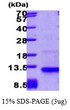
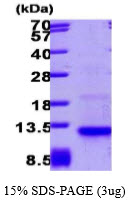
| Applications | SDS-PAGE |
| Host | E.coli |
| Note | STRICTLY FOR FURTHER SCIENTIFIC RESEARCH USE ONLY (RUO). MUST NOT TO BE USED IN DIAGNOSTIC OR THERAPEUTIC APPLICATIONS. |
Product Properties
| Concentration | 0.25 mg/mL |
| Formulation | Liquid in phosphate-Buffered Saline (pH 7.4) containing 10% Glycerol |
| Storage Instruction | For short term storage, keep at +2C to +8C for up to 1 week. For long term storage, aliquot and store at-20C, and avoid repeat freeze-thaw cycles. |
| Endotoxin | < 1 EU per 1ug of protein (determined by LAL method) |
Target Information
| Gene Symbol | CCL26 |
| Gene ID | 10344 |
| Uniprot ID | CCL26_HUMAN |
| Accession Number | NP_006063 |
| Immunogen | Human |
| Immunogen Region | 24-94aa |
| Immunogen Sequence | MTRGSDISKT CCFQYSHKPL PWTWVRSYEF TSNSCSQRAV IFTTKRGKKV CTHPRKKWVQ KYISLLKTPK QL |
Additional Info
| Tissue Specificity | Ubiquitously expressed at low levels in various tissues including heart and ovary. |
| Function | Chemoattractant for eosinophils and basophils. Acts as a ligand for C-C chemokine receptor CCR3 which triggers Ca(2+) mobilization in eosinophils. Also acts as a ligand for CX3C chemokine receptor CX3CR1, inducing cell chemotaxis. |
| Protein Name | C-C Motif Chemokine 26Cc Chemokine ImacEotaxin-3Macrophage Inflammatory Protein 4-AlphaMip-4-AlphaSmall-Inducible Cytokine A26Thymic Stroma Chemokine-1Tsc-1 |
| Database Links | |
| Cellular Localisation | Secreted |
| Alternative Protein Names | C-C Motif Chemokine 26 proteinCc Chemokine Imac proteinEotaxin-3 proteinMacrophage Inflammatory Protein 4-Alpha proteinMip-4-Alpha proteinSmall-Inducible Cytokine A26 proteinThymic Stroma Chemokine-1 proteinTsc-1 proteinCCL26 proteinSCYA26 proteinUNQ216 proteinPRO242 protein |
Information sourced from Uniprot.org