

Human Biliverdin Reductase B/BLVRB protein (Recombinant) (No-Tag) (STJP019581)
SPECIFICATIONS
HostE.coli
ImmunogenHuman
General Information
| Short Description | Recombinant-Human Biliverdin Reductase B/BLVRB-No-Tag protein was developed from e.coli and has a target region of No-Tag. For use in research applications. |
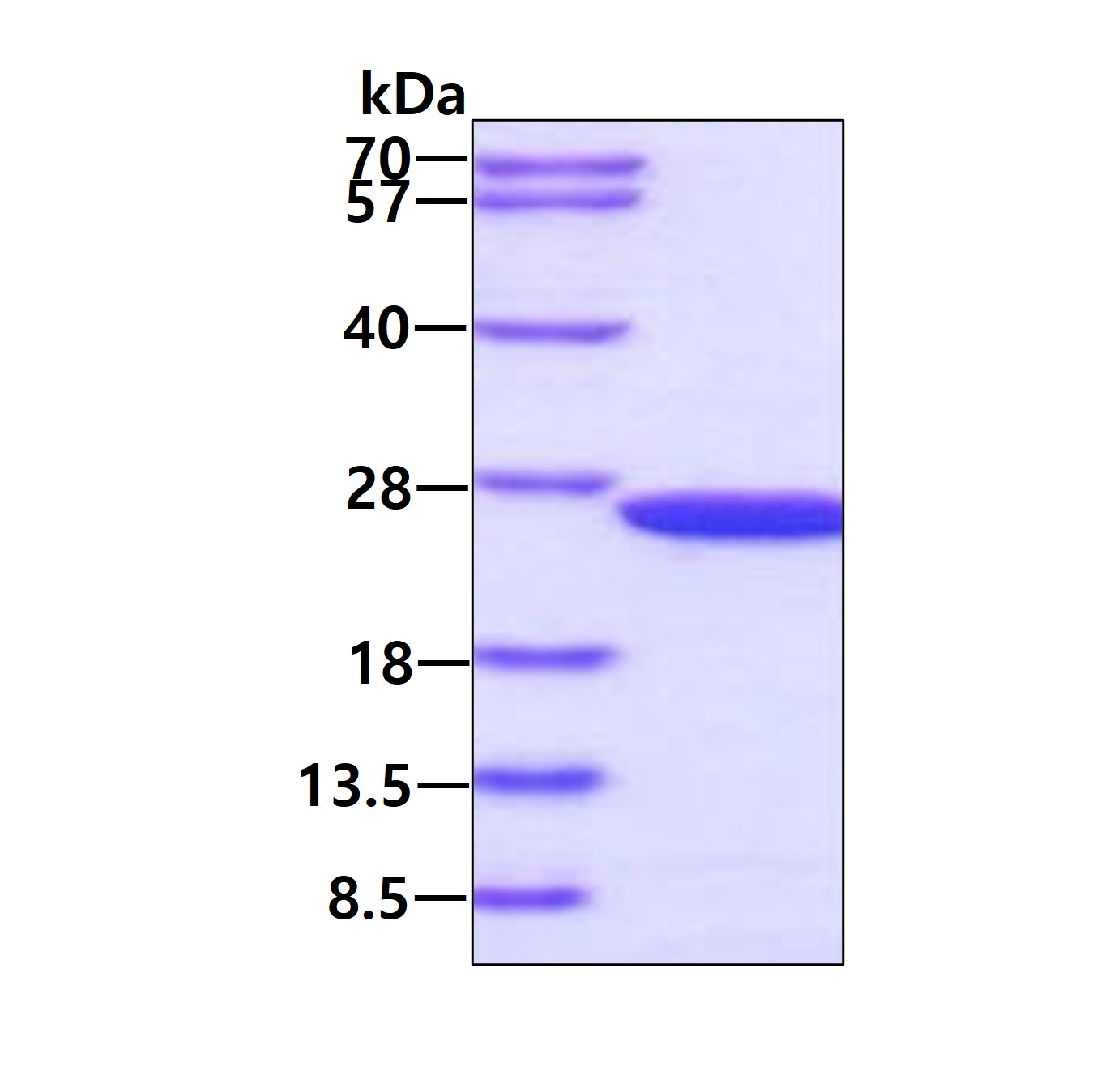
| Applications | SDS-PAGE |
| Host | E.coli |
| Note | STRICTLY FOR FURTHER SCIENTIFIC RESEARCH USE ONLY (RUO). MUST NOT TO BE USED IN DIAGNOSTIC OR THERAPEUTIC APPLICATIONS. |
Product Properties
| Concentration | 1 mg/mL |
| Formulation | Liquid in 20mM Tris-HCl buffer (pH 8.5) containing 10% Glycerol, 1mM DTT |
| Storage Instruction | For short term storage, keep at +2C to +8C for up to 1 week. For long term storage, aliquot and store at-20C, and avoid repeat freeze-thaw cycles. |
Target Information
| Gene Symbol | BLVRB |
| Gene ID | 645 |
| Uniprot ID | BLVRB_HUMAN |
| Accession Number | NP_000704.1 |
| Immunogen | Human |
| Immunogen Region | 1-206aa |
| Immunogen Sequence | MAVKKIAIFG ATGQTGLTTL AQAVQAGYEV TVLVRDSSRL PSEGPRPAHV VVGDVLQAAD VDKTVAGQDA VIVLLGTRND LSPTTVMSEG ARNIVAAMKA HGVDKVVACT SAFLLWDPTK VPPRLQAVTD DHIRMHKVLR ESGLKYVAVM PPHIGDQPLT GAYTVTLDGR GPSRVISKHD LGHFMLRCLT TDEYDGHSTY PSHQYQ |
Additional Info
| Tissue Specificity | Predominantly expressed in liver and erythrocytes. At lower levels in heart, lung, adrenal gland and cerebrum. Expressed in adult red blood cells. |
| Function | Enzyme that can both act as a NAD(P)H-dependent reductase and a S-nitroso-CoA-dependent nitrosyltransferase. Promotes fetal heme degradation during development. Also expressed in adult tissues, where it acts as a regulator of hematopoiesis, intermediary metabolism (glutaminolysis, glycolysis, TCA cycle and pentose phosphate pathway) and insulin signaling. Has a broad specificity oxidoreductase activity by catalyzing the NAD(P)H-dependent reduction of a variety of flavins, such as riboflavin, FAD or FMN, biliverdins, methemoglobin and PQQ (pyrroloquinoline quinone). Contributes to fetal heme catabolism by catalyzing reduction of biliverdin IXbeta into bilirubin IXbeta in the liver. Biliverdin IXbeta, which constitutes the major heme catabolite in the fetus is not present in adult. Does not reduce bilirubin IXalpha. Can also reduce the complexed Fe(3+) iron to Fe(2+) in the presence of FMN and NADPH. Acts as a protein nitrosyltransferase by catalyzing nitrosylation of cysteine residues of target proteins, such as HMOX2, INSR and IRS1. S-nitroso-CoA-dependent nitrosyltransferase activity is mediated via a 'ping-pong' mechanism: BLVRB first associates with both S-nitroso-CoA and protein substrate, nitric oxide group is then transferred from S-nitroso-CoA to Cys-109 and Cys-188 residues of BLVRB and from S-nitroso-BLVRB to the protein substrate. Inhibits insulin signaling by mediating nitrosylation of INSR and IRS1, leading to their inhibition. |
| Protein Name | Flavin ReductaseNadphFrBiliverdin Reductase BBvr-BBiliverdin-Ix Beta-ReductaseGreen Heme-Binding ProteinGhbpNadph-Dependent DiaphoraseNadph-Flavin ReductaseFlrS-Nitroso-Coa-Assisted NitrosyltransferaseSno-Coa-Assisted Nitrosyltransferase |
| Database Links | Reactome: R-HSA-189483Reactome: R-HSA-9707564 |
| Cellular Localisation | Cytoplasm |
| Alternative Protein Names | Flavin Reductase proteinNadph proteinFr proteinBiliverdin Reductase B proteinBvr-B proteinBiliverdin-Ix Beta-Reductase proteinGreen Heme-Binding Protein proteinGhbp proteinNadph-Dependent Diaphorase proteinNadph-Flavin Reductase proteinFlr proteinS-Nitroso-Coa-Assisted Nitrosyltransferase proteinSno-Coa-Assisted Nitrosyltransferase proteinBLVRB proteinFLR proteinSCAN protein |
Information sourced from Uniprot.org