

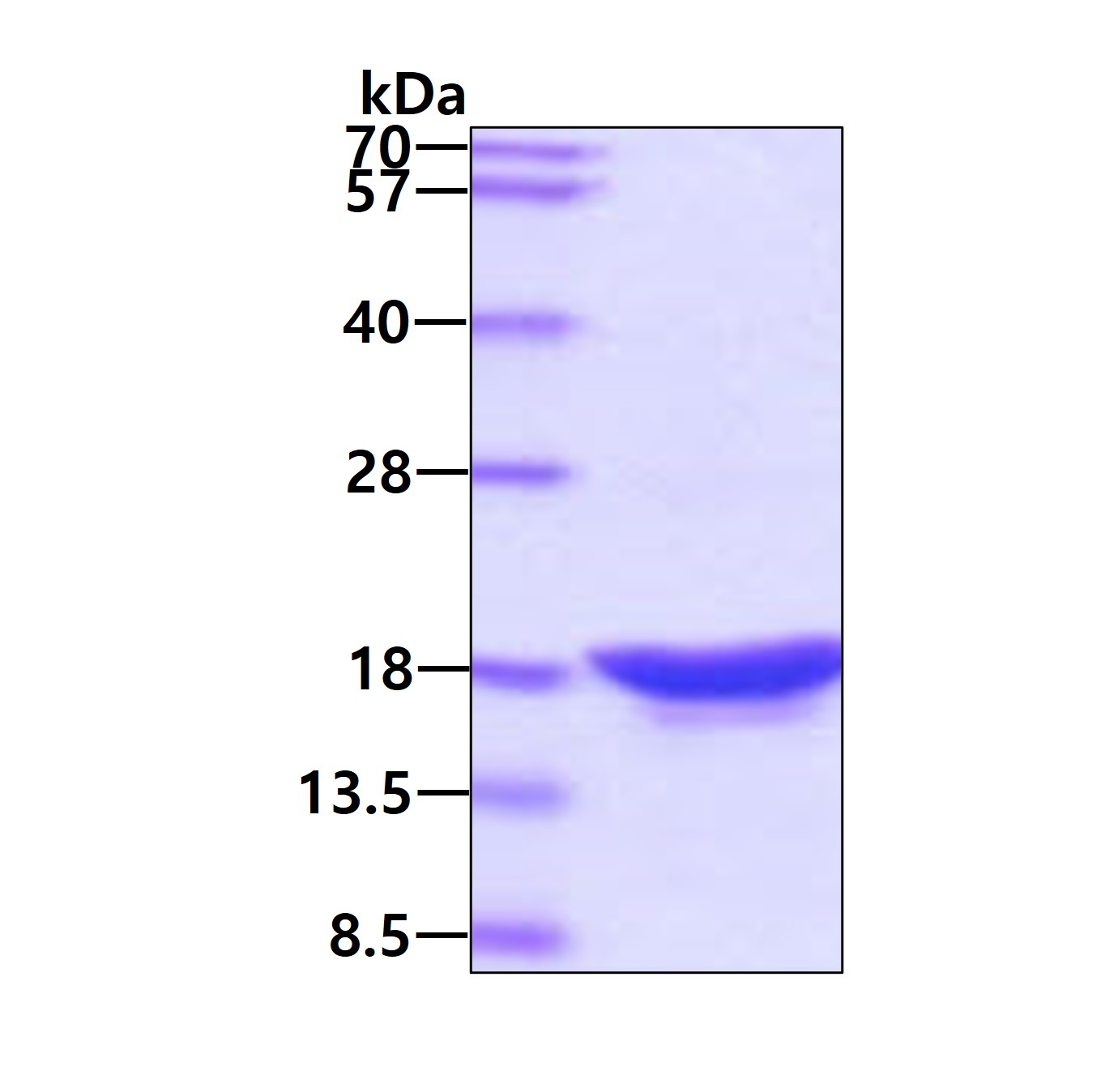

Human beta-Synuclein protein (Recombinant) (No-Tag) (STJP019776)
SPECIFICATIONS
HostE.coli
ImmunogenHuman
General Information
| Short Description | Recombinant-Human beta-Synuclein-No-Tag protein was developed from e.coli and has a target region of No-Tag. For use in research applications. |
| Applications | SDS-PAGE |
| Host | E.coli |
| Note | STRICTLY FOR FURTHER SCIENTIFIC RESEARCH USE ONLY (RUO). MUST NOT TO BE USED IN DIAGNOSTIC OR THERAPEUTIC APPLICATIONS. |
Product Properties
| Concentration | 1 mg/mL |
| Formulation | Liquid in 20mM Tris-HCl buffer (pH 7.5) containing 0.1 M NaCl, 1mM MgCl2 |
| Storage Instruction | For short term storage, keep at +2C to +8C for up to 1 week. For long term storage, aliquot and store at-20C, and avoid repeat freeze-thaw cycles. |
Target Information
| Gene Symbol | SNCB |
| Gene ID | 6620 |
| Uniprot ID | SYUB_HUMAN |
| Accession Number | NP_001001502.1 |
| Immunogen | Human |
| Immunogen Region | 1-134aa |
| Immunogen Sequence | MDVFMKGLSM AKEGVVAAAE KTKQGVTEAA EKTKEGVLYV GSKTREGVVQ GVASVAEKTK EQASHLGGAV FSGAGNIAAA TGLVKREEFP TDLKPEEVAQ EAAEEPLIEP LMEPEGESYE DPPQEEYQEY EPEA |
Additional Info
| Tissue Specificity | Expressed predominantly in brain.concentrated in presynaptic nerve terminals. |
| Post Translational Modifications | Phosphorylated. Phosphorylation by G-protein coupled receptor kinases (GRK) is more efficient than phosphorylation by CK1, CK2 and CaM-kinase II. |
| Function | Non-amyloid component of senile plaques found in Alzheimer disease. Could act as a regulator of SNCA aggregation process. Protects neurons from staurosporine and 6-hydroxy dopamine (6OHDA)-stimulated caspase activation in a p53/TP53-dependent manner. Contributes to restore the SNCA anti-apoptotic function abolished by 6OHDA. Not found in the Lewy bodies associated with Parkinson disease. |
| Protein Name | Beta-Synuclein |
| Database Links | Reactome: R-HSA-5660489 |
| Cellular Localisation | Cytoplasm |
| Alternative Protein Names | Beta-Synuclein proteinSNCB protein |
Information sourced from Uniprot.org