

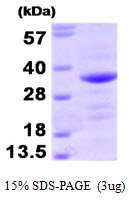

Human BAG1 protein (Recombinant) (No-Tag) (STJP016649)
SPECIFICATIONS
HostE.coli
ImmunogenHuman
General Information
| Short Description | Recombinant-Human BAG1-No-Tag protein was developed from e.coli and has a target region of No-Tag. For use in research applications. |
| Applications | SDS-PAGE |
| Host | E.coli |
| Note | STRICTLY FOR FURTHER SCIENTIFIC RESEARCH USE ONLY (RUO). MUST NOT TO BE USED IN DIAGNOSTIC OR THERAPEUTIC APPLICATIONS. |
Product Properties
| Concentration | 1 mg/mL |
| Formulation | Liquid in 20mM Tris-HCl buffer (pH 7.5) containing 100mM NaCl, 10% Glycerol |
| Storage Instruction | For short term storage, keep at +2C to +8C for up to 1 week. For long term storage, aliquot and store at-20C, and avoid repeat freeze-thaw cycles. |
Target Information
| Gene Symbol | BAG1 |
| Gene ID | 573 |
| Uniprot ID | BAG1_HUMAN |
| Accession Number | NP_001165886 |
| Immunogen | Human |
| Immunogen Region | 1-230aa |
| Immunogen Sequence | MNRSQEVTRD EESTRSEEVT REEMAAAGLT VTVTHSNEKH DLHVTSQQGS SEPVVQDLAQ VVEEVIGVPQ SFQKLIFKGK SLKEMETPLS ALGIQDGCRV MLIGKKNSPQ EEVELKKLKH LEKSVEKIAD QLEELNKELT GIQQGFLPKD LQAEALCKLD RRVKATIEQF MKILEEIDTL ILPENFKDSR LKRKGLVKKV QAFLAECDTV EQNICQETER LQSTNFAL |
Additional Info
| Tissue Specificity | Isoform 4 is the most abundantly expressed isoform. It is ubiquitously expressed throughout most tissues, except the liver, colon, breast and uterine myometrium. Isoform 1 is expressed in the ovary and testis. Isoform 4 is expressed in several types of tumor cell lines, and at consistently high levels in leukemia and lymphoma cell lines. Isoform 1 is expressed in the prostate, breast and leukemia cell lines. Isoform 3 is the least abundant isoform in tumor cell lines (at protein level). |
| Post Translational Modifications | Ubiquitinated.mediated by SIAH1 or SIAH2 and leading to its subsequent proteasomal degradation. |
| Function | Co-chaperone for HSP70 and HSC70 chaperone proteins. Acts as a nucleotide-exchange factor (NEF) promoting the release of ADP from the HSP70 and HSC70 proteins thereby triggering client/substrate protein release. Nucleotide release is mediated via its binding to the nucleotide-binding domain (NBD) of HSPA8/HSC70 where as the substrate release is mediated via its binding to the substrate-binding domain (SBD) of HSPA8/HSC70. Inhibits the pro-apoptotic function of PPP1R15A, and has anti-apoptotic activity. Markedly increases the anti-cell death function of BCL2 induced by various stimuli. Involved in the STUB1-mediated proteasomal degradation of ESR1 in response to age-related circulating estradiol (17-beta-estradiol/E2) decline, thereby promotes neuronal apoptosis in response to ischemic reperfusion injury. |
| Protein Name | Bag Family Molecular Chaperone Regulator 1Bag-1Bcl-2-Associated Athanogene 1 |
| Database Links | Reactome: R-HSA-3371453 |
| Cellular Localisation | Isoform 1: NucleusCytoplasmIsoform 1 Localizes Predominantly To The NucleusIsoform 2: CytoplasmNucleusIsoform 2 Localizes To The Cytoplasm And Shuttles Into The Nucleus In Response To Heat ShockIsoform 4: CytoplasmIsoform 4 Localizes Predominantly To The CytoplasmThe Cellular Background In Which It Is Expressed Can Influence Whether It Resides Primarily In The Cytoplasm Or Is Also Found In The NucleusIn The Presence Of Bcl2Localizes To Intracellular Membranes (What Appears To Be The Nuclear Envelope And Perinuclear Membranes) As Well As Punctate Cytosolic Structures Suggestive Of Mitochondria |
| Alternative Protein Names | Bag Family Molecular Chaperone Regulator 1 proteinBag-1 proteinBcl-2-Associated Athanogene 1 proteinBAG1 proteinHAP protein |
Information sourced from Uniprot.org