

Human ATP5O protein (Recombinant) (His-Tag) (STJP016985)
SPECIFICATIONS
HostE.coli
ImmunogenHuman
General Information
| Short Description | Recombinant-Human ATP5O-His-Tag protein was developed from e.coli and has a target region of His-Tag. For use in research applications. |
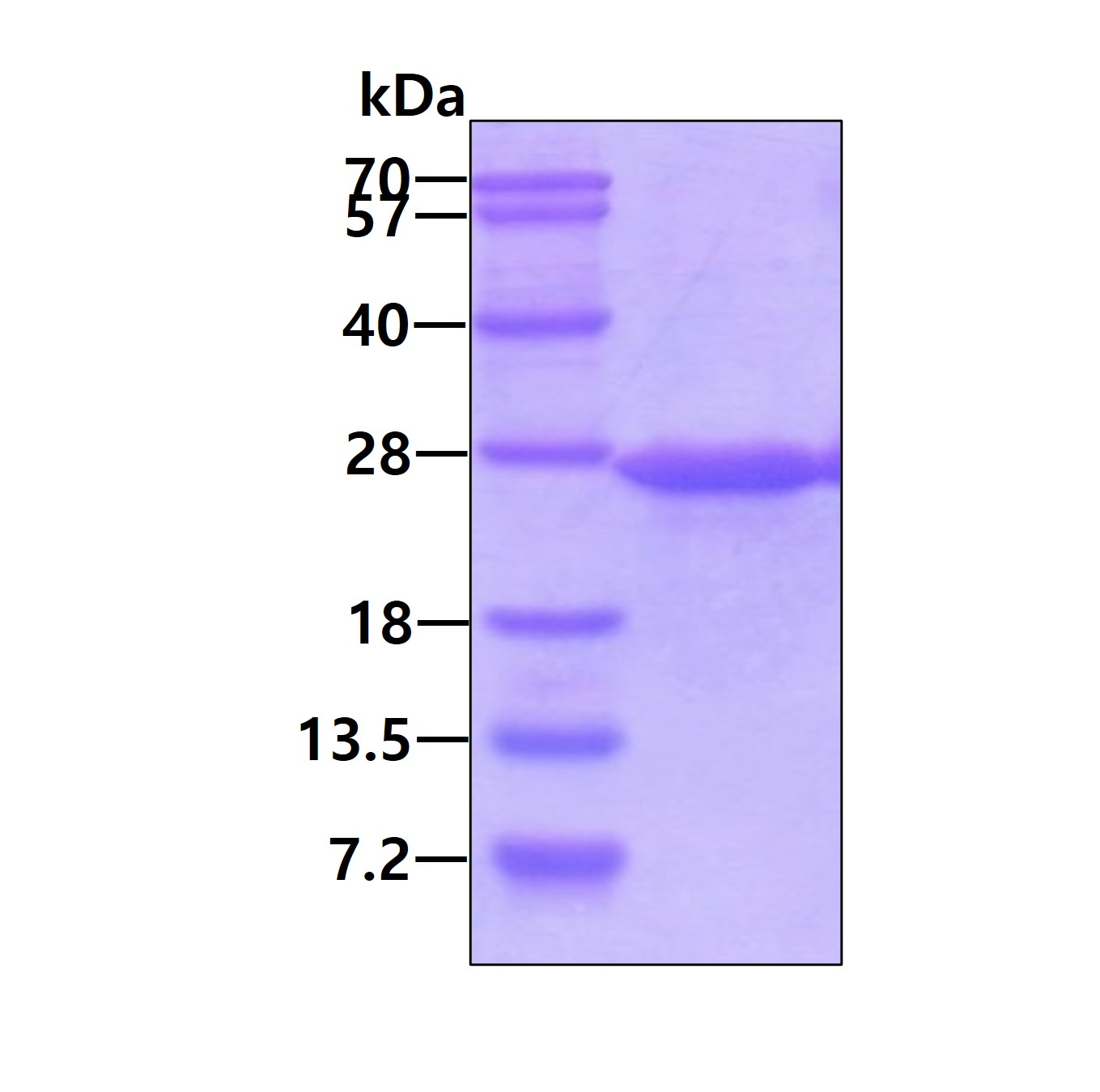
| Applications | SDS-PAGE |
| Host | E.coli |
| Note | STRICTLY FOR FURTHER SCIENTIFIC RESEARCH USE ONLY (RUO). MUST NOT TO BE USED IN DIAGNOSTIC OR THERAPEUTIC APPLICATIONS. |
Product Properties
| Concentration | 1 mg/mL |
| Formulation | Liquid in 20mM Tris-HCl buffer (pH 8.0) containing 1mM DTT, 40% Glycerol, 0.2M NaCl |
| Storage Instruction | For short term storage, keep at +2C to +8C for up to 1 week. For long term storage, aliquot and store at-20C, and avoid repeat freeze-thaw cycles. |
Target Information
| Gene Symbol | ATP5PO |
| Gene ID | 539 |
| Uniprot ID | ATPO_HUMAN |
| Accession Number | NP_001688 |
| Immunogen | Human |
| Immunogen Region | 24-213aa |
| Immunogen Sequence |
Additional Info
| Post Translational Modifications | Acetylation at Lys-162 decreases ATP production. Deacetylated by SIRT3. In response to mitochondrial stress, the precursor protein is ubiquitinated by the SIFI complex in the cytoplasm before mitochondrial import, leading to its degradation. Within the SIFI complex, UBR4 initiates ubiquitin chain that are further elongated or branched by KCMF1. |
| Function | Subunit OSCP, of the mitochondrial membrane ATP synthase complex (F(1)F(0) ATP synthase or Complex V) that produces ATP from ADP in the presence of a proton gradient across the membrane which is generated by electron transport complexes of the respiratory chain. ATP synthase complex consist of a soluble F(1) head domain - the catalytic core - and a membrane F(1) domain - the membrane proton channel. These two domains are linked by a central stalk rotating inside the F(1) region and a stationary peripheral stalk. During catalysis, ATP synthesis in the catalytic domain of F(1) is coupled via a rotary mechanism of the central stalk subunits to proton translocation (Probable). In vivo, can only synthesize ATP although its ATP hydrolase activity can be activated artificially in vitro. Part of the complex F(0) domain. Part of the complex F(0) domain and the peripheric stalk, which acts as a stator to hold the catalytic alpha(3)beta(3) subcomplex and subunit a/ATP6 static relative to the rotary elements. |
| Protein Name | Atp Synthase Peripheral Stalk Subunit Oscp - MitochondrialAtp Synthase Subunit OOligomycin Sensitivity Conferral ProteinOscp |
| Database Links | Reactome: R-HSA-163210Reactome: R-HSA-8949613Reactome: R-HSA-9837999 |
| Cellular Localisation | MitochondrionMitochondrion Inner Membrane |
| Alternative Protein Names | Atp Synthase Peripheral Stalk Subunit Oscp - Mitochondrial proteinAtp Synthase Subunit O proteinOligomycin Sensitivity Conferral Protein proteinOscp proteinATP5PO proteinATP5O proteinATPO protein |
Information sourced from Uniprot.org