

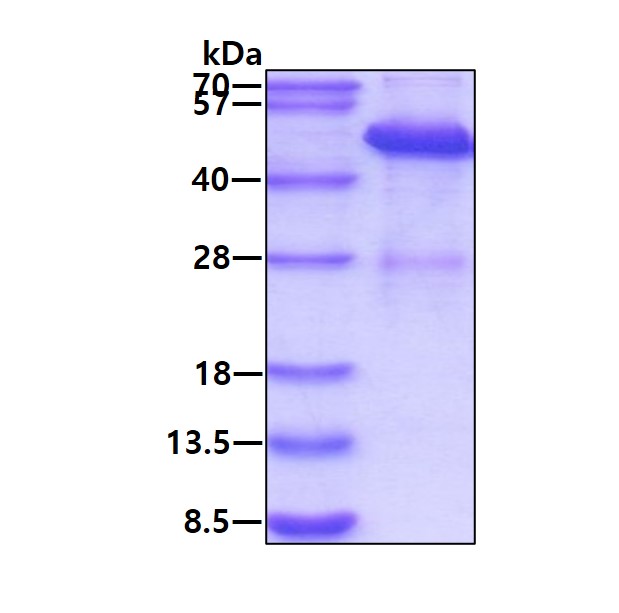

Human ATG4B protein (Recombinant) (His-Tag) (STJP017554)
SPECIFICATIONS
HostE.coli
ImmunogenHuman
General Information
| Short Description | Recombinant-Human ATG4B-His-Tag protein was developed from e.coli and has a target region of His-Tag. For use in research applications. |
| Applications | SDS-PAGE |
| Host | E.coli |
| Note | STRICTLY FOR FURTHER SCIENTIFIC RESEARCH USE ONLY (RUO). MUST NOT TO BE USED IN DIAGNOSTIC OR THERAPEUTIC APPLICATIONS. |
Product Properties
| Concentration | 0.5 mg/mL |
| Formulation | Liquid in 20mM Tris-HCl buffer (pH 8.0) containing 20% Glycerol, 1mM DTT, 0.1mM PMSF |
| Storage Instruction | For short term storage, keep at +2C to +8C for up to 1 week. For long term storage, aliquot and store at-20C, and avoid repeat freeze-thaw cycles. |
Target Information
| Gene Symbol | ATG4B |
| Gene ID | 23192 |
| Uniprot ID | ATG4B_HUMAN |
| Accession Number | AAH00719.1 |
| Immunogen | Human |
| Immunogen Region | 1-393aa |
| Immunogen Sequence | MDAATLTYDT LRFAEFEDFP ETSEPVWILG RKYSIFTEKD EILSDVASRL WFTYRKNFPA IGGTGPTSDT GWGCMLRCGQ MIFAQALVCR HLGRDWRWTQ RKRQPDSYFS VLNAFIDRKD SYYSIHQIAQ MGVGEGKSIG QWYGPNTVAQ VLKKLAVFDT WSSLAVHIAM DNTVVMEEIR RLCRTSVPCA GATAFPADSD RHCNGFPAGA EVTNRPSPWR PLVLLIPL |
Additional Info
| Post Translational Modifications | Phosphorylation at Ser-383 and Ser-392 promotes autophagy by increasing protein delipidation activity without affecting proteolytic activation of ATG8 proteins. Phosphorylation at Ser-316 by ULK1 inhibits autophagy by decreasing both proteolytic activation and delipidation activities. Phosphorylation at Ser-316 is dephosphorylated by protein phosphatase 2A (PP2A). Phosphorylation at Ser-34 by AKT2 promotes its hydrolase activity, leading to increased proteolytic activation and delipidation of ATG8 family proteins. Phosphorylation at Ser-34 by AKT1 promotes mitochondrial localization and inhibition of the F1F0-ATP synthase activity, leading to elevation of mitochondrial reactive oxygen species (ROS). Ubiquitinated by RNF5, leading to its degradation by the proteasome. S-nitrosylation at Cys-189 and Cys-292 in response to high glucose decreases both proteolytic activation and delipidation activities. O-glycosylated by OGT, leading to increase protease activity, thereby promoting the proteolytic activation of ATG8 family proteins. Forms reversible intrachain disulfide bonds in response to oxidative stress. Forms interchain disulfide bonds, leading to formation of homooligomers in response to oxidation. |
| Function | Cysteine protease that plays a key role in autophagy by mediating both proteolytic activation and delipidation of ATG8 family proteins. Required for canonical autophagy (macroautophagy), non-canonical autophagy as well as for mitophagy. The protease activity is required for proteolytic activation of ATG8 family proteins: cleaves the C-terminal amino acid of ATG8 proteins MAP1LC3A, MAP1LC3B, MAP1LC3C, GABARAPL1, GABARAPL2 and GABARAP, to reveal a C-terminal glycine. Exposure of the glycine at the C-terminus is essential for ATG8 proteins conjugation to phosphatidylethanolamine (PE) and insertion to membranes, which is necessary for autophagy. Protease activity is also required to counteract formation of high-molecular weight conjugates of ATG8 proteins (ATG8ylation): acts as a deubiquitinating-like enzyme that removes ATG8 conjugated to other proteins, such as ATG3. In addition to the protease activity, also mediates delipidation of ATG8 family proteins. Catalyzes delipidation of PE-conjugated forms of ATG8 proteins during macroautophagy. Also involved in non-canonical autophagy, a parallel pathway involving conjugation of ATG8 proteins to single membranes at endolysosomal compartments, by catalyzing delipidation of ATG8 proteins conjugated to phosphatidylserine (PS). Compared to other members of the family (ATG4A, ATG4C or ATG4C), constitutes the major protein for proteolytic activation of ATG8 proteins, while it displays weaker delipidation activity than other ATG4 paralogs. Involved in phagophore growth during mitophagy independently of its protease activity and of ATG8 proteins: acts by regulating ATG9A trafficking to mitochondria and promoting phagophore-endoplasmic reticulum contacts during the lipid transfer phase of mitophagy. |
| Protein Name | Cysteine Protease Atg4bAut-Like 1 Cysteine EndopeptidaseAutophagy-Related Cysteine Endopeptidase 1Autophagin-1Autophagy-Related Protein 4 Homolog BHsapg4bHapg4b |
| Database Links | Reactome: R-HSA-1632852 |
| Cellular Localisation | CytoplasmCytosolCytoplasmic VesicleAutophagosomeEndoplasmic ReticulumMitochondrionMainly Localizes To The CytoplasmIncluding CytosolA Samll Potion Localizes To MitochondriaPhosphorylation At Ser-34 Promotes Localization To Mitochondria |
| Alternative Protein Names | Cysteine Protease Atg4b proteinAut-Like 1 Cysteine Endopeptidase proteinAutophagy-Related Cysteine Endopeptidase 1 proteinAutophagin-1 proteinAutophagy-Related Protein 4 Homolog B proteinHsapg4b proteinHapg4b proteinATG4B proteinAPG4B proteinAUTL1 proteinKIAA0943 protein |
Information sourced from Uniprot.org