
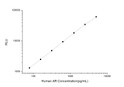


Human AR (Androgen receptor) CLIA Kit for Quantitative Detection
SPECIFICATIONS
General Information
| Short Description | This human AR kit is a highly sensitive in-vitro chemiluminescent immunoassay for the measurement of trace amounts of analytes in serum, plasma and other biological fluids. |
| Applications | CLIA |
| Reactivity | Human |
| Sensitivity | 46.88pg/mL |
| Detection Limit | 78.13~5000pg/mL |
| Note | FOR SCIENTIFIC EDUCATIONAL RESEARCH USE ONLY (RUO). MUST NOT BE USED IN DIAGNOSTIC OR OTHER MEDICAL APPLICATIONS. |
Product Properties
| Storage Instruction | If unopened the kit may be stored at 2-8°C for up to 1 month. If the kit will not be used within 1 month, store the components separately, according to the component table in the manual. |
| Assay Time | 3.5h |
| Detection | Chemiluminescence |
Target Information
| Gene Symbol | AR |
| Gene ID | 367 |
| Uniprot ID | ANDR_HUMAN |
| Specificity | This kit recognizes Human AR in samples. No significant cross-reactivity or interference between Human AR and analogues was observed. |
| Sample Type | Serum, plasma and other biological fluids |
Additional Info
| Tissue Specificity | Isoform 2: Mainly expressed in heart and skeletal muscle. Isoform 3: Expressed in basal and stromal cells of the prostate (at protein level). |
| Post Translational Modifications | Sumoylated on Lys-388 (major) and Lys-521. Ubiquitinated. Deubiquitinated by USP26. 'Lys-6' and 'Lys-27'-linked polyubiquitination by RNF6 modulates AR transcriptional activity and specificity. Phosphorylated in prostate cancer cells in response to several growth factors including EGF. Phosphorylation is induced by c-Src kinase (CSK). Tyr-535 is one of the major phosphorylation sites and an increase in phosphorylation and Src kinase activity is associated with prostate cancer progression. Phosphorylation by TNK2 enhances the DNA-binding and transcriptional activity and may be responsible for androgen-independent progression of prostate cancer. Phosphorylation at Ser-83 by CDK9 regulates AR promoter selectivity and cell growth. Phosphorylation by PAK6 leads to AR-mediated transcription inhibition. Palmitoylated by ZDHHC7 and ZDHHC21. Palmitoylation is required for plasma membrane targeting and for rapid intracellular signaling via ERK and AKT kinases and cAMP generation. |
| Function | Steroid hormone receptors are ligand-activated transcription factors that regulate eukaryotic gene expression and affect cellular proliferation and differentiation in target tissues. Transcription factor activity is modulated by bound coactivator and corepressor proteins like ZBTB7A that recruits NCOR1 and NCOR2 to the androgen response elements/ARE on target genes, negatively regulating androgen receptor signaling and androgen-induced cell proliferation. Transcription activation is also down-regulated by NR0B2. Activated, but not phosphorylated, by HIPK3 and ZIPK/DAPK3. Isoform 3: Lacks the C-terminal ligand-binding domain and may therefore constitutively activate the transcription of a specific set of genes independently of steroid hormones. Isoform 4: Lacks the C-terminal ligand-binding domain and may therefore constitutively activate the transcription of a specific set of genes independently of steroid hormones. |
| Protein Name | Androgen ReceptorDihydrotestosterone ReceptorNuclear Receptor Subfamily 3 Group C Member 4 |
| Database Links | Reactome: R-HSA-3371497Reactome: R-HSA-383280Reactome: R-HSA-4090294Reactome: R-HSA-5625886Reactome: R-HSA-5689880Reactome: R-HSA-8940973 |
| Cellular Localisation | NucleusCytoplasmDetected At The Promoter Of Target GenesPredominantly Cytoplasmic In Unligated Form But Translocates To The Nucleus Upon Ligand-BindingCan Also Translocate To The Nucleus In Unligated Form In The Presence Of Rack1 |
| Alternative CLIA Names | Androgen Receptor CLIA kitDihydrotestosterone Receptor CLIA kitNuclear Receptor Subfamily 3 Group C Member 4 CLIA kitAR CLIA kitDHTR CLIA kitNR3C4 CLIA kit |
| Specificity | This kit recognizes Human AR in samples. No significant cross-reactivity or interference between Human AR and analogues was observed. |
| Reproducibility | Both intra-CV and inter-CV are |
Information sourced from Uniprot.org
| Item | Specifications | Storage |
|---|---|---|
| Micro CLIA Plate (Dismountable) | 96T: 8 wells ×12 strips strips | -20℃, 6 months |
| Reference Standard | 96T: 2 vials 48T: 1 vial | -20℃, 6 months |
| Concentrated Biotinylated Detection Ab (100×) | 96T: 1 vial, 120 μL 60 μL | -20℃, 6 months |
| Concentrated HRP Conjugate (100×) | 96T: 1 vial, 120 μL 60 μL | -20℃ (Protect from light), 6 months |
| Reference Standard & Sample Diluent | 1 vial, 20 mL | 2-8°C, 6 months |
| Biotinylated Detection Ab Diluent | 1 vial, 14 mL | 2-8°C, 6 months |
| HRP Conjugate Diluent | 1 vial, 14 mL | 2-8°C, 6 months |
| Concentrated Wash Buffer (25×) | 1 vial, 30 mL | 2-8°C, 6 months |
| Substrate Reagent A | 1 vial, 5 mL | 2-8℃ (Protect from light) |
| Substrate Reagent B | 1 vial, 5 mL | 2-8℃ (Protect from light) |
| Plate Sealer | 5 pieces | |
| Manual | 1 copy | |
| Certificate of Analysis | 1 copy |
| Sample Type | Range (%) | Average Recovery (%) |
|---|---|---|
| Serum(n=8) | 85-97 | 91 |
| EDTA plasma(n=8) | 92-109 | 99 |
| Cell culture media(n=8) | 102-117 | 107 |
| Intra-assay Precision | Intra-assay Precision | Intra-assay Precision | Inter-assay Precision | Inter-assay Precision | Inter-assay Precision | |
|---|---|---|---|---|---|---|
| Sample | 1.00 | 2.00 | 3.00 | 1.00 | 2.00 | 3.00 |
| n | 20.00 | 20.00 | 20.00 | 20.00 | 20.00 | 20.00 |
| Mean (pg/mL) | 244.45 | 603.30 | 2105.79 | 220.68 | 626.53 | 2157.68 |
| Standard deviation | 28.75 | 72.28 | 208.47 | 22.49 | 48.18 | 210.81 |
| CV (%) | 11.76 | 11.98 | 9.90 | 10.19 | 7.69 | 9.77 |