

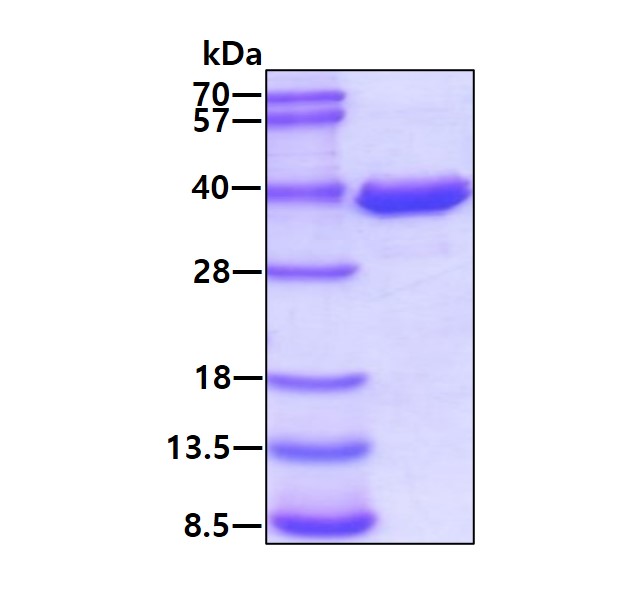

Human Aldo-keto reductase 1B1/AKR1B1 protein (Recombinant) (No-Tag) (STJP016416)
SPECIFICATIONS
HostE.coli
ImmunogenHuman
General Information
| Short Description | Recombinant-Human Aldo-keto reductase 1B1/AKR1B1-No-Tag protein was developed from e.coli and has a target region of No-Tag. For use in research applications. |
| Applications | SDS-PAGE/Enzyme Activity |
| Host | E.coli |
| Note | STRICTLY FOR FURTHER SCIENTIFIC RESEARCH USE ONLY (RUO). MUST NOT TO BE USED IN DIAGNOSTIC OR THERAPEUTIC APPLICATIONS. |
Product Properties
| Concentration | 1 mg/mL |
| Formulation | Liquid in 20mM Tris-HCl buffer (pH 8.0) containing 1mM DTT, 10% Glycerol |
| Storage Instruction | For short term storage, keep at +2C to +8C for up to 1 week. For long term storage, aliquot and store at-20C, and avoid repeat freeze-thaw cycles. |
| Endotoxin | < 1 EU per 1ug of protein (determined by LAL method) |
| Immunoreactivity | Specific activity is >800pmol/min/ug, and is defined as the amount of enzyme that catalyze the reduction of 1.0pmole DL-glyceraldehyde in the presence of NADPH per minute at pH7.0 at 37C. |
Target Information
| Gene Symbol | AKR1B1 |
| Gene ID | 231 |
| Uniprot ID | ALDR_HUMAN |
| Accession Number | NP_001619.1 |
| Immunogen | Human |
| Immunogen Region | 1-316aa |
| Immunogen Sequence | MASRLLLNNG AKMPILGLGT WKSPPGQVTE AVKVAIDVGY RHIDCAHVYQ NENEVGVAIQ EKLREQVVKR EELFIVSKLW CTYHEKGLVK GACQKTLSDL KLDYLDLYLI HWPTGFKPGK EFFPLDESGN VVPSDTNILD TWAAMEELVD EGLVKAIGIS NFNHLQVEMI LNKPGLKYKP AVNQIECHPY LTQEKLIQYC QSKGIVVTAY SPLGSPDRPW AKPEDPSL |
Additional Info
| Tissue Specificity | Highly expressed in embryonic epithelial cells (EUE) in response to osmotic stress. |
| Function | Catalyzes the NADPH-dependent reduction of a wide variety of carbonyl-containing compounds to their corresponding alcohols. Displays enzymatic activity towards endogenous metabolites such as aromatic and aliphatic aldehydes, ketones, monosacharides, bile acids and xenobiotics substrates. Key enzyme in the polyol pathway, catalyzes reduction of glucose to sorbitol during hyperglycemia. Reduces steroids and their derivatives and prostaglandins. Displays low enzymatic activity toward all-trans-retinal, 9-cis-retinal, and 13-cis-retinal. Catalyzes the reduction of diverse phospholipid aldehydes such as 1-palmitoyl-2-(5-oxovaleroyl)-sn -glycero-3-phosphoethanolamin (POVPC) and related phospholipid aldehydes that are generated from the oxydation of phosphotidylcholine and phosphatdyleethanolamides. Plays a role in detoxifying dietary and lipid-derived unsaturated carbonyls, such as crotonaldehyde, 4-hydroxynonenal, trans-2-hexenal, trans-2,4-hexadienal and their glutathione-conjugates carbonyls (GS-carbonyls). |
| Protein Name | Aldo-Keto Reductase Family 1 Member B1 Aldehyde ReductaseAldose ReductaseAr |
| Database Links | Reactome: R-HSA-196108Reactome: R-HSA-5652227 |
| Cellular Localisation | Cytoplasm |
| Alternative Protein Names | Aldo-Keto Reductase Family 1 Member B1 proteinAldehyde Reductase proteinAldose Reductase proteinAr proteinAKR1B1 proteinALDR1 proteinALR2 protein |
Information sourced from Uniprot.org