
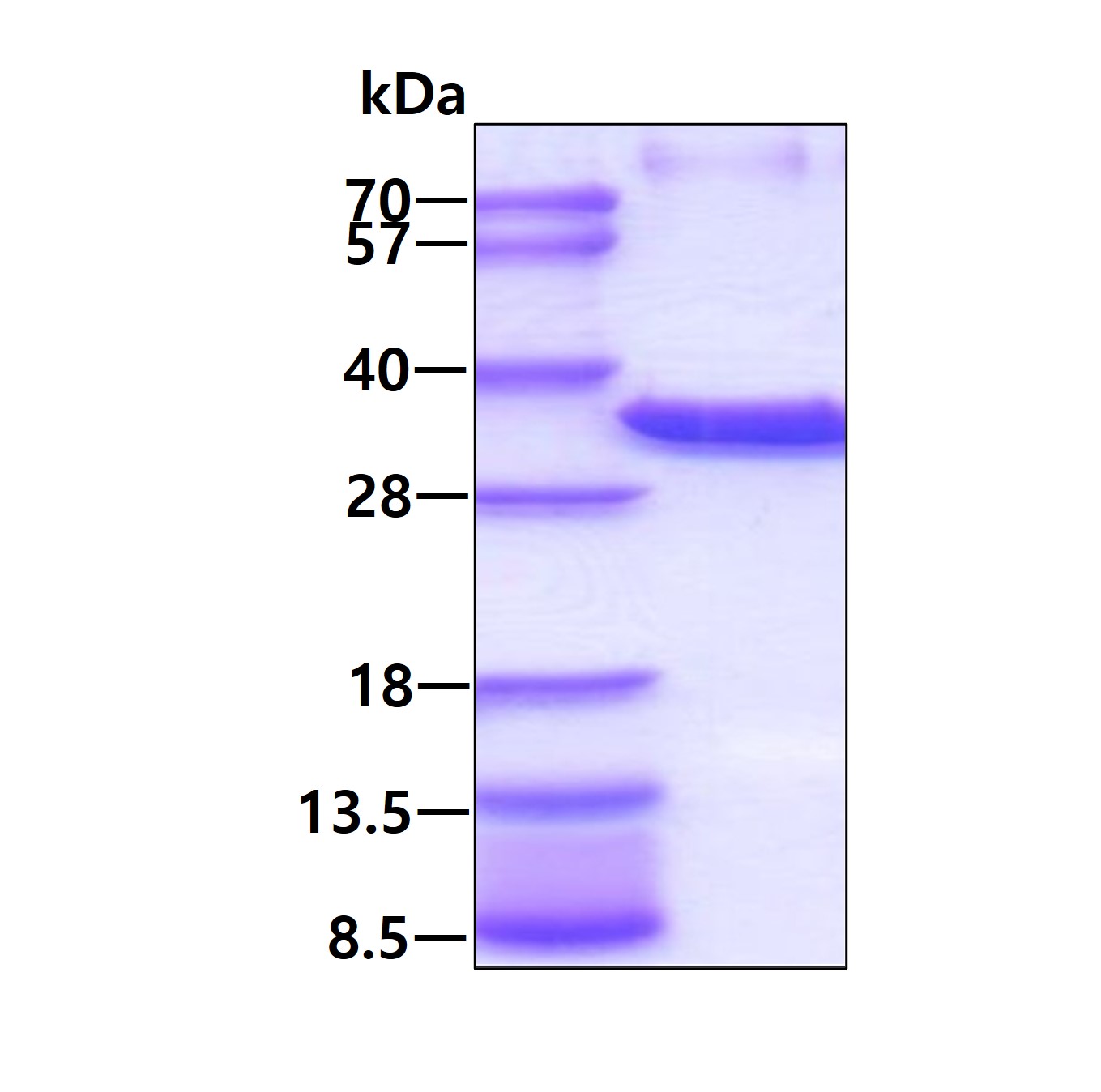

Human 17 beta-HSD8/HSD17B8 protein (Recombinant) (His-Tag) (STJP017138)
SPECIFICATIONS
HostE.coli
ImmunogenHuman
General Information
| Short Description | Recombinant-Human 17 beta-HSD8/HSD17B8-His-Tag protein was developed from e.coli and has a target region of His-Tag. For use in research applications. |
| Applications | SDS-PAGE |
| Host | E.coli |
| Note | STRICTLY FOR FURTHER SCIENTIFIC RESEARCH USE ONLY (RUO). MUST NOT TO BE USED IN DIAGNOSTIC OR THERAPEUTIC APPLICATIONS. |
Product Properties
| Concentration | 0.5 mg/mL |
| Formulation | Liquid in 20mM Tris-HCl buffer (pH 8.0) containing 40% Glycerol, 150mM NaCl |
| Storage Instruction | For short term storage, keep at +2C to +8C for up to 1 week. For long term storage, aliquot and store at-20C, and avoid repeat freeze-thaw cycles. |
Target Information
| Gene Symbol | HSD17B8 |
| Gene ID | 7923 |
| Uniprot ID | DHB8_HUMAN |
| Accession Number | NP_055049.1 |
| Immunogen | Human |
| Immunogen Region | 1-261aa |
| Immunogen Sequence |
Additional Info
| Tissue Specificity | Widely expressed, particularly abundant in prostate, placenta and kidney. Expressed at protein level in various tissues like brain, cerebellum, heart, lung, kidney, ovary, testis, adrenals and prostate. |
| Function | Required for the solubility and assembly of the heterotetramer 3-ketoacyl-acyl carrier protein (ACP) reductase functional complex (KAR or KAR1) that forms part of the mitochondrial fatty acid synthase (mtFAS). Alpha-subunit of the KAR complex that acts as a scaffold protein required for the stability of carbonyl reductase type-4 (CBR4, beta-subunit of the KAR complex) and for its 3-ketoacyl-ACP reductase activity, thereby participating in mitochondrial fatty acid biosynthesis. Catalyzes the NAD-dependent conversion of (3R)-3-hydroxyacyl-CoA into 3-ketoacyl-CoA (3-oxoacyl-CoA) with no chain length preference.this enzymatic activity is not needed for the KAR function. Prefers (3R)-3-hydroxyacyl-CoA over (3S)-3-hydroxyacyl-CoA and displays enzymatic activity only in the presence of NAD(+). Cooperates with enoyl-CoA hydratase 1 in mitochondria, together they constitute an alternative route to the auxiliary enzyme pathways for the breakdown of Z-PUFA (cis polyunsaturated fatty acid) enoyl-esters (Probable). NAD-dependent 17-beta-hydroxysteroid dehydrogenase with highest activity towards estradiol (17beta-estradiol or E2). Has very low activity towards testosterone and dihydrotestosterone (17beta-hydroxy-5alpha-androstan-3-one). Primarily an oxidative enzyme, it can switch to a reductive mode determined in the appropriate physiologic milieu and catalyze the reduction of estrone (E1) to form biologically active 17beta-estradiol. |
| Protein Name | (3r-3-Hydroxyacyl-Coa Dehydrogenase17-Beta-Hydroxysteroid Dehydrogenase 817-Beta-Hsd 8Hsd17b83-Ketoacyl-Acyl-Carrier-Protein Reductase Alpha SubunitKar Alpha Subunit3-Oxoacyl-Acyl-Carrier-Protein ReductaseEstradiol 17-Beta-Dehydrogenase 8Protein Ke6Ke6Short Chain Dehydrogenase/Reductase Family 30c Member 1Testosterone 17-Beta-Dehydrogenase 8 |
| Database Links | Reactome: R-HSA-75105 |
| Cellular Localisation | Mitochondrion Matrix |
| Alternative Protein Names | (3r-3-Hydroxyacyl-Coa Dehydrogenase protein17-Beta-Hydroxysteroid Dehydrogenase 8 protein17-Beta-Hsd 8 proteinHsd17b8 protein3-Ketoacyl-Acyl-Carrier-Protein Reductase Alpha Subunit proteinKar Alpha Subunit protein3-Oxoacyl-Acyl-Carrier-Protein Reductase proteinEstradiol 17-Beta-Dehydrogenase 8 proteinProtein Ke6 proteinKe6 proteinShort Chain Dehydrogenase/Reductase Family 30c Member 1 proteinTestosterone 17-Beta-Dehydrogenase 8 proteinHSD17B8 proteinFABGL proteinHKE6 proteinRING2 proteinSDR30C1 protein |
Information sourced from Uniprot.org