

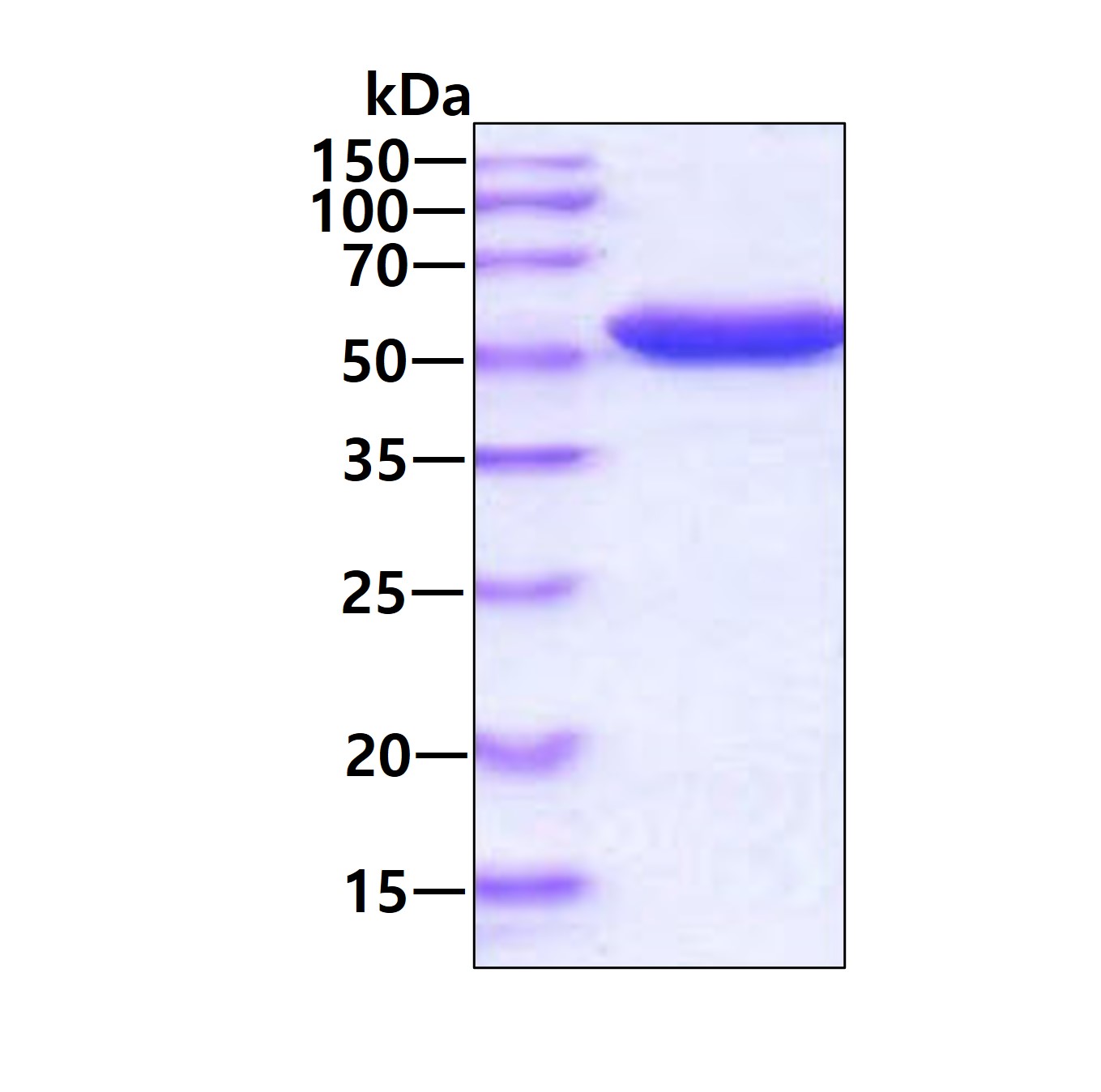

E.coli G6PD protein (Recombinant) (No-Tag) (STJP019640)
SPECIFICATIONS
HostE.coli
ImmunogenE.coli
General Information
| Short Description | Recombinant-E.coli G6PD-No-Tag protein was developed from e.coli and has a target region of No-Tag. For use in research applications. |
| Applications | SDS-PAGE/Enzyme Activity |
| Host | E.coli |
| Note | STRICTLY FOR FURTHER SCIENTIFIC RESEARCH USE ONLY (RUO). MUST NOT TO BE USED IN DIAGNOSTIC OR THERAPEUTIC APPLICATIONS. |
Product Properties
| Concentration | 1 mg/mL |
| Formulation | Liquid in phosphate-Buffered Saline (pH 7.4) containing 10% Glycerol, 0.1mM PMSF, 2mM EDTA, 0.5mM DTT |
| Storage Instruction | For short term storage, keep at +2C to +8C for up to 1 week. For long term storage, aliquot and store at-20C, and avoid repeat freeze-thaw cycles. |
| Immunoreactivity | Specific activity is > 50unit/mg obtained by measuring the increase of beta-NADPH in absorbance at 340 nm resulting from the reduction of beta-NADP. One unit oxidizes 1.0 umole D-glucose-6-phosphate to 6-phospho-D-gluconate per min in the presence of |
Target Information
| Accession Number | NP_416366.1 |
| Immunogen | E.coli |
| Immunogen Region | 1-491aa |
| Immunogen Sequence | MAVTQTAQAC DLVIFGAKGD LARRKLLPSL YQLEKAGQLN PDTRIIGVGR ADWDKAAYTK VVREALETFM KETIDEGLWD TLSARLDFCN LDVNDTAAFS RLGAMLDQKN RITINYFAMP PSTFGAICKG LGEAKLNAKP ARVVMEKPLG TSLATSQEIN DQVGEYFEEC QVYRIDHYLG KETVLNLLAL RFANSLFVNN WDNRTIDHVE ITVAEEVGIE GRWGYFDK |
Additional Info
| Background | Glucose-6-phosphate dehydrogenase (G6PD) is the rate-limiting enzyme of the pentose phosphate pathway, a metabolic pathway that supplies reducing energy to cells by maintaining the level of NADPH. G6PD converts glucose-6-phosphate into 6-phosphoglucono-delta-lactone and simultaneously produce NADPH. The NADPH in turn maintains the level of glutathione in these cells that helps protect the red blood cells against oxidative damage. G6PD deficiency cause acute hemolytic anemia. Recombinant G6PD protein was expressed in E. coli and purified by conventional chromatography techniques. |
Information sourced from Uniprot.org