

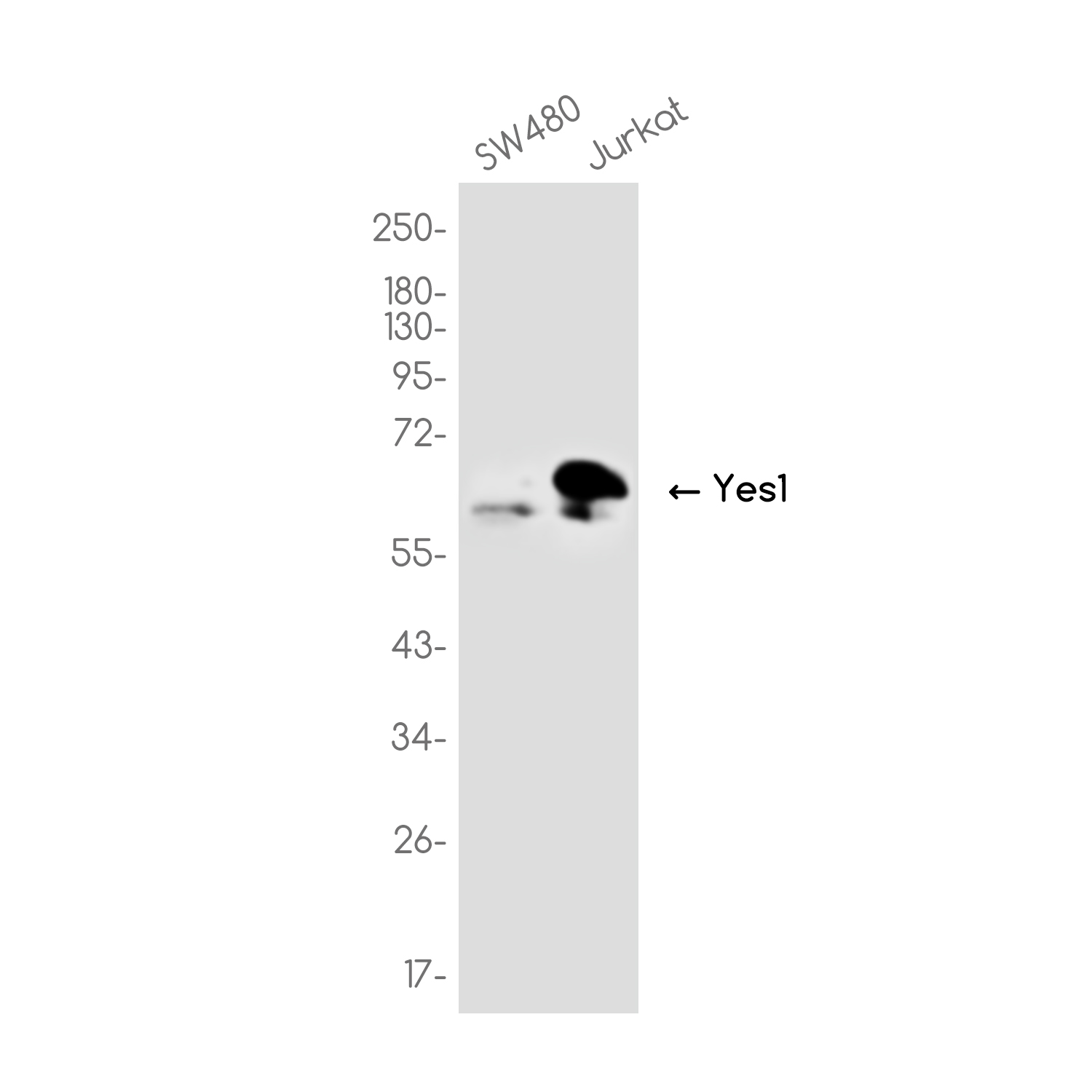

Anti-Yes1 antibody (STJA0037509)
SPECIFICATIONS
ClonalityMonoclonal
HostRabbit
ConjugationUnconjugated
IsotypeIgG
ImmunogenPeptide
General Information
| Short Description | Rabbit monoclonal anti-Yes1 for use in WB, IHC-P, ICC and IF in Human, Mouse and Rat samples. Datasheet included with dilution recommendations, and related reagents. |
| Applications | WB/IHC-P/ICC/IF |
| Host | Rabbit |
| Reactivity | Human/Mouse/Rat |
| Note | STRICTLY FOR FURTHER SCIENTIFIC RESEARCH USE ONLY (RUO). MUST NOT TO BE USED IN DIAGNOSTIC OR THERAPEUTIC APPLICATIONS. |
Product Properties
| Clonality | Monoclonal |
| Isotype | IgG |
| Conjugation | Unconjugated |
| Purification | Affinity Purified |
| Dilution Range | WB-1:1000-1:5000IHC-P-1:50-1:100ICC/IF-1:50-1:100 |
| Formulation | Liquid in 50mM Tris-Glycine (pH 7.4) , 0.15M NaCl, 40%Glycerol, 0.01% sodium azide and 0.05% BSA. |
| Storage Instruction | Store at 4°C short term. Aliquot and store at-20°C long term. Avoid freeze/thaw cycles. |
Target Information
| Gene Symbol | YES1 |
| Gene ID | 7525 |
| Uniprot ID | YES_HUMAN |
| Immunogen | Peptide |
Additional Info
| Tissue Specificity | Expressed in the epithelial cells of renal proximal tubules and stomach as well as hematopoietic cells in the bone marrow and spleen in the fetal tissues. In adult, expressed in epithelial cells of the renal proximal tubules and present in keratinocytes in the basal epidermal layer of epidermis. |
| Post Translational Modifications | Phosphorylated. Phosphorylation by CSK on the C-terminal tail maintains the enzyme in an inactive state. Autophosphorylation at Tyr-426 maintains enzyme activity by blocking CSK-mediated inhibition. Palmitoylation at Cys-3 promotes membrane localization. |
| Function | Non-receptor protein tyrosine kinase that is involved in the regulation of cell growth and survival, apoptosis, cell-cell adhesion, cytoskeleton remodeling, and differentiation. Stimulation by receptor tyrosine kinases (RTKs) including EGFR, PDGFR, CSF1R and FGFR leads to recruitment of YES1 to the phosphorylated receptor, and activation and phosphorylation of downstream substrates. Upon EGFR activation, promotes the phosphorylation of PARD3 to favor epithelial tight junction assembly. Participates in the phosphorylation of specific junctional components such as CTNND1 by stimulating the FYN and FER tyrosine kinases at cell-cell contacts. Upon T-cell stimulation by CXCL12, phosphorylates collapsin response mediator protein 2/DPYSL2 and induces T-cell migration. Participates in CD95L/FASLG signaling pathway and mediates AKT-mediated cell migration. Plays a role in cell cycle progression by phosphorylating the cyclin-dependent kinase 4/CDK4 thus regulating the G1 phase. Also involved in G2/M progression and cytokinesis. Catalyzes phosphorylation of organic cation transporter OCT2 which induces its transport activity. |
| Protein Name | Tyrosine-Protein Kinase YesProto-Oncogene C-YesP61-Yes |
| Database Links | Reactome: R-HSA-1227986Reactome: R-HSA-1433557Reactome: R-HSA-1433559Reactome: R-HSA-2029481Reactome: R-HSA-210990Reactome: R-HSA-2682334Reactome: R-HSA-389356Reactome: R-HSA-389513Reactome: R-HSA-3928662Reactome: R-HSA-3928663Reactome: R-HSA-3928665Reactome: R-HSA-8940973Reactome: R-HSA-912631Reactome: R-HSA-9664323Reactome: R-HSA-9664422Reactome: R-HSA-9670439Reactome: R-HSA-9680350 |
| Cellular Localisation | Cell MembraneCytoplasmCytoskeletonMicrotubule Organizing CenterCentrosomeCytosolCell JunctionNewly Synthesized Protein Initially Accumulates In The Golgi Region And Traffics To The Plasma Membrane Through The Exocytic PathwayLocalized To Small Puncta Throughout The Cytoplasm And Cell Membrane When In The Presence Of Snail1 |
| Alternative Antibody Names | Anti-Tyrosine-Protein Kinase Yes antibodyAnti-Proto-Oncogene C-Yes antibodyAnti-P61-Yes antibodyAnti-YES1 antibodyAnti-YES antibody |
Information sourced from Uniprot.org