

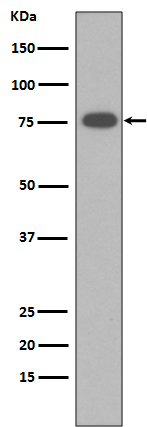

Anti-Vitronectin antibody [R02-6F3] (STJA0035925)
SPECIFICATIONS
ClonalityMonoclonal
HostRabbit
ConjugationUnconjugated
IsotypeIgG
ImmunogenA synthesized peptide derived from human Vitronectin
General Information
| Short Description | Rabbit monoclonal anti-Vitronectin for use in WB, IHC-P, ICC and IF in Human, Mouse and Rat samples. Datasheet included with dilution recommendations, and related reagents. |
| Applications | WB/IHC-P/ICC/IF |
| Host | Rabbit |
| Reactivity | Human/Mouse/Rat |
| Note | STRICTLY FOR FURTHER SCIENTIFIC RESEARCH USE ONLY (RUO). MUST NOT TO BE USED IN DIAGNOSTIC OR THERAPEUTIC APPLICATIONS. |
Product Properties
| Clonality | Monoclonal |
| Clone ID | R02-6F3 |
| Isotype | IgG |
| Conjugation | Unconjugated |
| Purification | Affinity Chromatography |
| Dilution Range | WB 1:500-1:1000IHC 1:50-1:100IF 1:50-1:200 |
| Formulation | Rabbit IgG in phosphate buffered saline, pH 7.4, 150mM NaCl, 0.02% sodium azide and 50% glycerol. |
| Storage Instruction | Store at 4°C short term. Aliquot and store at-20°C long term. Avoid freeze/thaw cycles. |
Target Information
| Gene Symbol | VTN |
| Gene ID | 7448 |
| Uniprot ID | VTNC_HUMAN |
| Immunogen | A synthesized peptide derived from human Vitronectin |
Additional Info
| Tissue Specificity | Expressed in the retina pigment epithelium (at protein level). Expressed in plasma (at protein level). Expressed in serum (at protein level). |
| Post Translational Modifications | Sulfated on tyrosine residues. N- and O-glycosylated. Phosphorylation on Thr-69 and Thr-76 favors cell adhesion and spreading. It has been suggested that the active SMB domain may be permitted considerable disulfide bond heterogeneity or variability, thus two alternate disulfide patterns based on 3D structures are described with 1 disulfide bond conserved in both. Phosphorylation sites are present in the extracellular medium. |
| Function | Vitronectin is a cell adhesion and spreading factor found in serum and tissues. Vitronectin interact with glycosaminoglycans and proteoglycans. Is recognized by certain members of the integrin family and serves as a cell-to-substrate adhesion molecule. Inhibitor of the membrane-damaging effect of the terminal cytolytic complement pathway. Somatomedin-B is a growth hormone-dependent serum factor with protease-inhibiting activity. |
| Protein Name | VitronectinVnS-ProteinSerum-Spreading FactorV75 Cleaved Into - Vitronectin V65 Subunit - Vitronectin V10 Subunit - Somatomedin-B |
| Database Links | Reactome: R-HSA-2129379Reactome: R-HSA-216083Reactome: R-HSA-3000170Reactome: R-HSA-3000178Reactome: R-HSA-977606 |
| Cellular Localisation | SecretedExtracellular SpaceParasitophorous Vacuole(Microbial Infection) In PFalciparum-Infected Red Blood CellsVtn Internalization Is Detected At The Early Trophozoite StageColocalizes With Sera5 At The Schizont Stage And With Sera5 P47 At The Merozoite Surface |
| Alternative Antibody Names | Anti-Vitronectin antibodyAnti-Vn antibodyAnti-S-Protein antibodyAnti-Serum-Spreading Factor antibodyAnti-V75 Cleaved Into - Vitronectin V65 Subunit - Vitronectin V10 Subunit - Somatomedin-B antibodyAnti-VTN antibody |
Information sourced from Uniprot.org