


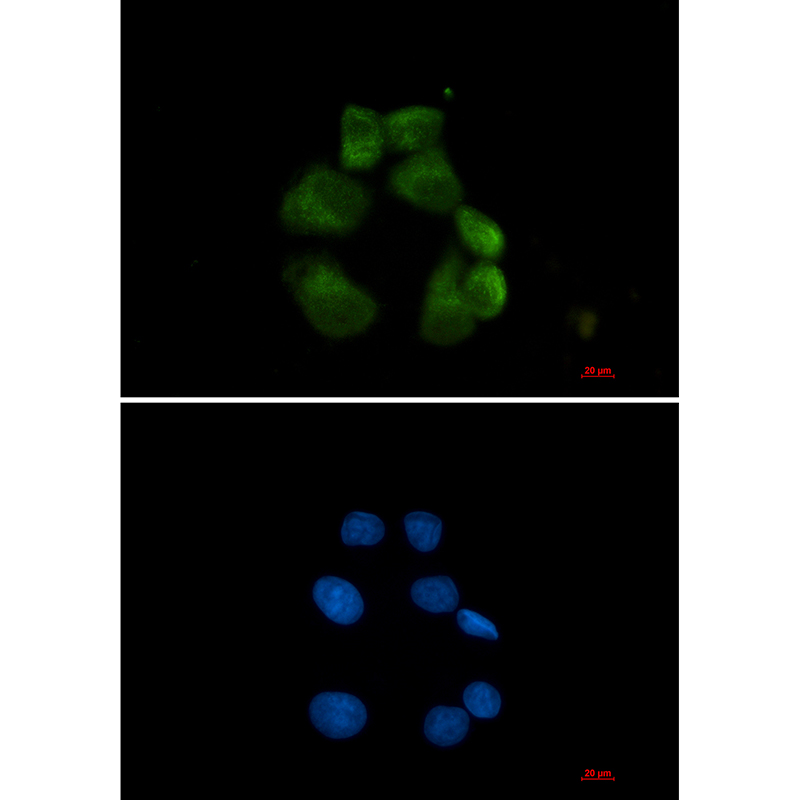
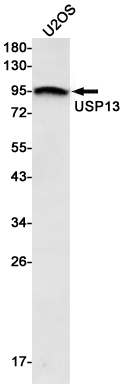

Anti-USP13 antibody [R08-8D3] (STJA0034982)
SPECIFICATIONS
ClonalityMonoclonal
HostRabbit
ConjugationUnconjugated
IsotypeIgG
ImmunogenA synthetic peptide of human USP13
General Information
| Short Description | Rabbit monoclonal anti-USP13 for use in WB, ICC, IF and IP in Human samples. Datasheet included with dilution recommendations, and related reagents. |
| Applications | WB/ICC/IF/IP |
| Host | Rabbit |
| Reactivity | Human |
| Note | STRICTLY FOR FURTHER SCIENTIFIC RESEARCH USE ONLY (RUO). MUST NOT TO BE USED IN DIAGNOSTIC OR THERAPEUTIC APPLICATIONS. |
Product Properties
| Clonality | Monoclonal |
| Clone ID | R08-8D3 |
| Isotype | IgG |
| Conjugation | Unconjugated |
| Concentration | 0.3 mg/mL |
| Purification | Affinity Purified |
| Dilution Range | WB 1:500-1:1000IF 1:50-1:200IP 1:20 |
| Formulation | 50mM Tris-Glycine (pH 7.4) , 0.15M NaCl, 40% Glycerol, 0.01% Sodium azide and 0.05% BSA |
| Storage Instruction | Store at 4°C short term. Aliquot and store at-20°C long term. Avoid freeze/thaw cycles. |
Target Information
| Gene Symbol | USP13 |
| Gene ID | 8975 |
| Uniprot ID | UBP13_HUMAN |
| Immunogen | A synthetic peptide of human USP13 |
Additional Info
| Tissue Specificity | Highly expressed in ovary and testes. |
| Post Translational Modifications | Phosphorylated by AURKB at Ser-114.leading to stabilization of cell cycle proteins such as SKP2 and AURKB, but not MCL1. |
| Function | Deubiquitinase that mediates deubiquitination of target proteins such as BECN1, MITF, SKP2 and USP10 and is involved in various processes such as autophagy, endoplasmic reticulum-associated degradation (ERAD), cell cycle progression or DNA damage response. Component of a regulatory loop that controls autophagy and p53/TP53 levels: mediates deubiquitination of BECN1, a key regulator of autophagy, leading to stabilize the PIK3C3/VPS34-containing complexes. Alternatively, forms with NEDD4 a deubiquitination complex, which subsequently stabilizes VPS34 to promote autophagy. Also deubiquitinates USP10, an essential regulator of p53/TP53 stability. In turn, PIK3C3/VPS34-containing complexes regulate USP13 stability, suggesting the existence of a regulatory system by which PIK3C3/VPS34-containing complexes regulate p53/TP53 protein levels via USP10 and USP13. Recruited by nuclear UFD1 and mediates deubiquitination of SKP2, thereby regulating endoplasmic reticulum-associated degradation (ERAD). Also regulates ERAD through the deubiquitination of UBL4A a component of the BAG6/BAT3 complex. Mediates stabilization of SIAH2 independently of deubiquitinase activity: binds ubiquitinated SIAH2 and acts by impairing SIAH2 autoubiquitination. Regulates the cell cycle progression by stabilizing cell cycle proteins such as SKP2 and AURKB. In addition, plays an important role in maintaining genomic stability and in DNA replication checkpoint activation via regulation of RAP80 and TOPBP1. Deubiquitinates the multifunctional protein HMGB1 and subsequently drives its nucleocytoplasmic localization and its secretion. Positively regulates type I and type II interferon signalings by deubiquitinating STAT1 but negatively regulates antiviral response by deubiquitinating STING1. |
| Protein Name | Ubiquitin Carboxyl-Terminal Hydrolase 13Deubiquitinating Enzyme 13Isopeptidase T-3Isot-3Ubiquitin Thioesterase 13Ubiquitin-Specific-Processing Protease 13 |
| Database Links | Reactome: R-HSA-5689880Reactome: R-HSA-8948751 |
| Cellular Localisation | Cytoplasm |
| Alternative Antibody Names | Anti-Ubiquitin Carboxyl-Terminal Hydrolase 13 antibodyAnti-Deubiquitinating Enzyme 13 antibodyAnti-Isopeptidase T-3 antibodyAnti-Isot-3 antibodyAnti-Ubiquitin Thioesterase 13 antibodyAnti-Ubiquitin-Specific-Processing Protease 13 antibodyAnti-USP13 antibodyAnti-ISOT3 antibody |
Information sourced from Uniprot.org