

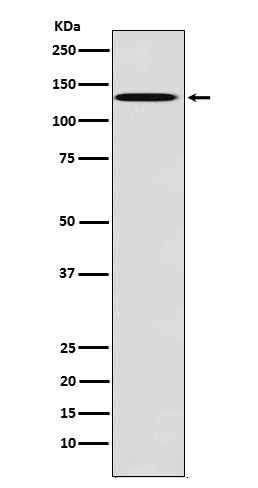

Anti-TYRO3 antibody [R65-7S-1] (STJA0035489)
SPECIFICATIONS
ClonalityMonoclonal
HostRabbit
ConjugationUnconjugated
IsotypeIgG
ImmunogenA synthesized peptide derived from human TYRO3
General Information
| Short Description | Rabbit monoclonal anti-TYRO3 for use in WB, IHC-P, ICC, IF and IP in Human, Mouse and Rat samples. Datasheet included with dilution recommendations, and related reagents. |
| Applications | WB/IHC-P/ICC/IF/IP |
| Host | Rabbit |
| Reactivity | Human/Mouse/Rat |
| Note | STRICTLY FOR FURTHER SCIENTIFIC RESEARCH USE ONLY (RUO). MUST NOT TO BE USED IN DIAGNOSTIC OR THERAPEUTIC APPLICATIONS. |
Product Properties
| Clonality | Monoclonal |
| Clone ID | R65-7S-1 |
| Isotype | IgG |
| Conjugation | Unconjugated |
| Purification | Affinity Chromatography |
| Dilution Range | WB 1:500-1:1000IHC 1:100-1:200IF 1:50-1:200IP 1:50 |
| Formulation | Liquid in PBS, pH 7.4, 150mM NaCl, 0.02% sodium azide and 50% glycerol. |
| Storage Instruction | Store at 4°C short term. Aliquot and store at-20°C long term. Avoid freeze/thaw cycles. |
Target Information
| Gene Symbol | TYRO3 |
| Gene ID | 7301 |
| Uniprot ID | TYRO3_HUMAN |
| Immunogen | A synthesized peptide derived from human TYRO3 |
Additional Info
| Tissue Specificity | Abundant in the brain and lower levels in other tissues. |
| Post Translational Modifications | Autophosphorylated. |
| Function | Receptor tyrosine kinase that transduces signals from the extracellular matrix into the cytoplasm by binding to several ligands including TULP1 or GAS6. Regulates many physiological processes including cell survival, migration and differentiation. Ligand binding at the cell surface induces dimerization and autophosphorylation of TYRO3 on its intracellular domain that provides docking sites for downstream signaling molecules. Following activation by ligand, interacts with PIK3R1 and thereby enhances PI3-kinase activity. Activates the AKT survival pathway, including nuclear translocation of NF-kappa-B and up-regulation of transcription of NF-kappa-B-regulated genes. TYRO3 signaling plays a role in various processes such as neuron protection from excitotoxic injury, platelet aggregation and cytoskeleton reorganization. Also plays an important role in inhibition of Toll-like receptors (TLRs)-mediated innate immune response by activating STAT1, which selectively induces production of suppressors of cytokine signaling SOCS1 and SOCS3. (Microbial infection) Acts as a receptor for lassa virus and lymphocytic choriomeningitis virus, possibly through GAS6 binding to phosphatidyl-serine at the surface of virion envelope. (Microbial infection) Acts as a receptor for Ebolavirus, possibly through GAS6 binding to phosphatidyl-serine at the surface of virion envelope. |
| Protein Name | Tyrosine-Protein Kinase Receptor Tyro3Tyrosine-Protein Kinase BykTyrosine-Protein Kinase DtkTyrosine-Protein Kinase RseTyrosine-Protein Kinase SkyTyrosine-Protein Kinase Tif |
| Database Links | |
| Cellular Localisation | Cell MembraneSingle-Pass Type I Membrane Protein |
| Alternative Antibody Names | Anti-Tyrosine-Protein Kinase Receptor Tyro3 antibodyAnti-Tyrosine-Protein Kinase Byk antibodyAnti-Tyrosine-Protein Kinase Dtk antibodyAnti-Tyrosine-Protein Kinase Rse antibodyAnti-Tyrosine-Protein Kinase Sky antibodyAnti-Tyrosine-Protein Kinase Tif antibodyAnti-TYRO3 antibodyAnti-BYK antibodyAnti-DTK antibodyAnti-RSE antibodyAnti-SKY antibodyAnti-TIF antibody |
Information sourced from Uniprot.org