

Anti-TRPM7 antibody (ECD) [M573] (STJA0041421)
SPECIFICATIONS
ClonalityMonoclonal
HostMouse
ConjugationUnconjugated
IsotypeIgG1
ImmunogenClone M573 was generated from TRPM7 synthetic peptide (coupled to carrier) corresponding to amino acids in the extracellular region of human TRPM7. This site is well conserved in rat and mouse TRPM7, but has low homology to other TRPM family members.
General Information
| Short Description | Mouse monoclonal anti-TRPM7 (ECD) for use in ELISA and WB in Human, Mouse and Rat samples. Datasheet included with dilution recommendations, and related reagents. |
| Applications | ELISA/WB |
| Host | Mouse |
| Reactivity | Human/Mouse/Rat |
| Note | STRICTLY FOR FURTHER SCIENTIFIC RESEARCH USE ONLY (RUO). MUST NOT TO BE USED IN DIAGNOSTIC OR THERAPEUTIC APPLICATIONS. |
Product Properties
| Clonality | Monoclonal |
| Clone ID | M573 |
| Isotype | IgG1 |
| Conjugation | Unconjugated |
| Purification | Antigen Affinity Purified |
| Dilution Range | WB 1:500 |
| Formulation | PBS + 1 mg/ml BSA, 0.05% NaN3 and 50% glycerol |
| Storage Instruction | Storage at-20°C is recommended, as aliquots may be taken without freeze/thawing due to presence of 50% glycerol. Stable for at least 1 year at-20°C. |
Target Information
| Gene Symbol | TRPM7 |
| Gene ID | 54822 |
| Uniprot ID | TRPM7_HUMAN |
| Immunogen | Clone M573 was generated from TRPM7 synthetic peptide (coupled to carrier) corresponding to amino acids in the extracellular region of human TRPM7. This site is well conserved in rat and mouse TRPM7, but has low homology to other TRPM family members. |
| Immunogen Region | ECD |
| Immunogen Sequence | Human |
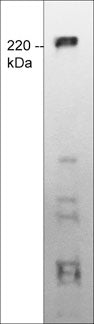
| Specificity | This antibody detects a 220 kDa* protein on SDS-PAGE immunoblots of human MCF7 cells. |
Additional Info
| Post Translational Modifications | Palmitoylated.palmitoylation at Cys-1143, Cys-1144 and Cys-1146 promotes TRPM7 trafficking from the Golgi to the surface membrane. Autophosphorylated.autophosphorylation of C-terminus regulates TRPM7 kinase activity towards its substrates. The C-terminal kinase domain can be cleaved from the channel segment in a cell-type-specific fashion. TRPM7 is cleaved by caspase-8, dissociating the kinase from the ion-conducting pore. The cleaved kinase fragments (M7CKs) can translocate to the cell nucleus and binds chromatin-remodeling complex proteins in a Zn(2+)-dependent manner to ultimately phosphorylate specific Ser/Thr residues of histones. |
| Function | Bifunctional protein that combines an ion channel with an intrinsic kinase domain, enabling it to modulate cellular functions either by conducting ions through the pore or by phosphorylating downstream proteins via its kinase domain. The channel is highly permeable to divalent cations, specifically calcium (Ca2+), magnesium (Mg2+) and zinc (Zn2+) and mediates their influx. Controls a wide range of biological processes such as Ca2(+), Mg(2+) and Zn(2+) homeostasis, vesicular Zn(2+) release channel and intracellular Ca(2+) signaling, embryonic development, immune responses, cell motility, proliferation and differentiation. The C-terminal alpha-kinase domain autophosphorylates cytoplasmic residues of TRPM7. In vivo, TRPM7 phosphorylates SMAD2, suggesting that TRPM7 kinase may play a role in activating SMAD signaling pathways. In vitro, TRPM7 kinase phosphorylates ANXA1 (annexin A1), myosin II isoforms and a variety of proteins with diverse cellular functions. TRPM7 channel, cleaved form: The cleaved channel exhibits substantially higher current and potentiates Fas receptor signaling. TRPM7 kinase, cleaved form: The C-terminal kinase domain can be cleaved from the channel segment in a cell-type-specific fashion. In immune cells, the TRPM7 kinase domain is clipped from the channel domain by caspases in response to Fas-receptor stimulation. The cleaved kinase fragments can translocate to the nucleus, and bind chromatin-remodeling complex proteins in a Zn(2+)-dependent manner to ultimately phosphorylate specific Ser/Thr residues of histones known to be functionally important for cell differentiation and embryonic development. |
| Protein Name | Transient Receptor Potential Cation Channel Subfamily M Member 7Channel-Kinase 1Long Transient Receptor Potential Channel 7Ltrpc-7Ltrpc7 Cleaved Into - Trpm7 Kinase - Cleaved FormM7ck - Trpm7 Channel - Cleaved Form |
| Database Links | Reactome: R-HSA-3295583 |
| Cellular Localisation | Cell MembraneMulti-Pass Membrane ProteinCytoplasmic Vesicle MembraneLocalized Largely In Intracellular Zn(2+)-Storage VesiclesTrpm7 KinaseCleaved Form: Nucleus |
| Alternative Antibody Names | Anti-Transient Receptor Potential Cation Channel Subfamily M Member 7 antibodyAnti-Channel-Kinase 1 antibodyAnti-Long Transient Receptor Potential Channel 7 antibodyAnti-Ltrpc-7 antibodyAnti-Ltrpc7 Cleaved Into - Trpm7 Kinase - Cleaved Form antibodyAnti-M7ck - Trpm7 Channel - Cleaved Form antibodyAnti-TRPM7 antibodyAnti-CHAK1 antibodyAnti-LTRPC7 antibody |
Information sourced from Uniprot.org