

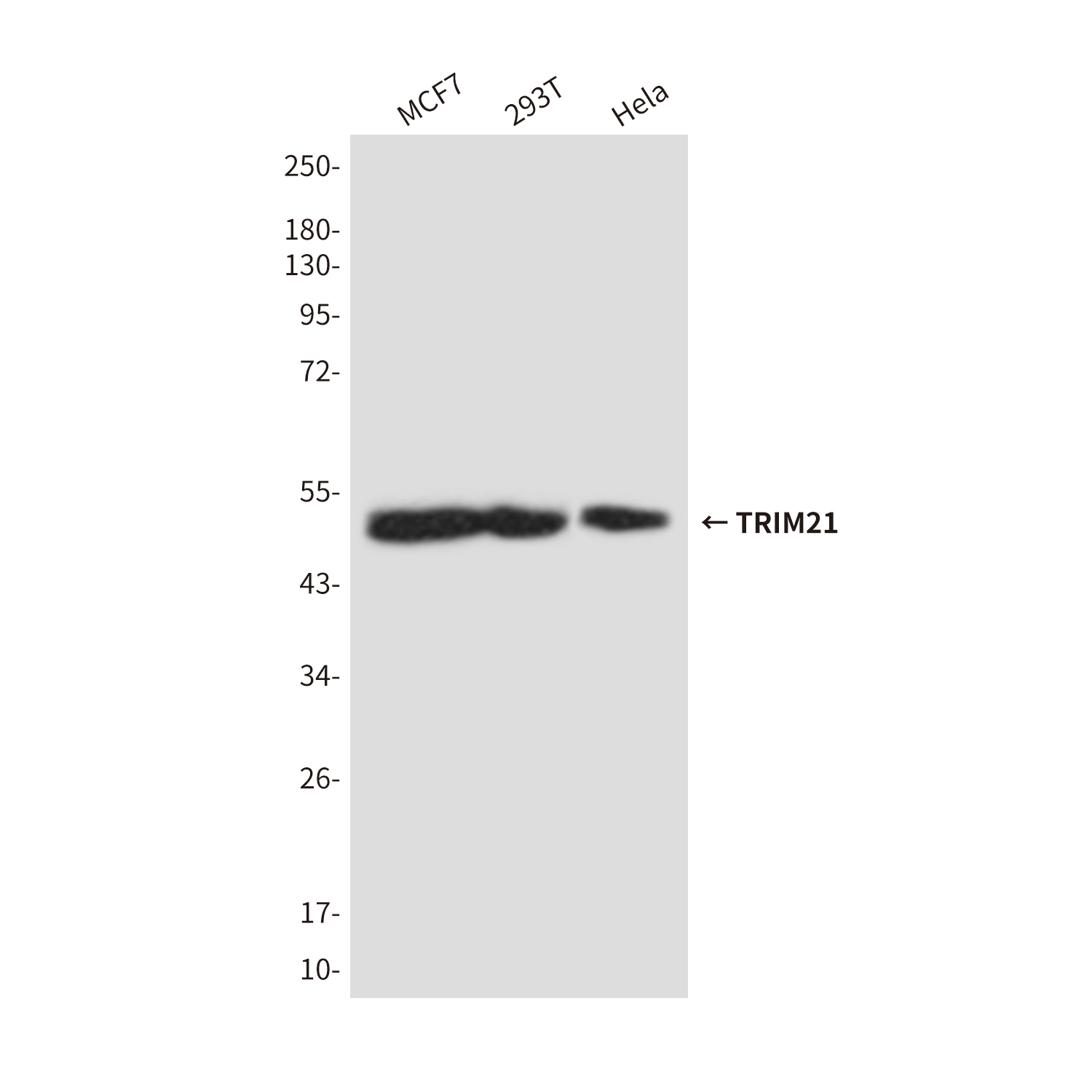

Anti-TRIM21 antibody [5B9-B9-H8] (STJA0032505)
SPECIFICATIONS
ClonalityMonoclonal
HostMouse
ConjugationUnconjugated
IsotypeIgG1
ImmunogenPurified recombinant human TRIM21 protein fragments expressed in E.coli.
General Information
| Short Description | Mouse monoclonal anti-TRIM21 for use in WB in Human samples. Datasheet included with dilution recommendations, and related reagents. |
| Applications | WB |
| Host | Mouse |
| Reactivity | Human |
| Note | STRICTLY FOR FURTHER SCIENTIFIC RESEARCH USE ONLY (RUO). MUST NOT TO BE USED IN DIAGNOSTIC OR THERAPEUTIC APPLICATIONS. |
Product Properties
| Clonality | Monoclonal |
| Clone ID | 5B9-B9-H8 |
| Isotype | IgG1 |
| Conjugation | Unconjugated |
| Concentration | 1 mg/mL |
| Purification | Affinity Purified |
| Dilution Range | WB 1:500-1:1000 |
| Formulation | Liquid in PBS containing 50% glycerol, 0.5% BSA and 0.02% sodium azide, pH 7.3. |
| Storage Instruction | Store at 4°C short term. Aliquot and store at-20°C long term. Avoid freeze/thaw cycles. |
Target Information
| Gene Symbol | TRIM21 |
| Gene ID | 6737 |
| Uniprot ID | RO52_HUMAN |
| Immunogen | Purified recombinant human TRIM21 protein fragments expressed in E.coli. |
Additional Info
| Tissue Specificity | Isoform 1 and isoform 2 are expressed in fetal and adult heart and fetal lung. |
| Post Translational Modifications | Autoubiquitinated.does not lead to its proteasomal degradation. Deubiquitinated by USP4.leading to its stabilization. |
| Function | E3 ubiquitin-protein ligase whose activity is dependent on E2 enzymes, UBE2D1, UBE2D2, UBE2E1 and UBE2E2. Forms a ubiquitin ligase complex in cooperation with the E2 UBE2D2 that is used not only for the ubiquitination of USP4 and IKBKB but also for its self-ubiquitination. Component of cullin-RING-based SCF (SKP1-CUL1-F-box protein) E3 ubiquitin-protein ligase complexes such as SCF(SKP2)-like complexes. A TRIM21-containing SCF(SKP2)-like complex is shown to mediate ubiquitination of CDKN1B ('Thr-187' phosphorylated-form), thereby promoting its degradation by the proteasome. Monoubiquitinates IKBKB that will negatively regulates Tax-induced NF-kappa-B signaling. Negatively regulates IFN-beta production post-pathogen recognition by catalyzing polyubiquitin-mediated degradation of IRF3. Mediates the ubiquitin-mediated proteasomal degradation of IgG1 heavy chain, which is linked to the VCP-mediated ER-associated degradation (ERAD) pathway. Promotes IRF8 ubiquitination, which enhanced the ability of IRF8 to stimulate cytokine genes transcription in macrophages. Plays a role in the regulation of the cell cycle progression. Enhances the decapping activity of DCP2. Exists as a ribonucleoprotein particle present in all mammalian cells studied and composed of a single polypeptide and one of four small RNA molecules. At least two isoforms are present in nucleated and red blood cells, and tissue specific differences in RO/SSA proteins have been identified. The common feature of these proteins is their ability to bind HY RNAs.2. Involved in the regulation of innate immunity and the inflammatory response in response to IFNG/IFN-gamma. Organizes autophagic machinery by serving as a platform for the assembly of ULK1, Beclin 1/BECN1 and ATG8 family members and recognizes specific autophagy targets, thus coordinating target recognition with assembly of the autophagic apparatus and initiation of autophagy. Also regulates autophagy through FIP200/RB1CC1 ubiquitination and subsequent decreased protein stability. Represses the innate antiviral response by facilitating the formation of the NMI-IFI35 complex through 'Lys-63'-linked ubiquitination of NMI. During viral infection, promotes cell pyroptosis by mediating 'Lys-6'-linked ubiquitination of ISG12a/IFI27, facilitating its translocation into the mitochondria and subsequent CASP3 activation. When up-regulated through the IFN/JAK/STAT signaling pathway, promotes 'Lys-27'-linked ubiquitination of MAVS, leading to the recruitment of TBK1 and up-regulation of innate immunity. Mediates 'Lys-63'-linked polyubiquitination of G3BP1 in response to heat shock, leading to stress granule disassembly. |
| Protein Name | E3 Ubiquitin-Protein Ligase Trim2152 Kda Ro Protein52 Kda Ribonucleoprotein Autoantigen Ro/Ss-ARing Finger Protein 81Ro(Ss-ASjoegren Syndrome Type A AntigenSs-ATripartite Motif-Containing Protein 21 |
| Database Links | Reactome: R-HSA-1834941Reactome: R-HSA-3134975Reactome: R-HSA-877300Reactome: R-HSA-9755511Reactome: R-HSA-983168 |
| Cellular Localisation | CytoplasmCytoplasmic VesicleAutophagosomeNucleusP-BodyStress GranuleEnters The Nucleus Upon Exposure To Nitric OxideLocalizes To Small Dot- Or Rod-Like Structures In The CytoplasmCalled Processing Bodies (P-Bodies) That Are Located Underneath The Plasma Membrane And Also Diffusely In The CytoplasmThey Are Located Along The Microtubules And Are Highly Motile In CellsColocalizes With Dcp2 In P-BodiesLocalizes To Stress Granules In Response To Oxidative Stress |
| Alternative Antibody Names | Anti-E3 Ubiquitin-Protein Ligase Trim21 antibodyAnti-52 Kda Ro Protein antibodyAnti-52 Kda Ribonucleoprotein Autoantigen Ro/Ss-A antibodyAnti-Ring Finger Protein 81 antibodyAnti-Ro(Ss-A antibodyAnti-Sjoegren Syndrome Type A Antigen antibodyAnti-Ss-A antibodyAnti-Tripartite Motif-Containing Protein 21 antibodyAnti-TRIM21 antibodyAnti-RNF81 antibodyAnti-RO52 antibodyAnti-SSA1 antibody |
Information sourced from Uniprot.org