



Anti-TLR7 antibody (451-500aa) [4F4] (STJA0041982)
SPECIFICATIONS
ClonalityMonoclonal
HostMouse
ConjugationUnconjugated
IsotypeIgG1k
ImmunogenRecombinant human TLR7 (451-500aa) purified from E. coli
General Information
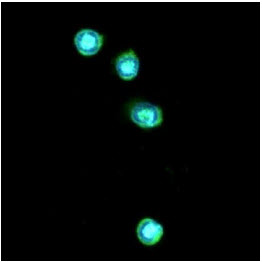
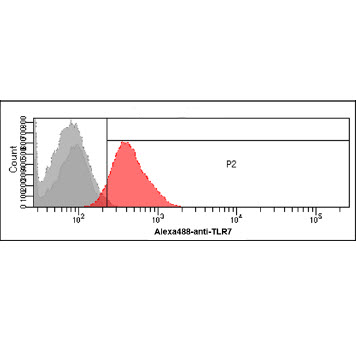
| Short Description | Mouse monoclonal anti-TLR7 (451-500aa) for use in ELISA, ICC, IF and FACS in Human samples. Datasheet included with dilution recommendations, and related reagents. |
| Applications | ELISA/ICC/IF/FACS |
| Host | Mouse |
| Reactivity | Human |
| Note | STRICTLY FOR FURTHER SCIENTIFIC RESEARCH USE ONLY (RUO). MUST NOT TO BE USED IN DIAGNOSTIC OR THERAPEUTIC APPLICATIONS. |
Product Properties
| Clonality | Monoclonal |
| Clone ID | 4F4 |
| Isotype | IgG1k |
| Conjugation | Unconjugated |
| Concentration | 1 mg/mL |
| Purification | By protein-G affinity chromatography |
| Formulation | Liquid in phosphate-Buffered Saline (pH 7.4) with 0.02% Sodium Azide, 10% Glycerol |
| Storage Instruction | For short term storage, keep at +2C to +8C for up to 1 week. For long term storage, aliquot and store at-20C, and avoid repeat freeze-thaw cycles. |
Target Information
| Gene Symbol | TLR7 |
| Gene ID | 51284 |
| Uniprot ID | TLR7_HUMAN |
| Accession Number | NP_057646 |
| Immunogen | Recombinant human TLR7 (451-500aa) purified from E. coli |
| Immunogen Region | 451-500aa |
Additional Info
| Tissue Specificity | Detected in brain, placenta, spleen, stomach, small intestine, lung and in plasmacytoid pre-dendritic cells. Expressed in peripheral mononuclear blood cells. |
| Function | Endosomal receptor that plays a key role in innate and adaptive immunity. Controls host immune response against pathogens through recognition of uridine-containing single strand RNAs (ssRNAs) of viral origin or guanosine analogs. Upon binding to agonists, undergoes dimerization that brings TIR domains from the two molecules into direct contact, leading to the recruitment of TIR-containing downstream adapter MYD88 through homotypic interaction. In turn, the Myddosome signaling complex is formed involving IRAK4, IRAK1, TRAF6, TRAF3 leading to activation of downstream transcription factors NF-kappa-B and IRF7 to induce pro-inflammatory cytokines and interferons, respectively. In plasmacytoid dendritic cells, RNASET2 endonuclease cooperates with PLD3 or PLD4 5'->3' exonucleases to process RNA and release 2',3'-cyclic guanosine monophosphate (2',3'-cGMP) and cytidine-rich RNA fragments that occupy TLR7 ligand-binding pockets and trigger a signaling-competent state. |
| Protein Name | Toll-Like Receptor 7 |
| Database Links | Reactome: R-HSA-1679131Reactome: R-HSA-168181Reactome: R-HSA-5686938Reactome: R-HSA-9679191Reactome: R-HSA-9692916Reactome: R-HSA-9705671Reactome: R-HSA-975110Reactome: R-HSA-975138Reactome: R-HSA-975155Reactome: R-HSA-9824856Reactome: R-HSA-9833110 |
| Cellular Localisation | Endoplasmic Reticulum MembraneSingle-Pass Type I Membrane ProteinEndosomeLysosomeCytoplasmic VesiclePhagosomeRelocalizes From Endoplasmic Reticulum To Endosome And Lysosome Upon Stimulation With Agonist |
| Alternative Antibody Names | Anti-Toll-Like Receptor 7 antibodyAnti-TLR7 antibodyAnti-UNQ248 antibodyAnti-PRO285 antibody |
Information sourced from Uniprot.org