

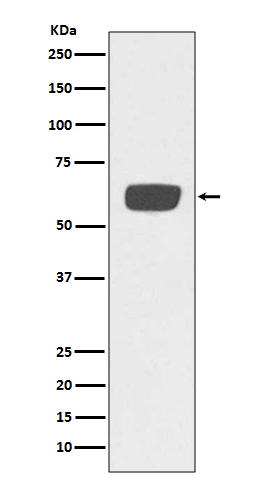

Anti-Tissue Type Plasminogen Activator antibody [R05-3D2] (STJA0036256)
SPECIFICATIONS
ClonalityMonoclonal
HostRabbit
ConjugationUnconjugated
IsotypeIgG
ImmunogenA synthesized peptide derived from human PLAT
General Information
| Short Description | Rabbit monoclonal anti-Tissue Type Plasminogen Activator for use in WB and IHC-P in Human, Mouse and Rat samples. Datasheet included with dilution recommendations, and related reagents. |
| Applications | WB/IHC-P |
| Host | Rabbit |
| Reactivity | Human/Mouse/Rat |
| Note | STRICTLY FOR FURTHER SCIENTIFIC RESEARCH USE ONLY (RUO). MUST NOT TO BE USED IN DIAGNOSTIC OR THERAPEUTIC APPLICATIONS. |
Product Properties
| Clonality | Monoclonal |
| Clone ID | R05-3D2 |
| Isotype | IgG |
| Conjugation | Unconjugated |
| Purification | Affinity Chromatography |
| Dilution Range | WB 1:500-1:1000IHC 1:50-1:100 |
| Formulation | Rabbit IgG in phosphate buffered saline, pH 7.4, 150mM NaCl, 0.02% sodium azide and 50% glycerol. |
| Storage Instruction | Store at 4°C short term. Aliquot and store at-20°C long term. Avoid freeze/thaw cycles. |
Target Information
| Gene Symbol | PLAT |
| Gene ID | 5327 |
| Uniprot ID | TPA_HUMAN |
| Immunogen | A synthesized peptide derived from human PLAT |
Additional Info
| Tissue Specificity | Synthesized in numerous tissues (including tumors) and secreted into most extracellular body fluids, such as plasma, uterine fluid, saliva, gingival crevicular fluid, tears, seminal fluid, and milk. |
| Post Translational Modifications | The single chain, almost fully active enzyme, can be further processed into a two-chain fully active form by a cleavage after Arg-310 catalyzed by plasmin, tissue kallikrein or factor Xa. Differential cell-specific N-linked glycosylation gives rise to two glycoforms, type I (glycosylated at Asn-219) and type II (not glycosylated at Asn-219). The single chain type I glycoform is less readily converted into the two-chain form by plasmin, and the two-chain type I glycoform has a lower activity than the two-chain type II glycoform in the presence of fibrin. N-glycosylation of Asn-152.the bound oligomannosidic glycan is involved in the interaction with the mannose receptor. Characterization of O-linked glycan was studied in Bowes melanoma cell line. |
| Function | Converts the abundant, but inactive, zymogen plasminogen to plasmin by hydrolyzing a single Arg-Val bond in plasminogen. By controlling plasmin-mediated proteolysis, it plays an important role in tissue remodeling and degradation, in cell migration and many other physiopathological events. During oocyte activation, plays a role in cortical granule reaction in the zona reaction, which contributes to the block to polyspermy. |
| Protein Name | Tissue-Type Plasminogen ActivatorT-PaT-Plasminogen ActivatorTpaAlteplaseReteplase Cleaved Into - Tissue-Type Plasminogen Activator Chain A - Tissue-Type Plasminogen Activator Chain B |
| Database Links | Reactome: R-HSA-186797Reactome: R-HSA-75205 |
| Cellular Localisation | SecretedExtracellular Space |
| Alternative Antibody Names | Anti-Tissue-Type Plasminogen Activator antibodyAnti-T-Pa antibodyAnti-T-Plasminogen Activator antibodyAnti-Tpa antibodyAnti-Alteplase antibodyAnti-Reteplase Cleaved Into - Tissue-Type Plasminogen Activator Chain A - Tissue-Type Plasminogen Activator Chain B antibodyAnti-PLAT antibody |
Information sourced from Uniprot.org