


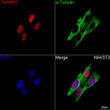


Anti-TARBP2 antibody (200-300) [S4MR] (STJ11102424)
SPECIFICATIONS
ClonalityMonoclonal
HostRabbit
ConjugationUnconjugated
IsotypeIgG
General Information
| Short Description | Rabbit monoclonal TRBP (200-300) antibody for use in WB, IHC-P, IF, ICC and ELISA in human, mouse and rat samples. Datasheet included with dilution recommendations, and related reagents. |
| Applications | WB/IHC-P/IF/ICC/ELISA |
| Host | Rabbit |
| Reactivity | Human/Mouse/Rat |
| Note | STRICTLY FOR FURTHER SCIENTIFIC RESEARCH USE ONLY (RUO). MUST NOT TO BE USED IN DIAGNOSTIC OR THERAPEUTIC APPLICATIONS. |
Product Properties
| Clonality | Monoclonal |
| Clone ID | S4MR |
| Isotype | IgG |
| Conjugation | Unconjugated |
| Concentration | Lot specific |
| Purification | Affinity purification |
| Dilution Range | WB:1:500-1:2000IHC-P:1:50-1:200IF/ICC:1:50-1:200ELISA:Recommended starting concentration is 1 Mu g/mL. Please optimize the concentration based on your specific assay requirements. |
| Formulation | PBS with 0.02% Sodium Azide, 0.05% BSA, 50% Glycerol, pH 7.3. |
| Storage Instruction | Store at-20°C for up to 1 year from the date of receipt, and avoid repeat freeze-thaw cycles. |
Target Information
| Gene Symbol | TARBP2 |
| Gene ID | 6895 |
| Uniprot ID | TRBP2_HUMAN |
| Immunogen Region | 200-300 |
| Immunogen Sequence | RFIEIGSGTSKKLAKRNAAA KMLLRVHTVPLDARDGNEVE PDDDHFSIGVGSRLDGLRNR GPGCTWDSLRNSVGEKILSL RSCSLGSLGALGPACCRVLS E |
| Specificity | A synthetic peptide corresponding to a sequence within amino acids 200-300 of human TARBP2 (Q15633). |
Additional Info
| Function | Required for formation of the RNA induced silencing complex (RISC). Component of the RISC loading complex (RLC), also known as the micro-RNA (miRNA) loading complex (miRLC), which is composed of DICER1, AGO2 and TARBP2. Within the RLC/miRLC, DICER1 and TARBP2 are required to process precursor miRNAs (pre-miRNAs) to mature miRNAs and then load them onto AGO2. AGO2 bound to the mature miRNA constitutes the minimal RISC and may subsequently dissociate from DICER1 and TARBP2. May also play a role in the production of short interfering RNAs (siRNAs) from double-stranded RNA (dsRNA) by DICER1. Binds in vitro to the PRM1 3'-UTR. Seems to act as a repressor of translation. For some pre-miRNA substrates, may also alter the choice of cleavage site by DICER1. Negatively regulates IRF7-mediated IFN-beta signaling triggered by viral infection by inhibiting the phosphorylation of IRF7 and promoting its 'Lys'-48-linked ubiquitination and degradation. (Microbial infection) Binds to the HIV-1 TAR RNA which is located in the long terminal repeat (LTR) of HIV-1, and stimulates translation of TAR-containing RNAs. This is achieved in part at least by binding to and inhibiting EIF2AK2/PKR, thereby reducing phosphorylation and inhibition of EIF2S1/eIF-2-alpha. May also promote translation of TAR-containing RNAs independently of EIF2AK2/PKR. Mediates recruitment of FTSJ3 methyltransferase to HIV-1 RNA, leading to 2'-O-methylation of the viral genome, allowing HIV-1 to escape the innate immune system. |
| Protein Name | Risc-Loading Complex Subunit Tarbp2Tar Rna-Binding Protein 2Trans-Activation-Responsive Rna-Binding Protein |
| Database Links | Reactome: R-HSA-203927Reactome: R-HSA-426486Reactome: R-HSA-9833482 |
| Cellular Localisation | CytoplasmPerinuclear RegionNucleus |
| Alternative Antibody Names | Anti-Risc-Loading Complex Subunit Tarbp2 antibodyAnti-Tar Rna-Binding Protein 2 antibodyAnti-Trans-Activation-Responsive Rna-Binding Protein antibodyAnti-TARBP2 antibodyAnti-TRBP antibody |
Information sourced from Uniprot.org