
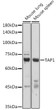


Anti-TAP1 antibody (524-808) (STJ27969)
SPECIFICATIONS
ClonalityPolyclonal
HostRabbit
ConjugationUnconjugated
IsotypeIgG
General Information
| Short Description | Rabbit polyclonal TAP1 (524-808) antibody for use in WB and ELISA in human and mouse samples. Datasheet included with dilution recommendations, and related reagents. |
| Applications | WB/ELISA |
| Host | Rabbit |
| Reactivity | Human/Mouse |
| Note | STRICTLY FOR FURTHER SCIENTIFIC RESEARCH USE ONLY (RUO). MUST NOT TO BE USED IN DIAGNOSTIC OR THERAPEUTIC APPLICATIONS. |
Product Properties
| Clonality | Polyclonal |
| Isotype | IgG |
| Conjugation | Unconjugated |
| Concentration | Lot specific |
| Purification | Affinity purification |
| Dilution Range | WB:1:500-1:1000ELISA:Recommended starting concentration is 1 Mu g/mL. Please optimize the concentration based on your specific assay requirements. |
| Formulation | PBS with 0.02% Sodium Azide, 50% Glycerol, pH 7.3. |
| Storage Instruction | Store at-20°C for up to 1 year from the date of receipt, and avoid repeat freeze-thaw cycles. |
Target Information
| Gene Symbol | TAP1 |
| Gene ID | 6890 |
| Uniprot ID | TAP1_HUMAN |
| Immunogen Region | 524-808 |
| Immunogen Sequence | IYPRVQKAVGSSEKIFEYLD RTPRCPPSGLLTPLHLEGLV QFQDVSFAYPNRPDVLVLQG LTFTLRPGEVTALVGPNGSG KSTVAALLQNLYQPTGGQLL LDGKPLPQYEHRYLHRQVAA VGQEPQVFGRSLQENIAYGL TQKPTMEEITAAAVKSGAHS FISGLPQGYDTEVDEAGSQL SGGQRQAVALARALIRKPCV LILDDATSALDANSQLQVEQ LLYESPERYSRSVLLITQH |
| Specificity | Recombinant fusion protein containing a sequence corresponding to amino acids 524-808 of human TAP1 (NP_000584.3). |
Additional Info
| Tissue Specificity | Highly expressed in professional APCs monocytes and dendritic cells as well as in lymphocyte subsets T cells, B cells and NK cells. |
| Function | ABC transporter associated with antigen processing. In complex with TAP2 mediates unidirectional translocation of peptide antigens from cytosol to endoplasmic reticulum (ER) for loading onto MHC class I (MHCI) molecules. Uses the chemical energy of ATP to export peptides against the concentration gradient. During the transport cycle alternates between 'inward-facing' state with peptide binding site facing the cytosol to 'outward-facing' state with peptide binding site facing the ER lumen. Peptide antigen binding to ATP-loaded TAP1-TAP2 induces a switch to hydrolysis-competent 'outward-facing' conformation ready for peptide loading onto nascent MHCI molecules. Subsequently ATP hydrolysis resets the transporter to the 'inward facing' state for a new cycle. Typically transports intracellular peptide antigens of 8 to 13 amino acids that arise from cytosolic proteolysis via IFNG-induced immunoproteasome. Binds peptides with free N- and C-termini, the first three and the C-terminal residues being critical. Preferentially selects peptides having a highly hydrophobic residue at position 3 and hydrophobic or charged residues at the C-terminal anchor. Proline at position 2 has the most destabilizing effect. As a component of the peptide loading complex (PLC), acts as a molecular scaffold essential for peptide-MHCI assembly and antigen presentation. |
| Protein Name | Antigen Peptide Transporter 1Apt1Atp-Binding Cassette Sub-Family B Member 2Peptide Supply Factor 1Peptide Transporter Psf1Psf-1Peptide Transporter Tap1Peptide Transporter Involved In Antigen Processing 1Really Interesting New Gene 4 ProteinRing4 |
| Database Links | Reactome: R-HSA-1236974Reactome: R-HSA-983170 |
| Cellular Localisation | Endoplasmic Reticulum MembraneMulti-Pass Membrane ProteinThe Transmembrane Segments Seem To Form A Pore In The Membrane |
| Alternative Antibody Names | Anti-Antigen Peptide Transporter 1 antibodyAnti-Apt1 antibodyAnti-Atp-Binding Cassette Sub-Family B Member 2 antibodyAnti-Peptide Supply Factor 1 antibodyAnti-Peptide Transporter Psf1 antibodyAnti-Psf-1 antibodyAnti-Peptide Transporter Tap1 antibodyAnti-Peptide Transporter Involved In Antigen Processing 1 antibodyAnti-Really Interesting New Gene 4 Protein antibodyAnti-Ring4 antibodyAnti-TAP1 antibodyAnti-ABCB2 antibodyAnti-PSF1 antibodyAnti-RING4 antibodyAnti-Y3 antibody |
Information sourced from Uniprot.org