

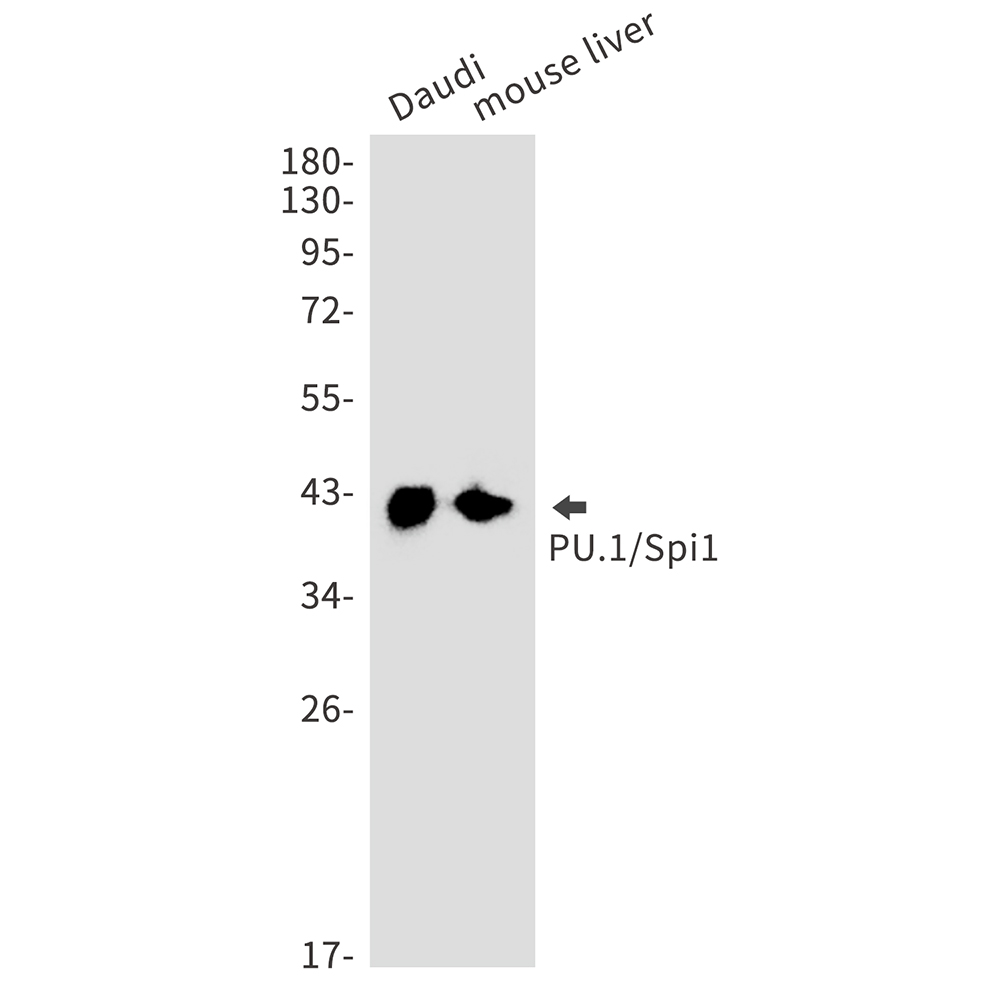

Anti-SPI1 antibody [R07-4D3] (STJA0034774)
SPECIFICATIONS
ClonalityMonoclonal
HostRabbit
ConjugationUnconjugated
IsotypeIgG
ImmunogenA synthetic peptide of human PU.1/Spi1
General Information
| Short Description | Rabbit monoclonal anti-SPI1 for use in WB and IHC-P in Human and Mouse samples. Datasheet included with dilution recommendations, and related reagents. |
| Applications | WB/IHC-P |
| Host | Rabbit |
| Reactivity | Human/Mouse |
| Note | STRICTLY FOR FURTHER SCIENTIFIC RESEARCH USE ONLY (RUO). MUST NOT TO BE USED IN DIAGNOSTIC OR THERAPEUTIC APPLICATIONS. |
Product Properties
| Clonality | Monoclonal |
| Clone ID | R07-4D3 |
| Isotype | IgG |
| Conjugation | Unconjugated |
| Concentration | 0.3 mg/mL |
| Purification | Affinity Purified |
| Dilution Range | WB 1:500-1:1000IHC 1:50-1:100 |
| Formulation | 50mM Tris-Glycine (pH 7.4) , 0.15M NaCl, 40% Glycerol, 0.01% Sodium azide and 0.05% BSA |
| Storage Instruction | Store at 4°C short term. Aliquot and store at-20°C long term. Avoid freeze/thaw cycles. |
Target Information
| Gene Symbol | SPI1 |
| Gene ID | 6688 |
| Uniprot ID | SPI1_HUMAN |
| Immunogen | A synthetic peptide of human PU.1/Spi1 |
Additional Info
| Tissue Specificity | In the bone marrow, concentrated in hematopoietic stem cell, lymphoid progenitor, myeloid lineage (granulocyte macrophage progenitors, classical dendritic cells, monocytes) and B-cell clusters. Among B-cells, predominantly expressed in pre-B1 cells. Expressed in germinal center B-cells. |
| Function | Pioneer transcription factor, which controls hematopoietic cell fate by decompacting stem cell heterochromatin and allowing other transcription factors to enter otherwise inaccessible genomic sites. Once in open chromatin, can directly control gene expression by binding genetic regulatory elements and can also more broadly influence transcription by recruiting transcription factors, such as interferon regulatory factors (IRFs), to otherwise inaccessible genomic regions. Transcriptionally activates genes important for myeloid and lymphoid lineages, such as CSF1R. Transcriptional activation from certain promoters, possibly containing low affinity binding sites, is achieved cooperatively with other transcription factors. FCER1A transactivation is achieved in cooperation with GATA1. May be particularly important for the pro- to pre-B cell transition. Binds (via the ETS domain) onto the purine-rich DNA core sequence 5'-GAGGAA-3', also known as the PU-box. In vitro can bind RNA and interfere with pre-mRNA splicing. |
| Protein Name | Transcription Factor Pu.131 Kda-Transforming Protein |
| Database Links | Reactome: R-HSA-8939236Reactome: R-HSA-9616222 |
| Cellular Localisation | Nucleus |
| Alternative Antibody Names | Anti-Transcription Factor Pu.1 antibodyAnti-31 Kda-Transforming Protein antibodyAnti-SPI1 antibody |
Information sourced from Uniprot.org