

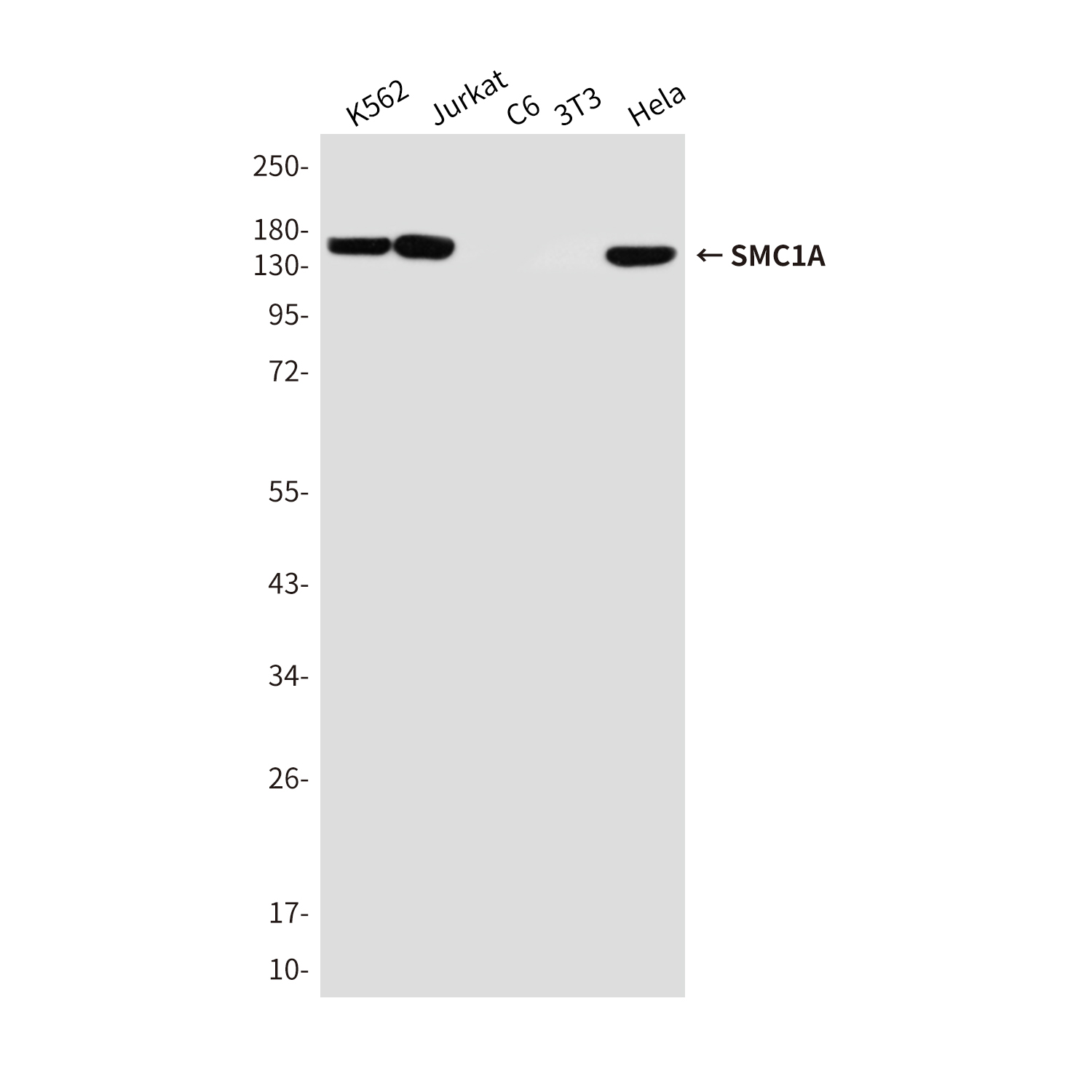

Anti-SMC1A antibody [4C5-C8-A11] (STJA0038209)
SPECIFICATIONS
ClonalityMonoclonal
HostMouse
ConjugationUnconjugated
IsotypeIgG1
ImmunogenPurified recombinant human SMC1A (C-term.) protein fragments expressed in E.coli.
General Information
| Short Description | Mouse monoclonal anti-SMC1A for use in WB, ICC and IF in Human samples. Datasheet included with dilution recommendations, and related reagents. |
| Applications | WB/ICC/IF |
| Host | Mouse |
| Reactivity | Human |
| Note | STRICTLY FOR FURTHER SCIENTIFIC RESEARCH USE ONLY (RUO). MUST NOT TO BE USED IN DIAGNOSTIC OR THERAPEUTIC APPLICATIONS. |
Product Properties
| Clonality | Monoclonal |
| Clone ID | 4C5-C8-A11 |
| Isotype | IgG1 |
| Conjugation | Unconjugated |
| Concentration | 3.11 mg/mL |
| Purification | Affinity Purified |
| Dilution Range | WB 1:500-1:1000IF 1:50-1:200 |
| Formulation | Liquid in PBS containing 50% glycerol, 0.5% BSA and 0.02% sodium azide, pH 7.3. |
| Storage Instruction | Store at 4°C short term. Aliquot and store at-20°C long term. Avoid freeze/thaw cycles. |
Target Information
| Gene Symbol | SMC1A |
| Gene ID | 8243 |
| Uniprot ID | SMC1A_HUMAN |
| Immunogen | Purified recombinant human SMC1A (C-term.) protein fragments expressed in E.coli. |
Additional Info
| Post Translational Modifications | Ubiquitinated by the DCX(DCAF15) complex, leading to its degradation. Phosphorylated by ATM upon ionizing radiation in a NBS1-dependent manner. Phosphorylated by ATR upon DNA methylation in a MSH2/MSH6-dependent manner. Phosphorylation of Ser-957 and Ser-966 activates it and is required for S-phase checkpoint activation. |
| Function | Involved in chromosome cohesion during cell cycle and in DNA repair. Central component of cohesin complex. The cohesin complex is required for the cohesion of sister chromatids after DNA replication. The cohesin complex apparently forms a large proteinaceous ring within which sister chromatids can be trapped. At anaphase, the complex is cleaved and dissociates from chromatin, allowing sister chromatids to segregate. The cohesin complex may also play a role in spindle pole assembly during mitosis. Involved in DNA repair via its interaction with BRCA1 and its related phosphorylation by ATM, or via its phosphorylation by ATR. Works as a downstream effector both in the ATM/NBS1 branch and in the ATR/MSH2 branch of S-phase checkpoint. |
| Protein Name | Structural Maintenance Of Chromosomes Protein 1aSmc Protein 1aSmc-1-AlphaSmc-1aSb1.8 |
| Database Links | Reactome: R-HSA-1221632Reactome: R-HSA-2467813Reactome: R-HSA-2468052Reactome: R-HSA-2470946Reactome: R-HSA-2500257Reactome: R-HSA-3108214Reactome: R-HSA-9018519 |
| Cellular Localisation | NucleusChromosomeCentromereKinetochoreAssociates With ChromatinBefore Prophase It Is Scattered Along Chromosome ArmsDuring ProphaseMost Of Cohesin Complexes Dissociate From Chromatin Probably Because Of Phosphorylation By PlkExcept At CentromeresWhere Cohesin Complexes RemainAt AnaphaseThe Rad21 Subunit Of The Cohesin Complex Is CleavedLeading To The Dissociation Of The Complex From ChromosomesAllowing Chromosome SeparationIn Germ CellsCohesin Complex Dissociates From Chromatin At Prophase IAnd May Be Replaced By A Meiosis-Specific Cohesin ComplexThe Phosphorylated Form On Ser-957 And Ser-966 Associates With Chromatin During G1/S/G2 Phases But Not During M PhaseSuggesting That Phosphorylation Does Not Regulate Cohesin FunctionIntegral Component Of The Functional Centromere-Kinetochore Complex At The Kinetochore Region During Mitosis |
| Alternative Antibody Names | Anti-Structural Maintenance Of Chromosomes Protein 1a antibodyAnti-Smc Protein 1a antibodyAnti-Smc-1-Alpha antibodyAnti-Smc-1a antibodyAnti-Sb1.8 antibodyAnti-SMC1A antibodyAnti-DXS423E antibodyAnti-KIAA0178 antibodyAnti-SB1.8 antibodyAnti-SMC1 antibodyAnti-SMC1L1 antibody |
Information sourced from Uniprot.org