

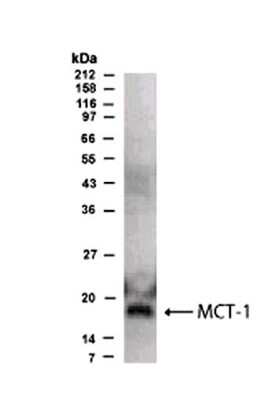

Anti-SLC16A1 antibody (N-Term) (STJA0005673)
SPECIFICATIONS
ClonalityPolyclonal
HostRabbit
ConjugationUnconjugated
IsotypeIgG
ImmunogenSynthetic peptide corresponding to amino acids from the N-terminal region of human MCT1 protein
General Information
| Short Description | Rabbit polyclonal anti-MCT1 (N-Term) for use in WB in Human samples. Datasheet included with dilution recommendations, and related reagents. |
| Applications | WB |
| Host | Rabbit |
| Reactivity | Human |
| Note | STRICTLY FOR FURTHER SCIENTIFIC RESEARCH USE ONLY (RUO). MUST NOT TO BE USED IN DIAGNOSTIC OR THERAPEUTIC APPLICATIONS. |
Product Properties
| Clonality | Polyclonal |
| Isotype | IgG |
| Conjugation | Unconjugated |
| Purification | Antigen Affinity Purified |
| Dilution Range | WB 1:500-1:1000 |
| Formulation | PBS + 0.02% NaN3 |
| Storage Instruction | Store at-20°C for up to 1 year from the date of receipt, and avoid repeat freeze-thaw cycles. |
Target Information
| Gene Symbol | SLC16A1 |
| Gene ID | 6566 |
| Uniprot ID | MOT1_HUMAN |
| Immunogen | Synthetic peptide corresponding to amino acids from the N-terminal region of human MCT1 protein |
| Immunogen Region | N-Term |
| Specificity | Reacts with the N-terminal region of human MCT1 |
Additional Info
| Function | Bidirectional proton-coupled monocarboxylate transporter. Catalyzes the rapid transport across the plasma membrane of many monocarboxylates such as lactate, pyruvate, acetate and the ketone bodies acetoacetate and beta-hydroxybutyrate, and thus contributes to the maintenance of intracellular pH. The transport direction is determined by the proton motive force and the concentration gradient of the substrate monocarboxylate. MCT1 is a major lactate exporter. Plays a role in cellular responses to a high-fat diet by modulating the cellular levels of lactate and pyruvate that contribute to the regulation of central metabolic pathways and insulin secretion, with concomitant effects on plasma insulin levels and blood glucose homeostasis. Facilitates the protonated monocarboxylate form of succinate export, that its transient protonation upon muscle cell acidification in exercising muscle and ischemic heart. Functions via alternate outward- and inward-open conformation states. Protonation and deprotonation of 309-Asp is essential for the conformational transition. |
| Protein Name | Monocarboxylate Transporter 1Mct 1Solute Carrier Family 16 Member 1 |
| Database Links | Reactome: R-HSA-210991Reactome: R-HSA-433692Reactome: R-HSA-5619070Reactome: R-HSA-9749641 |
| Cellular Localisation | Cell MembraneMulti-Pass Membrane ProteinBasolateral Cell MembraneApical Cell MembraneExpression At The Cell Surface Requires The Ancillary Proteins Bsg And EmbBinds Preferentially To Bsg |
| Alternative Antibody Names | Anti-Monocarboxylate Transporter 1 antibodyAnti-Mct 1 antibodyAnti-Solute Carrier Family 16 Member 1 antibodyAnti-SLC16A1 antibodyAnti-MCT1 antibody |
Information sourced from Uniprot.org