

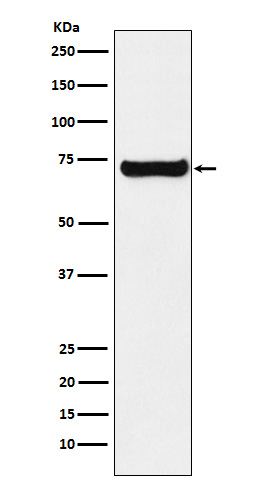

Anti-SESN1 antibody [R02-1W8] (STJA0037308)
SPECIFICATIONS
ClonalityMonoclonal
HostRabbit
ConjugationUnconjugated
IsotypeIgG
ImmunogenA synthesized peptide derived from human SESN1
General Information
| Short Description | Rabbit monoclonal anti-SESN1 for use in WB and FC in Human, Mouse and Rat samples. Datasheet included with dilution recommendations, and related reagents. |
| Applications | WB/FC |
| Host | Rabbit |
| Reactivity | Human/Mouse/Rat |
| Note | STRICTLY FOR FURTHER SCIENTIFIC RESEARCH USE ONLY (RUO). MUST NOT TO BE USED IN DIAGNOSTIC OR THERAPEUTIC APPLICATIONS. |
Product Properties
| Clonality | Monoclonal |
| Clone ID | R02-1W8 |
| Isotype | IgG |
| Conjugation | Unconjugated |
| Purification | Affinity Purified |
| Dilution Range | WB 1:500-1:1000FC 1:50-1:100 |
| Formulation | Rabbit IgG in phosphate buffered saline, pH 7.4, 150mM NaCl, 0.02% sodium azide and 50% glycerol. |
| Storage Instruction | Store at 4°C short term. Aliquot and store at-20°C long term. Avoid freeze/thaw cycles. |
Target Information
| Gene Symbol | SESN1 |
| Gene ID | 27244 |
| Uniprot ID | SESN1_HUMAN |
| Immunogen | A synthesized peptide derived from human SESN1 |
Additional Info
| Tissue Specificity | Widely expressed. |
| Function | Functions as an intracellular leucine sensor that negatively regulates the TORC1 signaling pathway through the GATOR complex. In absence of leucine, binds the GATOR subcomplex GATOR2 and prevents TORC1 signaling. Binding of leucine to SESN2 disrupts its interaction with GATOR2 thereby activating the TORC1 signaling pathway. This stress-inducible metabolic regulator may also play a role in protection against oxidative and genotoxic stresses. May positively regulate the transcription by NFE2L2 of genes involved in the response to oxidative stress by facilitating the SQSTM1-mediated autophagic degradation of KEAP1. Moreover, may prevent the accumulation of reactive oxygen species (ROS) through the alkylhydroperoxide reductase activity born by the N-terminal domain of the protein. Was originally reported to contribute to oxidative stress resistance by reducing PRDX1. However, this could not be confirmed. |
| Protein Name | Sestrin-1P53-Regulated Protein Pa26 |
| Database Links | Reactome: R-HSA-5628897Reactome: R-HSA-9639288Reactome: R-HSA-9755511 |
| Cellular Localisation | NucleusCytoplasm |
| Alternative Antibody Names | Anti-Sestrin-1 antibodyAnti-P53-Regulated Protein Pa26 antibodyAnti-SESN1 antibodyAnti-PA26 antibodyAnti-SEST1 antibody |
Information sourced from Uniprot.org