
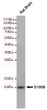


Anti-S100B antibody [5G3-C11] (STJ99307)
SPECIFICATIONS
ClonalityMonoclonal
HostMouse
ConjugationUnconjugated
IsotypeIgG2b
ImmunogenHuman S100B synthetic peptide conjugated to KLH.
General Information
| Short Description | Mouse monoclonal anti-Protein S100-B for use in WB in Rat samples. Datasheet included with dilution recommendations, and related reagents. |
| Applications | WB |
| Host | Mouse |
| Reactivity | Rat |
| Note | STRICTLY FOR FURTHER SCIENTIFIC RESEARCH USE ONLY (RUO). MUST NOT TO BE USED IN DIAGNOSTIC OR THERAPEUTIC APPLICATIONS. |
Product Properties
| Clonality | Monoclonal |
| Clone ID | 5G3-C11 |
| Isotype | IgG2b |
| Conjugation | Unconjugated |
| Concentration | 1 mg/mL |
| Purification | The antibody was affinity-purified from mouse ascites by affinity-chromatography using epitope-specific immunogen. |
| Dilution Range | WB 1:500 |
| Formulation | Liquid in PBS containing 50% Glycerol, 0.5% BSA and 0.02% Sodium Azide. |
| Storage Instruction | Store at-20°C for up to 1 year from the date of receipt, and avoid repeat freeze-thaw cycles. |
Target Information
| Gene Symbol | S100B |
| Gene ID | 6285 |
| Uniprot ID | S100B_HUMAN |
| Immunogen | Human S100B synthetic peptide conjugated to KLH. |
| Specificity | This antibody detects endogenous levels of S100B and does not cross-react with related proteins. |
Additional Info
| Function | Small zinc- and- and calcium-binding protein that is highly expressed in astrocytes and constitutes one of the most abundant soluble proteins in brain. Weakly binds calcium but binds zinc very tightly-distinct binding sites with different affinities exist for both ions on each monomer. Physiological concentrations of potassium ion antagonize the binding of both divalent cations, especially affecting high-affinity calcium-binding sites. Acts as a neurotrophic factor that promotes astrocytosis and axonal proliferation. Involved in innervation of thermogenic adipose tissue by acting as an adipocyte-derived neurotrophic factor that promotes sympathetic innervation of adipose tissue. Binds to and initiates the activation of STK38 by releasing autoinhibitory intramolecular interactions within the kinase. Interaction with AGER after myocardial infarction may play a role in myocyte apoptosis by activating ERK1/2 and p53/TP53 signaling. Could assist ATAD3A cytoplasmic processing, preventing aggregation and favoring mitochondrial localization. May mediate calcium-dependent regulation on many physiological processes by interacting with other proteins, such as TPR-containing proteins, and modulating their activity. |
| Protein Name | Protein S100-BS-100 Protein Beta ChainS-100 Protein Subunit BetaS100 Calcium-Binding Protein B |
| Database Links | Reactome: R-HSA-1251985Reactome: R-HSA-445989Reactome: R-HSA-879415Reactome: R-HSA-933542 |
| Cellular Localisation | CytoplasmNucleusSecretedSecretion Into The Medium Is Promoted By Interaction With Isoform Clstn3beta Of Clstn3 |
| Alternative Antibody Names | Anti-Protein S100-B antibodyAnti-S-100 Protein Beta Chain antibodyAnti-S-100 Protein Subunit Beta antibodyAnti-S100 Calcium-Binding Protein B antibodyAnti-S100B antibody |
Information sourced from Uniprot.org