
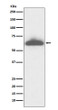
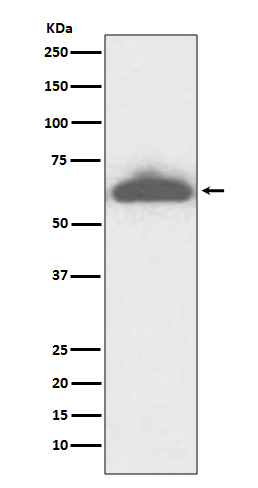

Anti-RPE65 antibody [R07-1E1] (STJA0036394)
SPECIFICATIONS
ClonalityMonoclonal
HostRabbit
ConjugationUnconjugated
IsotypeIgG
ImmunogenA synthesized peptide derived from human RPE65
General Information
| Short Description | Rabbit monoclonal anti-RPE65 for use in WB and IP in Human, Mouse and Rat samples. Datasheet included with dilution recommendations, and related reagents. |
| Applications | WB/IP |
| Host | Rabbit |
| Reactivity | Human/Mouse/Rat |
| Note | STRICTLY FOR FURTHER SCIENTIFIC RESEARCH USE ONLY (RUO). MUST NOT TO BE USED IN DIAGNOSTIC OR THERAPEUTIC APPLICATIONS. |
Product Properties
| Clonality | Monoclonal |
| Clone ID | R07-1E1 |
| Isotype | IgG |
| Conjugation | Unconjugated |
| Purification | Affinity Chromatography |
| Dilution Range | WB 1:500-1:1000IP 1:50 |
| Formulation | Rabbit IgG in phosphate buffered saline, pH 7.4, 150mM NaCl, 0.02% sodium azide and 50% glycerol. |
| Storage Instruction | Store at 4°C short term. Aliquot and store at-20°C long term. Avoid freeze/thaw cycles. |
Target Information
| Gene Symbol | RPE65 |
| Gene ID | 6121 |
| Uniprot ID | RPE65_HUMAN |
| Immunogen | A synthesized peptide derived from human RPE65 |
Additional Info
| Tissue Specificity | Retina (at protein level). Retinal pigment epithelium specific. |
| Post Translational Modifications | Palmitoylation by LRAT regulates ligand binding specificity.the palmitoylated form (membrane form) specifically binds all-trans-retinyl-palmitate, while the soluble unpalmitoylated form binds all-trans-retinol (vitamin A). |
| Function | Critical isomerohydrolase in the retinoid cycle involved in regeneration of 11-cis-retinal, the chromophore of rod and cone opsins. Catalyzes the cleavage and isomerization of all-trans-retinyl fatty acid esters to 11-cis-retinol which is further oxidized by 11-cis retinol dehydrogenase to 11-cis-retinal for use as visual chromophore. Essential for the production of 11-cis retinal for both rod and cone photoreceptors. Also capable of catalyzing the isomerization of lutein to meso-zeaxanthin an eye-specific carotenoid. The soluble form binds vitamin A (all-trans-retinol), making it available for LRAT processing to all-trans-retinyl ester. The membrane form, palmitoylated by LRAT, binds all-trans-retinyl esters, making them available for IMH (isomerohydrolase) processing to all-cis-retinol. The soluble form is regenerated by transferring its palmitoyl groups onto 11-cis-retinol, a reaction catalyzed by LRAT. |
| Protein Name | Retinoid IsomerohydrolaseAll-Trans-Retinyl-Palmitate HydrolaseLutein IsomeraseMeso-Zeaxanthin IsomeraseRetinal Pigment Epithelium-Specific 65 Kda ProteinRetinol Isomerase |
| Database Links | Reactome: R-HSA-2453902 |
| Cellular Localisation | CytoplasmCell MembraneLipid-AnchorMicrosome MembraneAttached To The Membrane By A Lipid Anchor When Palmitoylated (Membrane Form)Soluble When UnpalmitoylatedUndergoes Light-Dependent Intracellular Transport To Become More Concentrated In The Central Region Of The Retina Pigment Epithelium Cells |
| Alternative Antibody Names | Anti-Retinoid Isomerohydrolase antibodyAnti-All-Trans-Retinyl-Palmitate Hydrolase antibodyAnti-Lutein Isomerase antibodyAnti-Meso-Zeaxanthin Isomerase antibodyAnti-Retinal Pigment Epithelium-Specific 65 Kda Protein antibodyAnti-Retinol Isomerase antibodyAnti-RPE65 antibody |
Information sourced from Uniprot.org