

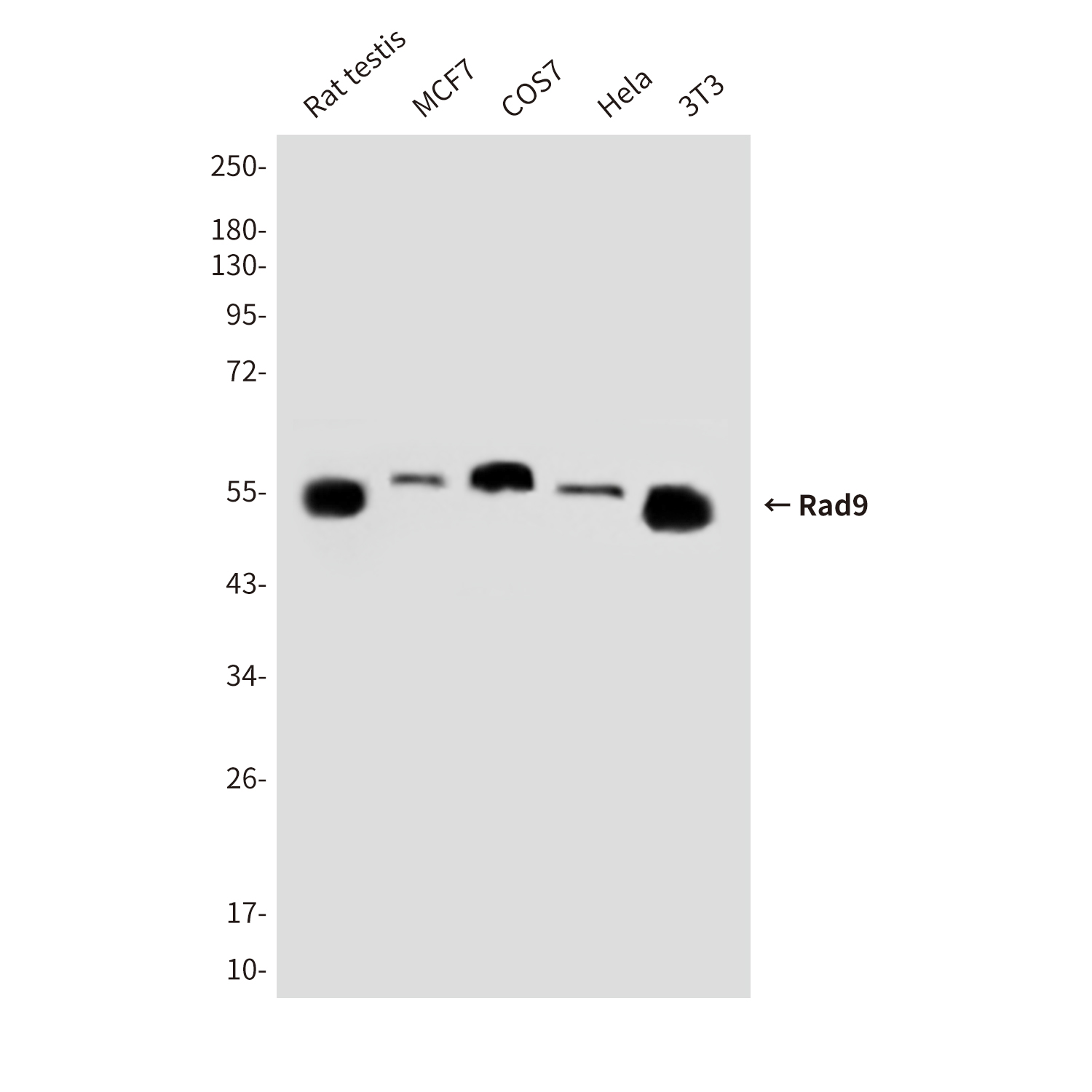
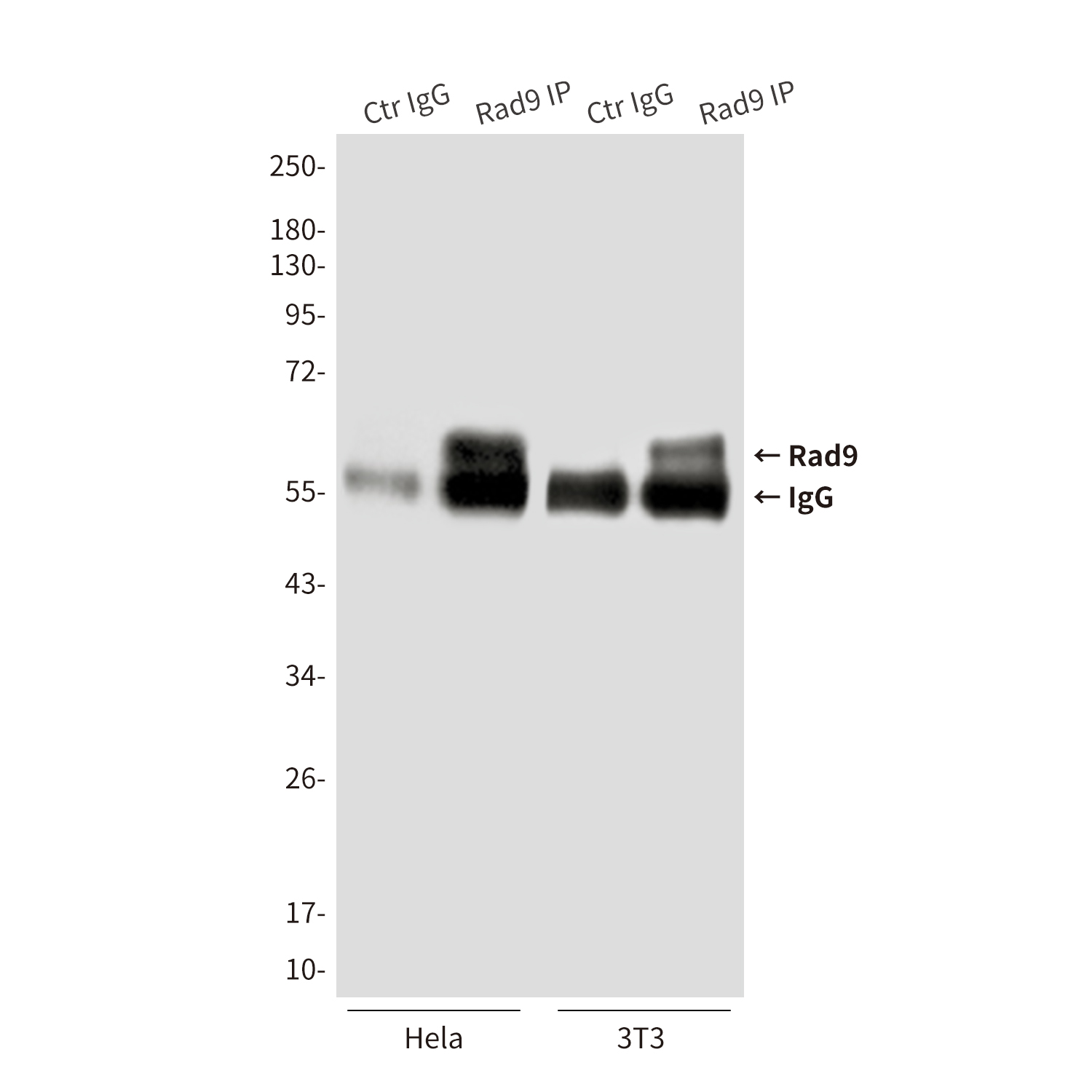

Anti-Rad9 antibody [3A3-A7-F8] (STJA0032425)
SPECIFICATIONS
ClonalityMonoclonal
HostMouse
ConjugationUnconjugated
IsotypeIgG2b
ImmunogenPurified recombinant human RAD9A protein fragments expressed in E.coli
General Information
| Short Description | Mouse monoclonal anti-Rad9 for use in WB and IP in Human, Mouse, Rat and Monkey samples. Datasheet included with dilution recommendations, and related reagents. |
| Applications | WB/IP |
| Host | Mouse |
| Reactivity | Human/Mouse/Rat/Monkey |
| Note | STRICTLY FOR FURTHER SCIENTIFIC RESEARCH USE ONLY (RUO). MUST NOT TO BE USED IN DIAGNOSTIC OR THERAPEUTIC APPLICATIONS. |
Product Properties
| Clonality | Monoclonal |
| Clone ID | 3A3-A7-F8 |
| Isotype | IgG2b |
| Conjugation | Unconjugated |
| Concentration | 3.8 mg/mL |
| Purification | Affinity Purified |
| Dilution Range | WB 1:500-1:1000IP 1:20 |
| Formulation | Liquid in PBS containing 50% glycerol, 0.5% BSA and 0.02% sodium azide, pH 7.3. |
| Storage Instruction | Store at 4°C short term. Aliquot and store at-20°C long term. Avoid freeze/thaw cycles. |
Target Information
| Gene Symbol | RAD9A |
| Gene ID | 5883 |
| Uniprot ID | RAD9A_HUMAN |
| Immunogen | Purified recombinant human RAD9A protein fragments expressed in E.coli |
Additional Info
| Post Translational Modifications | Constitutively phosphorylated on serine and threonine amino acids in absence of DNA damage. Hyperphosphorylated by PRKCD and ABL1 upon DNA damage. Its phosphorylation by PRKCD may be required for the formation of the 9-1-1 complex. Phosphorylated at Ser-341 and Ser-387 by CK2, promoting interaction with TOPBP1. |
| Function | Component of the 9-1-1 cell-cycle checkpoint response complex that plays a major role in DNA repair. The 9-1-1 complex is recruited to DNA lesion upon damage by the RAD17-replication factor C (RFC) clamp loader complex. Acts then as a sliding clamp platform on DNA for several proteins involved in long-patch base excision repair (LP-BER). The 9-1-1 complex stimulates DNA polymerase beta (POLB) activity by increasing its affinity for the 3'-OH end of the primer-template and stabilizes POLB to those sites where LP-BER proceeds.endonuclease FEN1 cleavage activity on substrates with double, nick, or gap flaps of distinct sequences and lengths.and DNA ligase I (LIG1) on long-patch base excision repair substrates. The 9-1-1 complex is necessary for the recruitment of RHNO1 to sites of double-stranded breaks (DSB) occurring during the S phase. RAD9A possesses 3'->5' double stranded DNA exonuclease activity. |
| Protein Name | Cell Cycle Checkpoint Control Protein Rad9aHrad9Dna Repair Exonuclease Rad9 Homolog A |
| Database Links | Reactome: R-HSA-176187Reactome: R-HSA-5685938Reactome: R-HSA-5693607Reactome: R-HSA-5693616Reactome: R-HSA-6804756Reactome: R-HSA-69473Reactome: R-HSA-9709570 |
| Cellular Localisation | Nucleus |
| Alternative Antibody Names | Anti-Cell Cycle Checkpoint Control Protein Rad9a antibodyAnti-Hrad9 antibodyAnti-Dna Repair Exonuclease Rad9 Homolog A antibodyAnti-RAD9A antibody |
Information sourced from Uniprot.org