

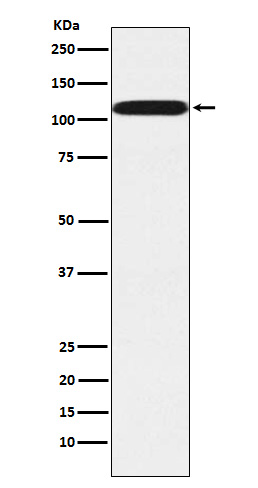

Anti-PUM2 antibody [R01-1P5] (STJA0037234)
SPECIFICATIONS
ClonalityMonoclonal
HostRabbit
ConjugationUnconjugated
IsotypeIgG
ImmunogenA synthesized peptide derived from human Pumilio 2
General Information
| Short Description | Rabbit monoclonal anti-PUM2 for use in WB, ICC, IF, IP and FC in Human, Mouse and Rat samples. Datasheet included with dilution recommendations, and related reagents. |
| Applications | WB/ICC/IF/IP/FC |
| Host | Rabbit |
| Reactivity | Human/Mouse/Rat |
| Note | STRICTLY FOR FURTHER SCIENTIFIC RESEARCH USE ONLY (RUO). MUST NOT TO BE USED IN DIAGNOSTIC OR THERAPEUTIC APPLICATIONS. |
Product Properties
| Clonality | Monoclonal |
| Clone ID | R01-1P5 |
| Isotype | IgG |
| Conjugation | Unconjugated |
| Purification | Affinity Purified |
| Dilution Range | WB 1:500-1:1000IF 1:50-1:200IP 1:20FC 1:50-1:100 |
| Formulation | Rabbit IgG in phosphate buffered saline, pH 7.4, 150mM NaCl, 0.02% sodium azide and 50% glycerol. |
| Storage Instruction | Store at 4°C short term. Aliquot and store at-20°C long term. Avoid freeze/thaw cycles. |
Target Information
| Gene Symbol | PUM2 |
| Gene ID | 23369 |
| Uniprot ID | PUM2_HUMAN |
| Immunogen | A synthesized peptide derived from human Pumilio 2 |
Additional Info
| Tissue Specificity | Expressed in male germ cells of adult testis (at protein level). Highly expressed in testis and ovary. Predominantly expressed in stem cells and germ cells. Expressed at lower level in brain, heart, kidney, liver, muscle, placenta, intestine and stomach Expressed in cerebellum, corpus callosum, caudate nucleus, hippocampus, medulla oblongata and putamen. Expressed in all fetal tissues tested. |
| Function | Sequence-specific RNA-binding protein that acts as a post-transcriptional repressor by binding the 3'-UTR of mRNA targets. Binds to an RNA consensus sequence, the Pumilio Response Element (PRE), 5'-UGUANAUA-3', that is related to the Nanos Response Element (NRE) (, PubMed:21397187). Mediates post-transcriptional repression of transcripts via different mechanisms: acts via direct recruitment of the CCR4-POP2-NOT deadenylase leading to translational inhibition and mRNA degradation. Also mediates deadenylation-independent repression by promoting accessibility of miRNAs. Acts as a post-transcriptional repressor of E2F3 mRNAs by binding to its 3'-UTR and facilitating miRNA regulation. Plays a role in cytoplasmic sensing of viral infection. Represses a program of genes necessary to maintain genomic stability such as key mitotic, DNA repair and DNA replication factors. Its ability to repress those target mRNAs is regulated by the lncRNA NORAD (non-coding RNA activated by DNA damage) which, due to its high abundance and multitude of PUMILIO binding sites, is able to sequester a significant fraction of PUM1 and PUM2 in the cytoplasm. May regulate DCUN1D3 mRNA levels. May support proliferation and self-renewal of stem cells. Binds specifically to miRNA MIR199A precursor, with PUM1, regulates miRNA MIR199A expression at a postranscriptional level. |
| Protein Name | Pumilio Homolog 2Pumilio-2 |
| Database Links | Reactome: R-HSA-8951664 |
| Cellular Localisation | CytoplasmCytoplasmic GranulePerinuclear RegionThe Cytoplasmic Granules Are Stress Granules Which Are A Dense Aggregation In The Cytosol Composed Of Proteins And Rnas That Appear When The Cell Is Under StressColocalizes With Nanos3 In The Stress GranulesColocalizes With Nanos1 And Snapin In The Perinuclear Region Of Germ Cells |
| Alternative Antibody Names | Anti-Pumilio Homolog 2 antibodyAnti-Pumilio-2 antibodyAnti-PUM2 antibodyAnti-KIAA0235 antibodyAnti-PUMH2 antibody |
Information sourced from Uniprot.org