
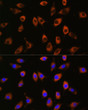


Anti-PPP1R9B antibody (250-350) (STJ119355)
SPECIFICATIONS
ClonalityPolyclonal
HostRabbit
ConjugationUnconjugated
IsotypeIgG
General Information
| Short Description | Rabbit polyclonal PPP1R9B (250-350) antibody for use in WB, IF, ICC and ELISA in human and mouse samples. Datasheet included with dilution recommendations, and related reagents. |
| Applications | WB/IF/ICC/ELISA |
| Host | Rabbit |
| Reactivity | Human/Mouse |
| Note | STRICTLY FOR FURTHER SCIENTIFIC RESEARCH USE ONLY (RUO). MUST NOT TO BE USED IN DIAGNOSTIC OR THERAPEUTIC APPLICATIONS. |
Product Properties
| Clonality | Polyclonal |
| Isotype | IgG |
| Conjugation | Unconjugated |
| Concentration | Lot specific |
| Purification | Affinity purification |
| Dilution Range | WB:1:500-1:2000IF/ICC:1:50-1:200ELISA:Recommended starting concentration is 1 Mu g/mL. Please optimize the concentration based on your specific assay requirements. |
| Formulation | PBS with 0.01% Thimerosal, 50% Glycerol, pH 7.3. |
| Storage Instruction | Store at-20°C for up to 1 year from the date of receipt, and avoid repeat freeze-thaw cycles. |
Target Information
| Gene Symbol | PPP1R9B |
| Gene ID | 84687 |
| Uniprot ID | NEB2_HUMAN |
| Immunogen Region | 250-350 |
| Immunogen Sequence | VFQPPPPPPPAPSGDAPAEK ERCPAGQQPPQHRVAPARPP PKPREVRKIKPVEVEESGES EAESAPGEVIQAEVTVHAAL ENGSTVATAASPAPEEPKAQ A |
| Specificity | A synthetic peptide corresponding to a sequence within amino acids 250-350 of human PPP1R9B (NP_115984.3). |
Additional Info
| Post Translational Modifications | Stimulation of D1 (but not D2) dopamine receptors induces Ser-94 phosphorylation. Dephosphorylation of Ser-94 is mediated mainly by PP1 and to a lesser extent by PP2A. Phosphorylation of spinophilin disrupts its association with F-actin, but does not affect its binding to PP1. |
| Function | Seems to act as a scaffold protein in multiple signaling pathways. Modulates excitatory synaptic transmission and dendritic spine morphology. Binds to actin filaments (F-actin) and shows cross-linking activity. Binds along the sides of the F-actin. May play an important role in linking the actin cytoskeleton to the plasma membrane at the synaptic junction. Believed to target protein phosphatase 1/PP1 to dendritic spines, which are rich in F-actin, and regulates its specificity toward ion channels and other substrates, such as AMPA-type and NMDA-type glutamate receptors. Plays a role in regulation of G-protein coupled receptor signaling, including dopamine D2 receptors and alpha-adrenergic receptors. May establish a signaling complex for dopaminergic neurotransmission through D2 receptors by linking receptors downstream signaling molecules and the actin cytoskeleton. Binds to ADRA1B and RGS2 and mediates regulation of ADRA1B signaling. May confer to Rac signaling specificity by binding to both, RacGEFs and Rac effector proteins. Probably regulates p70 S6 kinase activity by forming a complex with TIAM1. Required for hepatocyte growth factor (HGF)-induced cell migration. |
| Protein Name | Neurabin-2Neurabin-IiProtein Phosphatase 1 Regulatory Subunit 9bSpinophilin |
| Database Links | |
| Cellular Localisation | CytoplasmCytoskeletonNucleusCell ProjectionDendritic SpinePostsynaptic DensitySynapseCell JunctionAdherens JunctionCell MembraneLamellipodiumFilopodiumRuffle MembraneEnriched At Synapse And Cadherin-Based Cell-Cell Adhesion SitesIn NeuronsBoth Cytosolic And Membrane-AssociatedAnd Highly Enriched In The Postsynaptic Density Apposed To Exitatory SynapsesColocalizes With Ppp1r2 At Actin-Rich Adherens Junctions In Epithelial Cells And In Dendritic SpinesAccumulates In The LamellipodiumFilopodium And Ruffle Membrane In Response To Hepatocyte Growth Factor (Hgf) Treatment |
| Alternative Antibody Names | Anti-Neurabin-2 antibodyAnti-Neurabin-Ii antibodyAnti-Protein Phosphatase 1 Regulatory Subunit 9b antibodyAnti-Spinophilin antibodyAnti-PPP1R9B antibodyAnti-PPP1R6 antibody |
Information sourced from Uniprot.org