
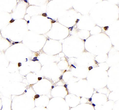
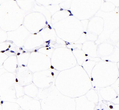


Anti-PPAR gamma antibody [SM0440] (STJA0010440)
SPECIFICATIONS
ClonalityMonoclonal
HostMouse
ConjugationUnconjugated
IsotypeIgG
ImmunogenRecombinant protein corresponding to Mouse PPAR Gamma
General Information
| Short Description | Mouse monoclonal anti-PPAR gamma for use in IHC and IF in Mouse and Rat samples. Datasheet included with dilution recommendations, and related reagents. |
| Applications | IHC/IF |
| Host | Mouse |
| Reactivity | Mouse/Rat |
| Note | STRICTLY FOR FURTHER SCIENTIFIC RESEARCH USE ONLY (RUO). MUST NOT TO BE USED IN DIAGNOSTIC OR THERAPEUTIC APPLICATIONS. |
Product Properties
| Clonality | Monoclonal |
| Clone ID | SM0440 |
| Isotype | IgG |
| Conjugation | Unconjugated |
| Purification | Affinity purification |
| Dilution Range | IHC/IF (M, R) 1:500-1:2000 |
| Storage Instruction | Store at-20C for up to one year, and avoid repeated freeze-thaw cycles. |
Target Information
| Gene Symbol | Pparg |
| Gene ID | 19016 |
| Uniprot ID | PPARG_MOUSE |
| Immunogen | Recombinant protein corresponding to Mouse PPAR Gamma |
Additional Info
| Post Translational Modifications | O-GlcNAcylation at Thr-84 reduces transcriptional activity in adipocytes. Phosphorylated in basal conditions and dephosphorylated when treated with the ligand. May be dephosphorylated by PPP5C. The phosphorylated Ser-112 form is recognized by PER2 and repressed, dephosphorylation at Ser-112 induces adipogenic activity. Ser-112 phosphorylation levels are reduced by 65% in brown adipose tissue compared to white adipose tissue. Ubiquitinated by E3 ubiquitin-protein ligase complex containing FBXO9.leading to proteasomal degradation. Ubiquitinated by E3 ubiquitin-protein ligase complex containing FBXO9.leading to proteasomal degradation. Ubiquitinated at Lys-252 by TRIM55 leading to proteasomal degradation. Ubiquitinated by E3 ubiquitin-protein ligase STUB1/CHIP.leading to proteasomal degradation. |
| Function | Nuclear receptor that binds peroxisome proliferators such as hypolipidemic drugs and fatty acids. Once activated by a ligand, the nuclear receptor binds to DNA specific PPAR response elements (PPRE) and modulates the transcription of its target genes, such as acyl-CoA oxidase. It therefore controls the peroxisomal beta-oxidation pathway of fatty acids. Key regulator of adipocyte differentiation and glucose homeostasis. ARF6 acts as a key regulator of the tissue-specific adipocyte P2 (aP2) enhancer. Acts as a critical regulator of gut homeostasis by suppressing NF-kappa-B-mediated pro-inflammatory responses. Plays a role in the regulation of cardiovascular circadian rhythms by regulating the transcription of BMAL1 in the blood vessels. |
| Protein Name | Peroxisome Proliferator-Activated Receptor GammaPpar-GammaNuclear Receptor Subfamily 1 Group C Member 3 |
| Database Links | Reactome: R-MMU-381340Reactome: -MMU-383280Reactome: -MMU-9841922 |
| Cellular Localisation | NucleusCytoplasmRedistributed From The Nucleus To The Cytosol Through A Map2k1/Mek1-Dependent MannerNoct Enhances Its Nuclear Translocation |
| Alternative Antibody Names | Anti-Peroxisome Proliferator-Activated Receptor Gamma antibodyAnti-Ppar-Gamma antibodyAnti-Nuclear Receptor Subfamily 1 Group C Member 3 antibodyAnti-Pparg antibodyAnti-Nr1c3 antibody |
Information sourced from Uniprot.org