

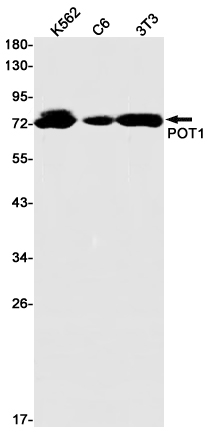

Anti-POT1 antibody [R06-9I1] (STJA0034744)
SPECIFICATIONS
ClonalityMonoclonal
HostRabbit
ConjugationUnconjugated
IsotypeIgG
ImmunogenA synthetic peptide of human POT1
General Information
| Short Description | Rabbit monoclonal anti-POT1 for use in WB in Human, Mouse and Rat samples. Datasheet included with dilution recommendations, and related reagents. |
| Applications | WB |
| Host | Rabbit |
| Reactivity | Human/Mouse/Rat |
| Note | STRICTLY FOR FURTHER SCIENTIFIC RESEARCH USE ONLY (RUO). MUST NOT TO BE USED IN DIAGNOSTIC OR THERAPEUTIC APPLICATIONS. |
Product Properties
| Clonality | Monoclonal |
| Clone ID | R06-9I1 |
| Isotype | IgG |
| Conjugation | Unconjugated |
| Concentration | 0.3 mg/mL |
| Purification | Affinity Purified |
| Dilution Range | WB 1:500-1:1000 |
| Formulation | 50mM Tris-Glycine (pH 7.4) , 0.15M NaCl, 40% Glycerol, 0.01% Sodium azide and 0.05% BSA |
| Storage Instruction | Store at 4°C short term. Aliquot and store at-20°C long term. Avoid freeze/thaw cycles. |
Target Information
| Gene Symbol | POT1 |
| Gene ID | 25913 |
| Uniprot ID | POTE1_HUMAN |
| Immunogen | A synthetic peptide of human POT1 |
Additional Info
| Tissue Specificity | Ubiquitous. |
| Function | Component of the telomerase ribonucleoprotein (RNP) complex that is essential for the replication of chromosome termini. Is a component of the double-stranded telomeric DNA-binding TRF1 complex which is involved in the regulation of telomere length by cis-inhibition of telomerase. Also acts as a single-stranded telomeric DNA-binding protein and thus may act as a downstream effector of the TRF1 complex and may transduce information about telomere maintenance and/or length to the telomere terminus. Component of the shelterin complex (telosome) that is involved in the regulation of telomere length and protection. Shelterin associates with arrays of double-stranded TTAGGG repeats added by telomerase and protects chromosome ends.without its protective activity, telomeres are no longer hidden from the DNA damage surveillance and chromosome ends are inappropriately processed by DNA repair pathways. Binds to two or more telomeric single-stranded 5'-TTAGGG-3' repeats (G-strand) and with high specificity to a minimal telomeric single-stranded 5'-TAGGGTTAG-3' sequence. Binds telomeric single-stranded sequences internally or at proximity of a 3'-end. Its activity is TERT dependent but it does not increase TERT activity by itself. In contrast, the ACD-POT1 heterodimer enhances telomere elongation by increasing telomerase processivity. |
| Protein Name | Protection Of Telomeres Protein 1Hpot1Pot1-Like Telomere End-Binding Protein |
| Database Links | Reactome: R-HSA-110328Reactome: R-HSA-110329Reactome: R-HSA-110330Reactome: R-HSA-110331Reactome: R-HSA-1221632Reactome: R-HSA-171306Reactome: R-HSA-171319Reactome: R-HSA-174411Reactome: R-HSA-174414Reactome: R-HSA-174417Reactome: R-HSA-174430Reactome: R-HSA-174437Reactome: R-HSA-2559586Reactome: R-HSA-9670095 |
| Cellular Localisation | NucleusChromosomeTelomereColocalizes With Telomeric Dna |
| Alternative Antibody Names | Anti-Protection Of Telomeres Protein 1 antibodyAnti-Hpot1 antibodyAnti-Pot1-Like Telomere End-Binding Protein antibodyAnti-POT1 antibody |
Information sourced from Uniprot.org