
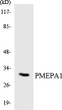
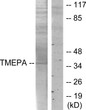


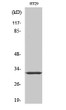
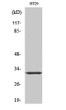


Anti-PMEPA1 antibody (101-150 aa) (STJ95165)
SPECIFICATIONS
ClonalityPolyclonal
HostRabbit
ConjugationUnconjugated
IsotypeIgG
ImmunogenThe antiserum was produced against synthesized peptide derived from the human TMEPA at the amino acid range 101-150
General Information
| Short Description | Rabbit polyclonal anti-Protein TMEPAI (101-150 aa) for use in WB, IHC, IF and ELISA in Human, Rat and Mouse samples. Datasheet included with dilution recommendations, and related reagents. |
| Applications | WB/IHC/IF/ELISA |
| Host | Rabbit |
| Reactivity | Human/Rat/Mouse |
| Note | STRICTLY FOR FURTHER SCIENTIFIC RESEARCH USE ONLY (RUO). MUST NOT TO BE USED IN DIAGNOSTIC OR THERAPEUTIC APPLICATIONS. |
Product Properties
| Clonality | Polyclonal |
| Isotype | IgG |
| Conjugation | Unconjugated |
| Concentration | 1 mg/mL |
| Purification | The antibody was affinity-purified from rabbit antiserum by affinity-chromatography using epitope-specific immunogen. |
| Dilution Range | WB 1:500-1:2000IHC 1:100-1:300IF 1:200-1:1000ELISA 1:20000 |
| Formulation | Liquid in PBS containing 50% Glycerol, 0.5% BSA and 0.02% Sodium Azide. |
| Storage Instruction | Store at-20°C for up to 1 year from the date of receipt, and avoid repeat freeze-thaw cycles. |
Target Information
| Gene Symbol | PMEPA1 |
| Gene ID | 56937 |
| Uniprot ID | PMEPA_HUMAN |
| Immunogen | The antiserum was produced against synthesized peptide derived from the human TMEPA at the amino acid range 101-150 |
| Immunogen Region | 101-150 aa |
| Specificity | PMEPA1 Polyclonal Antibody detects endogenous levels of PMEPA1 protein. |
Additional Info
| Function | Functions as a negative regulator of TGF-beta signaling and thereby probably plays a role in cell proliferation, differentiation, apoptosis, motility, extracellular matrix production and immunosuppression. In the canonical TGF-beta pathway, ZFYVE9/SARA recruits the intracellular signal transducer and transcriptional modulators SMAD2 and SMAD3 to the TGF-beta receptor. Phosphorylated by the receptor, SMAD2 and SMAD3 then form a heteromeric complex with SMAD4 that translocates to the nucleus to regulate transcription. Through interaction with SMAD2 and SMAD3, LDLRAD4 may compete with ZFYVE9 and SMAD4 and prevent propagation of the intracellular signal. Also involved in down-regulation of the androgen receptor (AR), enhancing ubiquitination and proteasome-mediated degradation of AR, probably by recruiting NEDD4. |
| Protein Name | Protein TmepaiProstate Transmembrane Protein Androgen Induced 1Solid Tumor-Associated 1 ProteinTransmembrane Prostate Androgen-Induced Protein |
| Database Links | Reactome: R-HSA-2173788 |
| Cellular Localisation | Early Endosome MembraneSingle-Pass Membrane ProteinGolgi Apparatus Membrane |
| Alternative Antibody Names | Anti-Protein Tmepai antibodyAnti-Prostate Transmembrane Protein Androgen Induced 1 antibodyAnti-Solid Tumor-Associated 1 Protein antibodyAnti-Transmembrane Prostate Androgen-Induced Protein antibodyAnti-PMEPA1 antibodyAnti-STAG1 antibodyAnti-TMEPAI antibody |
Information sourced from Uniprot.org