

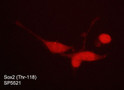


Anti-Phospho-Sox2-Thr-118 antibody (STJA0041412)
SPECIFICATIONS
ClonalityPolyclonal
HostRabbit
ConjugationUnconjugated
IsotypeIgG
ImmunogenPhospho-Sox2 (Thr-118) synthetic peptide (coupled to carrier) corresponding to amino acids surrounding Thr-118 in mouse Sox2. This site is well conserved in rat and human Sox2, and has high homology with the conserved site in Sox1 (Thr-126) and Sox3
General Information
| Short Description | Rabbit polyclonal anti-Phospho-Sox2-Thr-118 for use in ELISA, WB and ICC in Chicken, Human, Mouse, Rat and Xenopus samples. Datasheet included with dilution recommendations, and related reagents. |
| Applications | ELISA/WB/ICC |
| Host | Rabbit |
| Reactivity | Chicken/Human/Mouse/Rat/Xenopus |
| Note | STRICTLY FOR FURTHER SCIENTIFIC RESEARCH USE ONLY (RUO). MUST NOT TO BE USED IN DIAGNOSTIC OR THERAPEUTIC APPLICATIONS. |
Product Properties
| Clonality | Polyclonal |
| Isotype | IgG |
| Conjugation | Unconjugated |
| Purification | Antigen Affinity Purified |
| Dilution Range | WB 1:1000ICC 1:50 |
| Formulation | PBS + 1 mg/ml BSA, 0.05% NaN3 and 50% glycerol |
| Storage Instruction | Storage at-20°C is recommended, as aliquots may be taken without freeze/thawing due to presence of 50% glycerol. Stable for at least 1 year at-20°C. |
Target Information
| Gene Symbol | Sox2 |
| Gene ID | 20674 |
| Uniprot ID | SOX2_MOUSE |
| Immunogen | Phospho-Sox2 (Thr-118) synthetic peptide (coupled to carrier) corresponding to amino acids surrounding Thr-118 in mouse Sox2. This site is well conserved in rat and human Sox2, and has high homology with the conserved site in Sox1 (Thr-126) and Sox3 |
| Immunogen Sequence | Mouse |
| Specificity | The antibody was cross adsorbed to unphosphorylated Sox2 (Thr-118) peptide before affinity purification using phospho-Sox2 (Thr-118) peptide. This antibody antibody detects a 34 kDa* protein on SDS-PAGE immunoblots of mouse F9 stem cells. This reacti |
Additional Info
| Tissue Specificity | Expressed in the cochlea (at protein level). Expressed in the brain and retina. A very low level of expression is seen in the stomach and lung. Expressed in the kidney. |
| Post Translational Modifications | Sumoylation inhibits binding on DNA and negatively regulates the FGF4 transactivation. Methylation at Lys-44 and Lys-119 is necessary for the regulation of SOX2 proteasomal degradation. Ubiquitinated by WWP2, leading to proteasomal degradation. |
| Function | Transcription factor that forms a trimeric complex with POU5F1 (OCT3/4) on DNA and controls the expression of a number of genes involved in embryonic development such as YES1, FGF4, UTF1 and ZFP206. Binds to the proximal enhancer region of NANOG. Critical for early embryogenesis and for embryonic stem cell pluripotency. Downstream SRRT target that mediates the promotion of neural stem cell self-renewal. Keeps neural cells undifferentiated by counteracting the activity of proneural proteins and suppresses neuronal differentiation. May function as a switch in neuronal development. |
| Protein Name | Transcription Factor Sox-2 |
| Database Links | Reactome: R-MMU-3769402 |
| Cellular Localisation | NucleusCytoplasmNuclear Import Is Facilitated By Xpo4A Protein That Usually Acts As A Nuclear Export Signal Receptor |
| Alternative Antibody Names | Anti-Transcription Factor Sox-2 antibodyAnti-Sox2 antibodyAnti-Sox-2 antibody |
Information sourced from Uniprot.org