

Anti-Phospho-Prion Protein-Ser-43 antibody (STJA0041349)
SPECIFICATIONS
ClonalityPolyclonal
HostRabbit
ConjugationUnconjugated
IsotypeIgG
ImmunogenPrion Protein (Ser-43) antibody was generated from a phospho-peptide that included amino acids surrounding Serine 43 in human prion protein. This sequence has high homology to the conserved site in rat, mouse, and bovine prion protein.
General Information
| Short Description | Rabbit polyclonal anti-Phospho-Prion Protein-Ser-43 for use in ELISA and WB in Human, Mouse and Rat samples. Datasheet included with dilution recommendations, and related reagents. |
| Applications | ELISA/WB |
| Host | Rabbit |
| Reactivity | Human/Mouse/Rat |
| Note | STRICTLY FOR FURTHER SCIENTIFIC RESEARCH USE ONLY (RUO). MUST NOT TO BE USED IN DIAGNOSTIC OR THERAPEUTIC APPLICATIONS. |
Product Properties
| Clonality | Polyclonal |
| Isotype | IgG |
| Conjugation | Unconjugated |
| Purification | Antigen Affinity Purified |
| Dilution Range | WB 1:1000 |
| Formulation | PBS + 1 mg/ml BSA, 0.05% NaN3 and 50% glycerol |
| Storage Instruction | Storage at-20°C is recommended, as aliquots may be taken without freeze/thawing due to presence of 50% glycerol. Stable for at least 1 year at-20°C. |
Target Information
| Gene Symbol | PRNP |
| Gene ID | 5621 |
| Uniprot ID | PRIO_HUMAN |
| Immunogen | Prion Protein (Ser-43) antibody was generated from a phospho-peptide that included amino acids surrounding Serine 43 in human prion protein. This sequence has high homology to the conserved site in rat, mouse, and bovine prion protein. |
| Immunogen Sequence | Human |
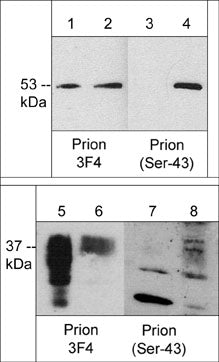
| Specificity | The antibody detects a human recombinant Prion protein after phosphorylation by Cdk5/p25 complex. In addition, the antibody may detect aggregrated forms of prion in human PC3 cells treated with Calyculin A. |
Additional Info
| Post Translational Modifications | The glycosylation pattern (the amount of mono-, di- and non-glycosylated forms or glycoforms) seems to differ in normal and CJD prion. |
| Function | Its primary physiological function is unclear. May play a role in neuronal development and synaptic plasticity. May be required for neuronal myelin sheath maintenance. May promote myelin homeostasis through acting as an agonist for ADGRG6 receptor. May play a role in iron uptake and iron homeostasis. Soluble oligomers are toxic to cultured neuroblastoma cells and induce apoptosis (in vitro). Association with GPC1 (via its heparan sulfate chains) targets PRNP to lipid rafts. Also provides Cu(2+) or Zn(2+) for the ascorbate-mediated GPC1 deaminase degradation of its heparan sulfate side chains. |
| Protein Name | Major Prion ProteinPrpAscrPrp27-30Prp33-35cCd Antigen Cd230 |
| Database Links | Reactome: R-HSA-419037Reactome: R-HSA-9609523 |
| Cellular Localisation | Cell MembraneLipid-AnchorGpi-AnchorGolgi ApparatusTargeted To Lipid Rafts Via Association With The Heparan Sulfate Chains Of Gpc1ColocatesIn The Presence Of Cu(2+)To Vesicles In Para- And Perinuclear RegionsWhere Both Proteins Undergo InternalizationHeparin Displaces Prnp From Lipid Rafts And Promotes Endocytosis |
| Alternative Antibody Names | Anti-Major Prion Protein antibodyAnti-Prp antibodyAnti-Ascr antibodyAnti-Prp27-30 antibodyAnti-Prp33-35c antibodyAnti-Cd Antigen Cd230 antibodyAnti-PRNP antibodyAnti-ALTPRP antibodyAnti-PRIP antibodyAnti-PRP antibody |
Information sourced from Uniprot.org