


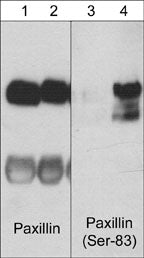

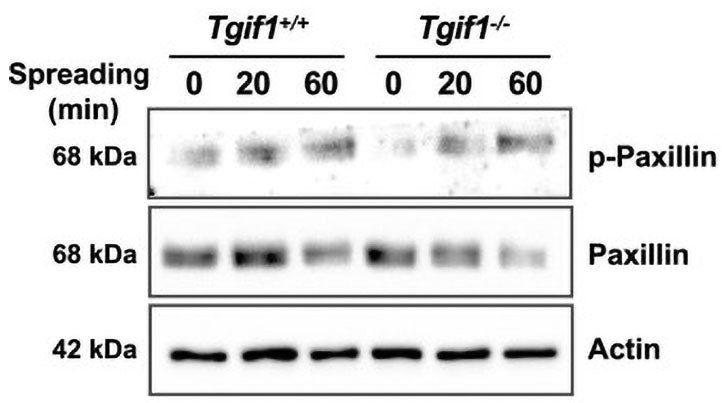

Anti-Phospho-Paxillin-Ser-83 antibody (STJA0041331)
SPECIFICATIONS
ClonalityPolyclonal
HostRabbit
ConjugationUnconjugated
IsotypeIgG
ImmunogenPhospho-Paxillin (Ser-83) synthetic peptide (coupled to KLH) corresponding to amino acid residues around serine 83 of mouse paxillin. This sequence is highly conserved in rat and human paxillin and is also found in all isoforms (a, b, g) of paxillin.
General Information
| Short Description | Rabbit polyclonal anti-Phospho-Paxillin-Ser-83 for use in ELISA, WB and ICC in Rat and Mouse samples. Datasheet included with dilution recommendations, and related reagents. |
| Applications | ELISA/WB/ICC |
| Host | Rabbit |
| Reactivity | Rat/Mouse |
| Note | STRICTLY FOR FURTHER SCIENTIFIC RESEARCH USE ONLY (RUO). MUST NOT TO BE USED IN DIAGNOSTIC OR THERAPEUTIC APPLICATIONS. |
Product Properties
| Clonality | Polyclonal |
| Isotype | IgG |
| Conjugation | Unconjugated |
| Purification | Antigen Affinity Purified |
| Dilution Range | WB 1:1000ICC 1:50 |
| Formulation | PBS + 1 mg/ml BSA, 0.05% NaN3 and 50% glycerol |
| Storage Instruction | Storage at-20°C is recommended, as aliquots may be taken without freeze/thawing due to presence of 50% glycerol. Stable for at least 1 year at-20°C. |
Target Information
| Gene Symbol | Pxn |
| Gene ID | 19303 |
| Uniprot ID | PAXI_MOUSE |
| Immunogen | Phospho-Paxillin (Ser-83) synthetic peptide (coupled to KLH) corresponding to amino acid residues around serine 83 of mouse paxillin. This sequence is highly conserved in rat and human paxillin and is also found in all isoforms (a, b, g) of paxillin. |
| Immunogen Sequence | Mouse |
| Specificity | The antibody detects a 68kDa* protein corresponding to the molecular mass of phosphorylated paxillin on SDS-PAGE immunoblots of NGF treated rat PC12 cells, as well as calyculin A treated human A431 cells and mouse macrophages. |
Additional Info
| Post Translational Modifications | Phosphorylated by MAPK1/ERK2. Phosphorylated on tyrosine residues during integrin-mediated cell adhesion, embryonic development, fibroblast transformation and following stimulation of cells by mitogens. Phosphorylation at Ser-244 by CDK5 reduces its interaction with PTK2/FAK1 in matrix-cell focal adhesions (MCFA) during oligodendrocytes (OLs) differentiation. Phosphorylation at Tyr-31 and Tyr-118 by PTK6 promote the activation of RAC1 via CRK/CrKII, thereby promoting migration and invasion. Phosphorylation at Ser-250 by SLK is required for PXN redistribution and cell motility. Phosphorylation at Ser-272 promotes focal adhesion disassembly during cell migration. |
| Function | Cytoskeletal protein involved in actin-membrane attachment at sites of cell adhesion to the extracellular matrix (focal adhesion). Recruits other proteins such as TRIM15 to focal adhesion. |
| Protein Name | Paxillin |
| Database Links | Reactome: R-MMU-180292Reactome: -MMU-4420097Reactome: -MMU-445355Reactome: -MMU-446343Reactome: -MMU-446388Reactome: -MMU-8849471 |
| Cellular Localisation | CytoplasmCytoskeletonCell JunctionFocal AdhesionCell CortexColocalizes With Integrins At The Cell PeripheryColocalizes With Pxn To Membrane Ruffles And The Leading Edge Of Migrating Cells |
| Alternative Antibody Names | Anti-Paxillin antibodyAnti-Pxn antibody |
Information sourced from Uniprot.org