

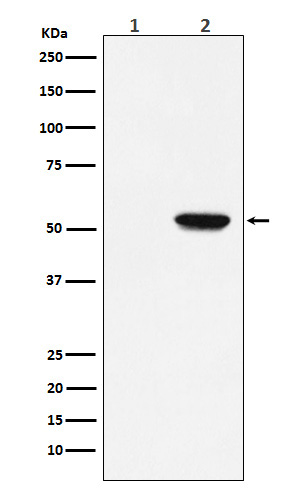

Anti-Phospho-MLKL-Ser358 antibody [R02-2I5] (STJA0036596)
SPECIFICATIONS
ClonalityMonoclonal
HostRabbit
ConjugationUnconjugated
IsotypeIgG
ImmunogenA synthesized peptide derived from human Phospho-MLKL (S358)
General Information
| Short Description | Rabbit monoclonal anti-Phospho-MLKL-Ser358 for use in WB and IHC-P in Human samples. Datasheet included with dilution recommendations, and related reagents. |
| Applications | WB/IHC-P |
| Host | Rabbit |
| Reactivity | Human |
| Note | STRICTLY FOR FURTHER SCIENTIFIC RESEARCH USE ONLY (RUO). MUST NOT TO BE USED IN DIAGNOSTIC OR THERAPEUTIC APPLICATIONS. |
Product Properties
| Clonality | Monoclonal |
| Clone ID | R02-2I5 |
| Isotype | IgG |
| Conjugation | Unconjugated |
| Purification | Affinity Chromatography |
| Dilution Range | WB 1:500-1:1000IHC 1:50-1:100 |
| Formulation | Rabbit IgG in phosphate buffered saline, pH 7.4, 150mM NaCl, 0.02% sodium azide and 50% glycerol. |
| Storage Instruction | Store at 4°C short term. Aliquot and store at-20°C long term. Avoid freeze/thaw cycles. |
Target Information
| Gene Symbol | MLKL |
| Gene ID | 197259 |
| Uniprot ID | MLKL_HUMAN |
| Immunogen | A synthesized peptide derived from human Phospho-MLKL (S358) |
Additional Info
| Post Translational Modifications | Phosphorylation by RIPK3 induces a conformational switch that is required for necroptosis. It also induces homotrimerization and localization to the plasma membrane. |
| Function | Pseudokinase that plays a key role in TNF-induced necroptosis, a programmed cell death process. Does not have protein kinase activity. Activated following phosphorylation by RIPK3, leading to homotrimerization, localization to the plasma membrane and execution of programmed necrosis characterized by calcium influx and plasma membrane damage. In addition to TNF-induced necroptosis, necroptosis can also take place in the nucleus in response to orthomyxoviruses infection: following activation by ZBP1, MLKL is phosphorylated by RIPK3 in the nucleus, triggering disruption of the nuclear envelope and leakage of cellular DNA into the cytosol.following ZBP1 activation, which senses double-stranded Z-RNA structures, nuclear RIPK3 catalyzes phosphorylation and activation of MLKL, promoting disruption of the nuclear envelope and leakage of cellular DNA into the cytosol. Binds to highly phosphorylated inositol phosphates such as inositolhexakisphosphate (InsP6) which is essential for its necroptotic function. |
| Protein Name | Mixed Lineage Kinase Domain-Like ProteinHmlkl |
| Database Links | Reactome: R-HSA-3295583Reactome: R-HSA-5213460Reactome: R-HSA-5675482Reactome: R-HSA-9686347 |
| Cellular Localisation | CytoplasmCell MembraneNucleusLocalizes To The Cytoplasm And Translocates To The Plasma Membrane On Necroptosis InductionLocalizes To The Nucleus In Response To Orthomyxoviruses Infection |
| Alternative Antibody Names | Anti-Mixed Lineage Kinase Domain-Like Protein antibodyAnti-Hmlkl antibodyAnti-MLKL antibody |
Information sourced from Uniprot.org