
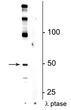
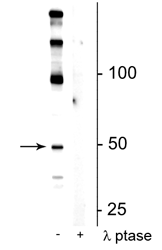

Anti-Phospho-EEF1A2-Ser358 antibody (STJA0003624)
SPECIFICATIONS
ClonalityPolyclonal
HostRabbit
ConjugationUnconjugated
IsotypeIgG
ImmunogenSynthetic phospho-peptide corresponding to amino acid residues surrounding Ser358 conjugated to KLH.
General Information
| Short Description | Rabbit polyclonal anti-Phospho-eEF1A2-Ser358 for use in WB in Human, Mouse, Chicken, Non-Human Primates, Rat, Sheep and Xenopus samples. Datasheet included with dilution recommendations, and related reagents. |
| Applications | WB |
| Host | Rabbit |
| Reactivity | Human/Mouse/Chicken/Non-Human Primates/Rat/Sheep/Xenopus |
| Note | STRICTLY FOR FURTHER SCIENTIFIC RESEARCH USE ONLY (RUO). MUST NOT TO BE USED IN DIAGNOSTIC OR THERAPEUTIC APPLICATIONS. |
Product Properties
| Clonality | Polyclonal |
| Isotype | IgG |
| Conjugation | Unconjugated |
| Purification | This antibody was antigen affinity purified from pooled serum. |
| Dilution Range | WB 1:1000 |
| Formulation | 100 µl in 10 mM HEPES (pH 7.5) , 150 mM NaCl, 100 µg per ml BSA and 50% Glycerol. |
| Storage Instruction | Store at-20°C for up to 1 year from the date of receipt, and avoid repeat freeze-thaw cycles. |
Target Information
| Gene Symbol | EEF1A2 |
| Gene ID | 1917 |
| Uniprot ID | EF1A2_HUMAN |
| Immunogen | Synthetic phospho-peptide corresponding to amino acid residues surrounding Ser358 conjugated to KLH. |
Additional Info
| Tissue Specificity | Brain, heart, and skeletal muscle. |
| Post Translational Modifications | Trimethylated at Lys-165 by EEF1AKMT3. Mono-, di-, and trimethylated at Lys-36 by EEF1AKMT4.trimethylated form is predominant. Methylation by EEF1AKMT4 contributes to the fine-tuning of translation rates for a subset of tRNAs. Trimethylated at the N-terminus by METTL13. Mono- and dimethylated at Lys-55 by METTL13.dimethylated form is predominant. |
| Function | Translation elongation factor that catalyzes the GTP-dependent binding of aminoacyl-tRNA (aa-tRNA) to the A-site of ribosomes during the elongation phase of protein synthesis. Base pairing between the mRNA codon and the aa-tRNA anticodon promotes GTP hydrolysis, releasing the aa-tRNA from EEF1A1 and allowing its accommodation into the ribosome. The growing protein chain is subsequently transferred from the P-site peptidyl tRNA to the A-site aa-tRNA, extending it by one amino acid through ribosome-catalyzed peptide bond formation. |
| Protein Name | Elongation Factor 1-Alpha 2Ef-1-Alpha-2Eukaryotic Elongation Factor 1 A-2Eef1a-2Statin-S1 |
| Database Links | Reactome: R-HSA-156842 |
| Cellular Localisation | Endoplasmic Reticulum Membrane |
| Alternative Antibody Names | Anti-Elongation Factor 1-Alpha 2 antibodyAnti-Ef-1-Alpha-2 antibodyAnti-Eukaryotic Elongation Factor 1 A-2 antibodyAnti-Eef1a-2 antibodyAnti-Statin-S1 antibodyAnti-EEF1A2 antibodyAnti-EEF1AL antibodyAnti-STN antibody |
Information sourced from Uniprot.org