
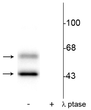


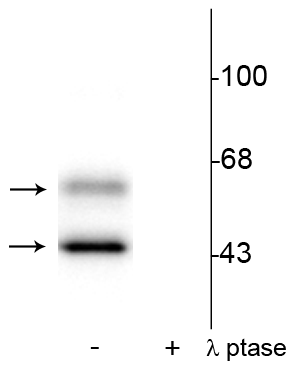
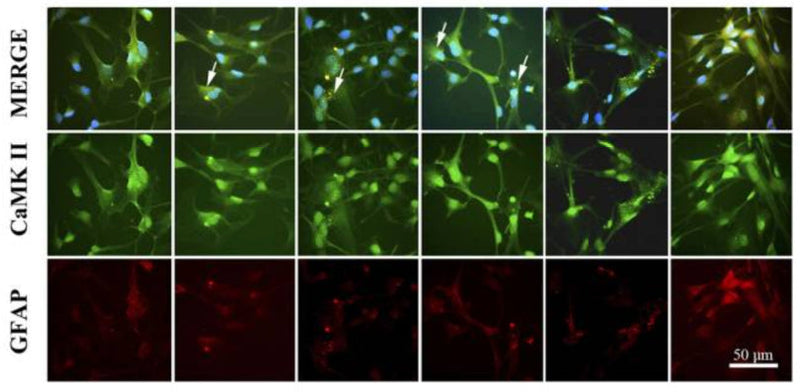


Anti-Phospho-CAMK2A/B-Thr286 antibody (STJA0003589)
SPECIFICATIONS
ClonalityPolyclonal
HostRabbit
ConjugationUnconjugated
IsotypeIgG
ImmunogenSynthetic phospho-peptide corresponding to amino acid residues surrounding Thr286 conjugated to KLH.
General Information
| Short Description | Rabbit polyclonal anti-Phospho-CaM Kinase II-Thr286 for use in WB and IHC in Human, Mouse, Rabbit, Rat and Zebrafish samples. Datasheet included with dilution recommendations, and related reagents. |
| Applications | WB/IHC |
| Host | Rabbit |
| Reactivity | Human/Mouse/Rabbit/Rat/Zebrafish |
| Note | STRICTLY FOR FURTHER SCIENTIFIC RESEARCH USE ONLY (RUO). MUST NOT TO BE USED IN DIAGNOSTIC OR THERAPEUTIC APPLICATIONS. |
Product Properties
| Clonality | Polyclonal |
| Isotype | IgG |
| Conjugation | Unconjugated |
| Purification | This antibody was antigen affinity purified from pooled serum. |
| Dilution Range | WB 1:1000IHC 1:1000 |
| Formulation | 100 µl in 10 mM HEPES (pH 7.5) , 150 mM NaCl, 100 µg per ml BSA and 50% Glycerol. |
| Storage Instruction | Store at-20°C for up to 1 year from the date of receipt, and avoid repeat freeze-thaw cycles. |
Target Information
| Gene Symbol | Camk2a |
| Gene ID | 25400 |
| Uniprot ID | KCC2A_RAT |
| Immunogen | Synthetic phospho-peptide corresponding to amino acid residues surrounding Thr286 conjugated to KLH. |
Additional Info
| Post Translational Modifications | Autophosphorylation of Thr-286 following activation by Ca(2+)/calmodulin. Phosphorylation of Thr-286 locks the kinase into an activated state. Palmitoylated. Probably palmitoylated by ZDHHC3 and ZDHHC7. |
| Function | Calcium/calmodulin-dependent protein kinase that functions autonomously after Ca(2+)/calmodulin-binding and autophosphorylation, and is involved in various processes, such as synaptic plasticity, neurotransmitter release and long-term potentiation. Member of the NMDAR signaling complex in excitatory synapses, it regulates NMDAR-dependent potentiation of the AMPAR and therefore excitatory synaptic transmission. Regulates dendritic spine development. Also regulates the migration of developing neurons. Phosphorylates the transcription factor FOXO3 to activate its transcriptional activity. Phosphorylates the transcription factor ETS1 in response to calcium signaling, thereby decreasing ETS1 affinity for DNA. In response to interferon-gamma (IFN-gamma) stimulation, catalyzes phosphorylation of STAT1, stimulating the JAK-STAT signaling pathway. In response to interferon-beta (IFN-beta) stimulation, stimulates the JAK-STAT signaling pathway. Acts as a negative regulator of 2-arachidonoylglycerol (2-AG)-mediated synaptic signaling via modulation of DAGLA activity. |
| Protein Name | Calcium/Calmodulin-Dependent Protein Kinase Type Ii Subunit AlphaCam Kinase Ii Subunit AlphaCamk-Ii Subunit Alpha |
| Database Links | Reactome: R-RNO-3371571Reactome: -RNO-399719Reactome: -RNO-4086398Reactome: -RNO-438066Reactome: -RNO-5578775Reactome: -RNO-5673000Reactome: -RNO-5673001Reactome: -RNO-877300Reactome: -RNO-936837 |
| Cellular Localisation | SynapsePostsynaptic DensityCell ProjectionDendritic SpineDendritePostsynaptic Lipid Rafts |
| Alternative Antibody Names | Anti-Calcium/Calmodulin-Dependent Protein Kinase Type Ii Subunit Alpha antibodyAnti-Cam Kinase Ii Subunit Alpha antibodyAnti-Camk-Ii Subunit Alpha antibodyAnti-Camk2a antibody |
Information sourced from Uniprot.org