


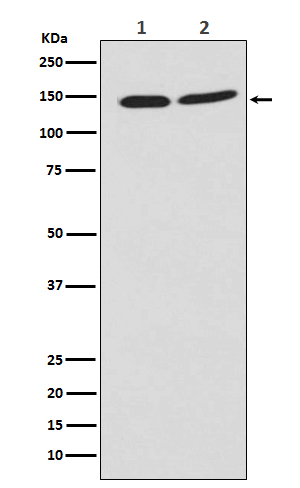
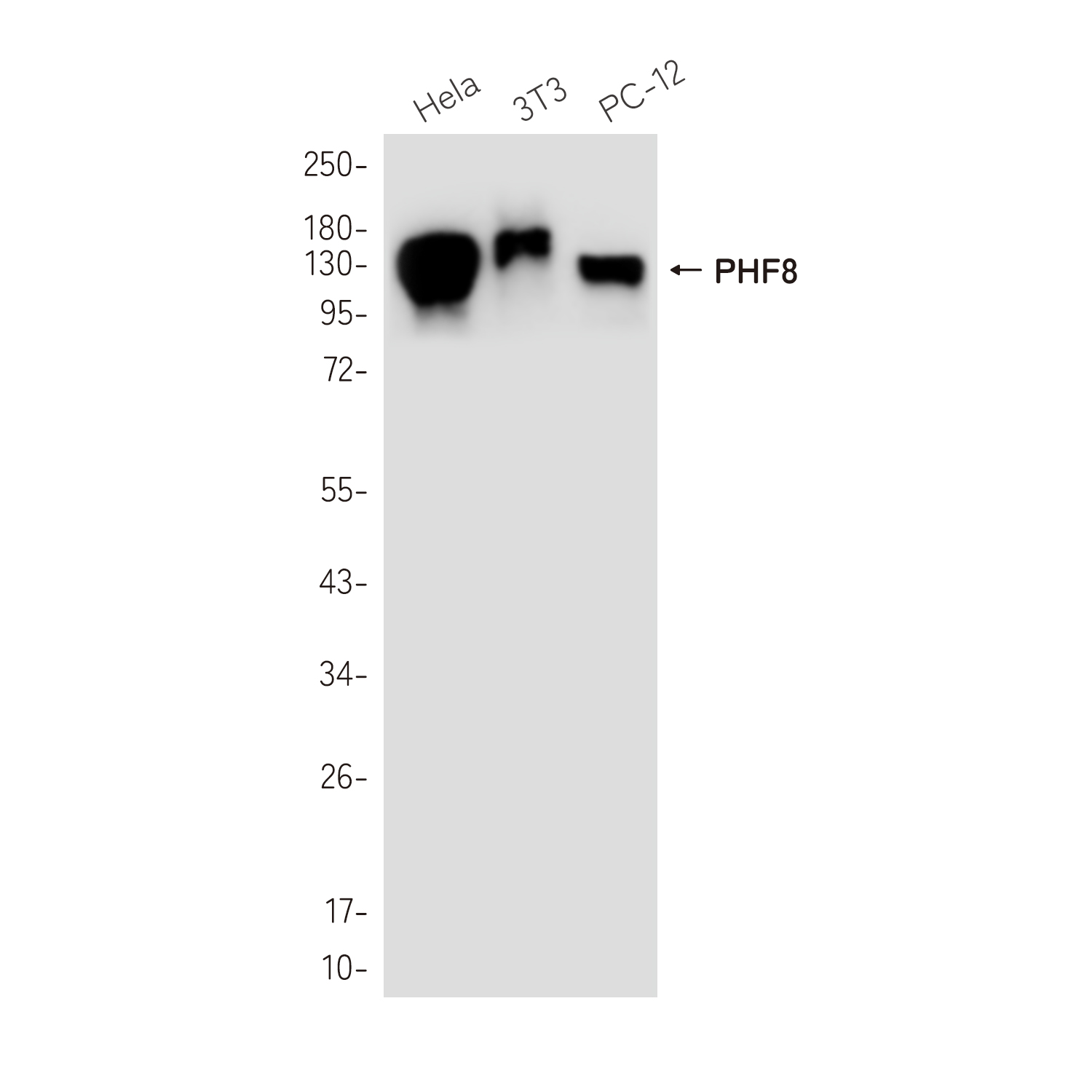

Anti-PHF8 antibody [R08-1C9] (STJA0036568)
SPECIFICATIONS
ClonalityMonoclonal
HostRabbit
ConjugationUnconjugated
IsotypeIgG
ImmunogenA synthesized peptide derived from human PHF8
General Information
| Short Description | Rabbit monoclonal anti-PHF8 for use in WB, ICC, IF and IP in Human, Mouse and Rat samples. Datasheet included with dilution recommendations, and related reagents. |
| Applications | WB/ICC/IF/IP |
| Host | Rabbit |
| Reactivity | Human/Mouse/Rat |
| Note | STRICTLY FOR FURTHER SCIENTIFIC RESEARCH USE ONLY (RUO). MUST NOT TO BE USED IN DIAGNOSTIC OR THERAPEUTIC APPLICATIONS. |
Product Properties
| Clonality | Monoclonal |
| Clone ID | R08-1C9 |
| Isotype | IgG |
| Conjugation | Unconjugated |
| Purification | Affinity Chromatography |
| Dilution Range | WB 1:500-1:1000IF 1:50-1:200IP 1:70 |
| Formulation | Rabbit IgG in phosphate buffered saline, pH 7.4, 150mM NaCl, 0.02% sodium azide and 50% glycerol. |
| Storage Instruction | Store at 4°C short term. Aliquot and store at-20°C long term. Avoid freeze/thaw cycles. |
Target Information
| Gene Symbol | PHF8 |
| Gene ID | 23133 |
| Uniprot ID | PHF8_HUMAN |
| Immunogen | A synthesized peptide derived from human PHF8 |
Additional Info
| Post Translational Modifications | Phosphorylation at Ser-69 and Ser-120 are required for dissociation from chromatin and accumulation of H4K20Me1 levels during prophase. |
| Function | Histone lysine demethylase with selectivity for the di- and monomethyl states that plays a key role cell cycle progression, rDNA transcription and brain development. Demethylates mono- and dimethylated histone H3 'Lys-9' residue (H3K9Me1 and H3K9Me2), dimethylated H3 'Lys-27' (H3K27Me2) and monomethylated histone H4 'Lys-20' residue (H4K20Me1). Acts as a transcription activator as H3K9Me1, H3K9Me2, H3K27Me2 and H4K20Me1 are epigenetic repressive marks. Involved in cell cycle progression by being required to control G1-S transition. Acts as a coactivator of rDNA transcription, by activating polymerase I (pol I) mediated transcription of rRNA genes. Required for brain development, probably by regulating expression of neuron-specific genes. Only has activity toward H4K20Me1 when nucleosome is used as a substrate and when not histone octamer is used as substrate. May also have weak activity toward dimethylated H3 'Lys-36' (H3K36Me2), however, the relevance of this result remains unsure in vivo. Specifically binds trimethylated 'Lys-4' of histone H3 (H3K4me3), affecting histone demethylase specificity: has weak activity toward H3K9Me2 in absence of H3K4me3, while it has high activity toward H3K9me2 when binding H3K4me3. Positively modulates transcription of histone demethylase KDM5C, acting synergistically with transcription factor ARX.synergy may be related to enrichment of histone H3K4me3 in regulatory elements. |
| Protein Name | Histone Lysine Demethylase Phf8Phd Finger Protein 8Histone H3-Dimethyl-L-Lysine(36 Demethylase Phf8Histone H3-Dimethyl-L-Lysine(9 Demethylase Phf8 |
| Database Links | Reactome: R-HSA-2299718Reactome: R-HSA-3214842 |
| Cellular Localisation | NucleusNucleolusRecruited To H3k4me3 Sites On Chromatin During InterphaseDissociates From Chromatin When Cells Enter Mitosis |
| Alternative Antibody Names | Anti-Histone Lysine Demethylase Phf8 antibodyAnti-Phd Finger Protein 8 antibodyAnti-Histone H3-Dimethyl-L-Lysine(36 Demethylase Phf8 antibodyAnti-Histone H3-Dimethyl-L-Lysine(9 Demethylase Phf8 antibodyAnti-PHF8 antibodyAnti-KIAA1111 antibodyAnti-ZNF422 antibody |
Information sourced from Uniprot.org