


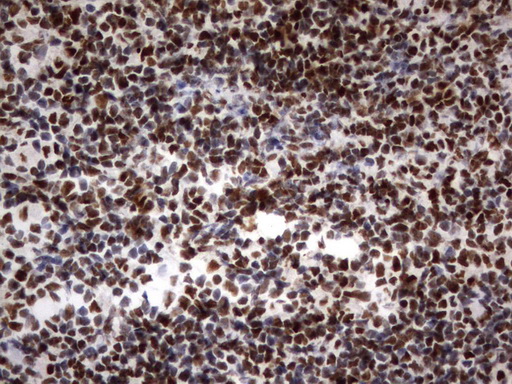
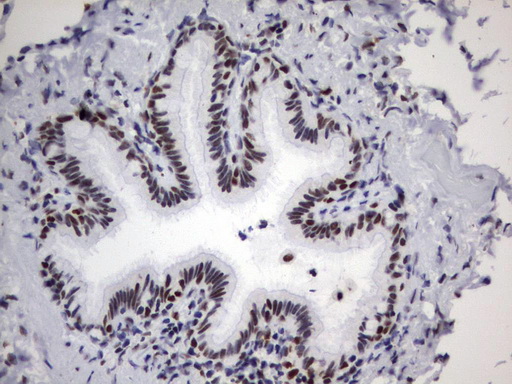

Anti-PARN antibody [ZN143] (STJA0033319)
SPECIFICATIONS
ClonalityMonoclonal
HostMouse
ConjugationUnconjugated
IsotypeIgG2a
ImmunogenHuman recombinant protein fragment of human PARN (NP_002573) produced in E.coli.
General Information
| Short Description | Mouse monoclonal anti-PARN for use in IHC-P in Human samples. Datasheet included with dilution recommendations, and related reagents. |
| Applications | IHC-P |
| Host | Mouse |
| Reactivity | Human |
| Note | STRICTLY FOR FURTHER SCIENTIFIC RESEARCH USE ONLY (RUO). MUST NOT TO BE USED IN DIAGNOSTIC OR THERAPEUTIC APPLICATIONS. |
Product Properties
| Clonality | Monoclonal |
| Clone ID | ZN143 |
| Isotype | IgG2a |
| Conjugation | Unconjugated |
| Concentration | 0.5-1.0 mg/mL |
| Purification | Affinity Chromatography |
| Dilution Range | IHC 1:50-1:100 |
| Formulation | PBS (PH 7.3) containing 1% BSA, 50% glycerol and 0.02% sodium azide. |
| Storage Instruction | Store at 4°C short term. Aliquot and store at-20°C long term. Avoid freeze/thaw cycles. |
Target Information
| Gene Symbol | PARN |
| Gene ID | 5073 |
| Uniprot ID | PARN_HUMAN |
| Immunogen | Human recombinant protein fragment of human PARN (NP_002573) produced in E.coli. |
Additional Info
| Tissue Specificity | Ubiquitous. |
| Post Translational Modifications | Phosphorylation by MAPKAPK2, preventing GADD45A mRNA degradation after genotoxic stress. |
| Function | 3'-exoribonuclease that has a preference for poly(A) tails of mRNAs, thereby efficiently degrading poly(A) tails. Exonucleolytic degradation of the poly(A) tail is often the first step in the decay of eukaryotic mRNAs and is also used to silence certain maternal mRNAs translationally during oocyte maturation and early embryonic development. Interacts with both the 3'-end poly(A) tail and the 5'-end cap structure during degradation, the interaction with the cap structure being required for an efficient degradation of poly(A) tails. Involved in nonsense-mediated mRNA decay, a critical process of selective degradation of mRNAs that contain premature stop codons. Also involved in degradation of inherently unstable mRNAs that contain AU-rich elements (AREs) in their 3'-UTR, possibly via its interaction with KHSRP. Probably mediates the removal of poly(A) tails of AREs mRNAs, which constitutes the first step of destabilization. Also able to recognize and trim poly(A) tails of microRNAs such as MIR21 and H/ACA box snoRNAs (small nucleolar RNAs) leading to microRNAs degradation or snoRNA increased stability. |
| Protein Name | Poly(A-Specific Ribonuclease ParnDeadenylating NucleaseDeadenylation NucleasePolyadenylate-Specific Ribonuclease |
| Database Links | Reactome: R-HSA-380994Reactome: R-HSA-429947Reactome: R-HSA-450604 |
| Cellular Localisation | NucleusCytoplasmNucleolusSome Nuclear Fraction Is Nucleolar |
| Alternative Antibody Names | Anti-Poly(A-Specific Ribonuclease Parn antibodyAnti-Deadenylating Nuclease antibodyAnti-Deadenylation Nuclease antibodyAnti-Polyadenylate-Specific Ribonuclease antibodyAnti-PARN antibodyAnti-DAN antibody |
Information sourced from Uniprot.org