


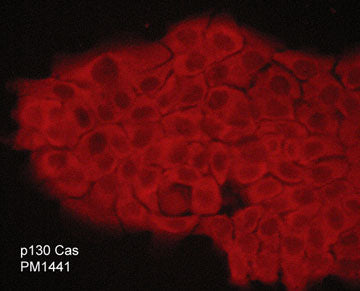

Anti-p130 Cas antibody (C-Term) [M144] (STJA0041311)
SPECIFICATIONS
ClonalityMonoclonal
HostMouse
ConjugationUnconjugated
IsotypeIgG1
ImmunogenClone M144 was generated from a recombinant protein containing amino acid residues in the C-terminal region of rat p130 Cas. This rat sequence is highly conserved in human, mouse, and chicken p130 Cas.
General Information
| Short Description | Mouse monoclonal anti-p130 Cas (C-Term) for use in ELISA, WB, ICC, IHC and IP in Chicken, Human, Mouse and Rat samples. Datasheet included with dilution recommendations, and related reagents. |
| Applications | ELISA/WB/ICC/IHC/IP |
| Host | Mouse |
| Reactivity | Chicken/Human/Mouse/Rat |
| Note | STRICTLY FOR FURTHER SCIENTIFIC RESEARCH USE ONLY (RUO). MUST NOT TO BE USED IN DIAGNOSTIC OR THERAPEUTIC APPLICATIONS. |
Product Properties
| Clonality | Monoclonal |
| Clone ID | M144 |
| Isotype | IgG1 |
| Conjugation | Unconjugated |
| Purification | Protein A Purified |
| Dilution Range | WB 1:1000IHC 1:250ICC 1:200IP 1:100 |
| Formulation | PBS + 1 mg/ml BSA, 0.05% NaN3 and 50% glycerol |
| Storage Instruction | Storage at-20°C is recommended, as aliquots may be taken without freeze/thawing due to presence of 50% glycerol. Stable for at least 1 year at-20°C. |
Target Information
| Gene Symbol | Bcar1 |
| Gene ID | 25414 |
| Uniprot ID | BCAR1_RAT |
| Immunogen | Clone M144 was generated from a recombinant protein containing amino acid residues in the C-terminal region of rat p130 Cas. This rat sequence is highly conserved in human, mouse, and chicken p130 Cas. |
| Immunogen Region | C-Term |
| Immunogen Sequence | Rat |
| Specificity | The antibody detects a 130 kDa* protein corresponding to the molecular mass of p130 Cas on SDS-PAGE immunoblots of human A431, endothelial, and Hct116 cells. |
Additional Info
| Tissue Specificity | Widely expressed. Higher expression in lung, intestine and testis. |
| Post Translational Modifications | PTK2/FAK1 activation mediates phosphorylation at the YDYVHL motif.phosphorylation is most likely catalyzed by SRC family members. SRC-family kinases are recruited to the phosphorylated sites and can phosphorylate other tyrosine residues. Tyrosine phosphorylation is triggered by integrin mediated adhesion of cells to the extracellular matrix. Phosphorylated by SRC kinase in a EDN1- and PTK2B-mediated manner.phosphorylation strengthens its interaction with BCAR3 as part of the PTK2B/BCAR1/BCAR3/RAP1 signaling pathway. Dephosphorylated by PTPN14 at Tyr-226. |
| Function | Docking protein which plays a central coordinating role for tyrosine-kinase-based signaling related to cell adhesion. Implicated in induction of cell migration and cell branching. Involved in the BCAR3-mediated inhibition of TGFB signaling. |
| Protein Name | Breast Cancer Anti-Estrogen Resistance Protein 1Crk-Associated SubstrateP130cas |
| Database Links | Reactome: R-RNO-186763Reactome: -RNO-372708Reactome: -RNO-4420097Reactome: -RNO-8849471 |
| Cellular Localisation | Cell JunctionFocal AdhesionCytoplasmCell ProjectionAxonUnphosphorylated Form Localizes In The CytoplasmLocalizes To Focal Adhesion Sites Following Integrin Engagement |
| Alternative Antibody Names | Anti-Breast Cancer Anti-Estrogen Resistance Protein 1 antibodyAnti-Crk-Associated Substrate antibodyAnti-P130cas antibodyAnti-Bcar1 antibodyAnti-Cas antibodyAnti-Crkas antibody |
Information sourced from Uniprot.org