


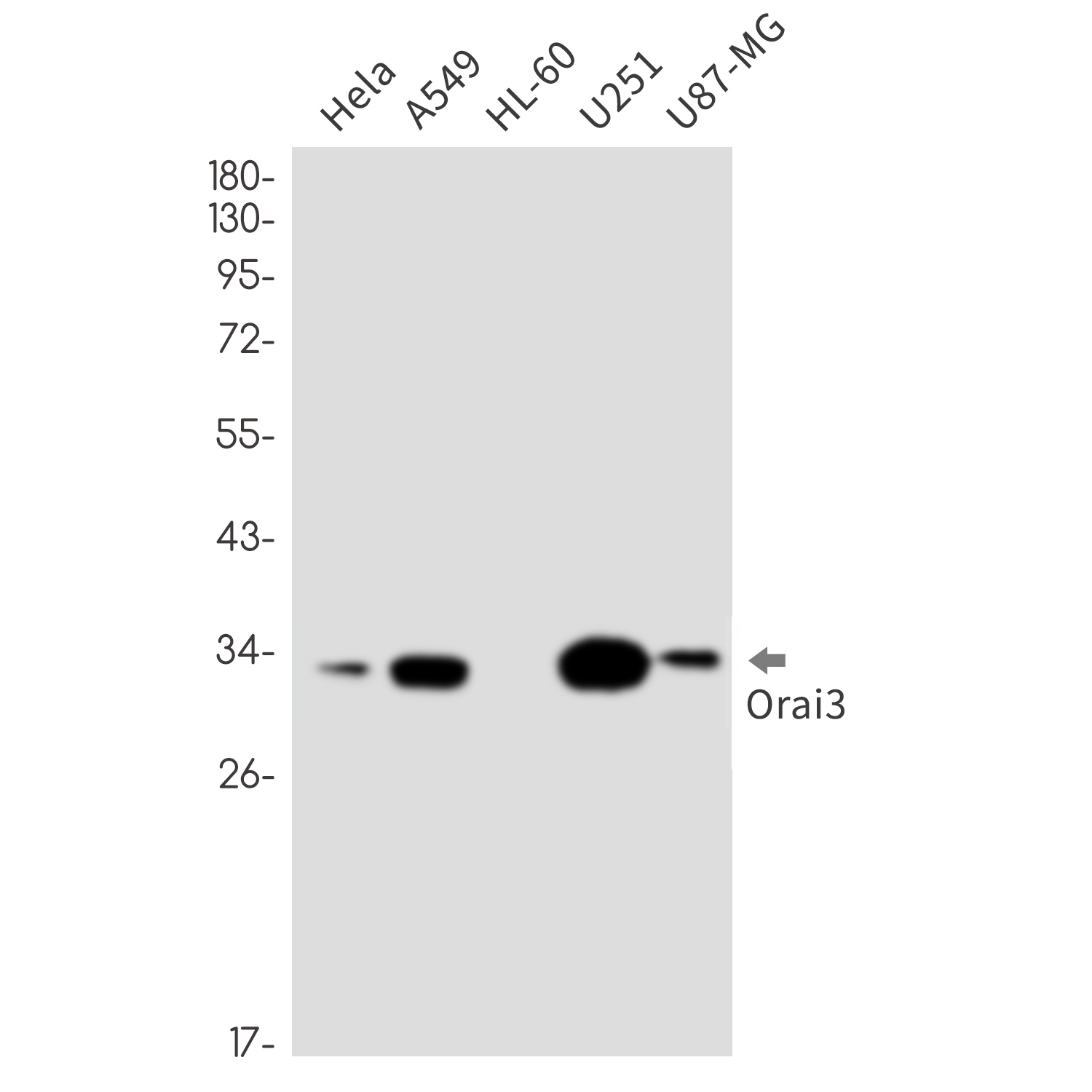


Anti-ORAI3 antibody [R06-8B3] (STJA0035306)
SPECIFICATIONS
ClonalityMonoclonal
HostRabbit
ConjugationUnconjugated
IsotypeIgG
ImmunogenRecombinant protein of human Orai3
General Information
| Short Description | Rabbit monoclonal anti-ORAI3 for use in WB and IHC-P in Human samples. Datasheet included with dilution recommendations, and related reagents. |
| Applications | WB/IHC-P |
| Host | Rabbit |
| Reactivity | Human |
| Note | STRICTLY FOR FURTHER SCIENTIFIC RESEARCH USE ONLY (RUO). MUST NOT TO BE USED IN DIAGNOSTIC OR THERAPEUTIC APPLICATIONS. |
Product Properties
| Clonality | Monoclonal |
| Clone ID | R06-8B3 |
| Isotype | IgG |
| Conjugation | Unconjugated |
| Concentration | 0.3 mg/mL |
| Purification | Affinity Purified |
| Dilution Range | WB 1:500-1:1000IHC 1:50-1:100 |
| Formulation | 50mM Tris-Glycine (pH 7.4) , 0.15M NaCl, 40% Glycerol, 0.01% Sodium azide and 0.05% BSA |
| Storage Instruction | Store at 4°C short term. Aliquot and store at-20°C long term. Avoid freeze/thaw cycles. |
Target Information
| Gene Symbol | ORAI3 |
| Gene ID | 93129 |
| Uniprot ID | ORAI3_HUMAN |
| Immunogen | Recombinant protein of human Orai3 |
Additional Info
| Tissue Specificity | Expressed in both naive and effector T helper cells with higher levels in effector cells. |
| Function | Pore-forming subunit of two major inward rectifying Ca(2+) channels at the plasma membrane: Ca(2+) release-activated Ca(2+) (CRAC) channels and arachidonate-regulated Ca(2+)-selective (ARC) channels. Assembles with ORAI1 and ORAI2 to form hexameric CRAC channels that mediate Ca(2+) influx upon depletion of endoplasmic reticulum Ca(2+) store and channel activation by Ca(2+) sensor STIM1, a process known as store-operated Ca(2+) entry (SOCE). Various pore subunit combinations may account for distinct CRAC channel spatiotemporal and cell-type specific dynamics. ORAI1 mainly contributes to the generation of Ca(2+) plateaus involved in sustained Ca(2+) entry and is dispensable for cytosolic Ca(2+) oscillations, whereas ORAI2 and ORAI3 generate oscillatory patterns. CRAC channels assemble in Ca(2+) signaling microdomains where Ca(2+) influx is coupled to calmodulin and calcineurin signaling and activation of NFAT transcription factors recruited to ORAI1 via AKAP5. CRAC channels are the main pathway for Ca(2+) influx in T cells and promote the immune response to pathogens by activating NFAT-dependent cytokine and chemokine transcription. Assembles with ORAI1 to form channels that mediate store-independent Ca(2+) influx in response to inflammatory metabolites arachidonate or its derivative leukotriene C4, termed ARC and LRC channels respectively. |
| Protein Name | Protein Orai-3Transmembrane Protein 142c |
| Database Links | |
| Cellular Localisation | Cell MembraneMulti-Pass Membrane ProteinColocalizes With Stim1 Upon Store Depletion |
| Alternative Antibody Names | Anti-Protein Orai-3 antibodyAnti-Transmembrane Protein 142c antibodyAnti-ORAI3 antibodyAnti-TMEM142C antibody |
Information sourced from Uniprot.org