



Anti-nSMase3 antibody (C-Term) (STJA0041389)
SPECIFICATIONS
ClonalityPolyclonal
HostRabbit
ConjugationUnconjugated
IsotypeIgG
ImmunogennSMase3 synthetic peptide corresponds to amino acids in the C-terminal region of mouse nSMase3. This sequence is highly conserved in rat and human nSMase3, and has low homology to other nSMase family members.
General Information
| Short Description | Rabbit polyclonal anti-nSMase3 (C-Term) for use in ELISA, WB, ICC and IP in Human, Mouse and Rat samples. Datasheet included with dilution recommendations, and related reagents. |
| Applications | ELISA/WB/ICC/IP |
| Host | Rabbit |
| Reactivity | Human/Mouse/Rat |
| Note | STRICTLY FOR FURTHER SCIENTIFIC RESEARCH USE ONLY (RUO). MUST NOT TO BE USED IN DIAGNOSTIC OR THERAPEUTIC APPLICATIONS. |
Product Properties
| Clonality | Polyclonal |
| Isotype | IgG |
| Conjugation | Unconjugated |
| Purification | Antigen Affinity Purified |
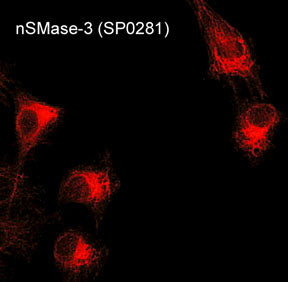
| Dilution Range | WB 1:1000ICC 1:250IP 1:100 |
| Formulation | PBS + 1 mg/ml BSA, 0.05% NaN3 and 50% glycerol |
| Storage Instruction | Storage at-20°C is recommended, as aliquots may be taken without freeze/thawing due to presence of 50% glycerol. Stable for at least 1 year at-20°C. |
Target Information
| Gene Symbol | Smpd4 |
| Gene ID | 77626 |
| Uniprot ID | NSMA3_MOUSE |
| Immunogen | nSMase3 synthetic peptide corresponds to amino acids in the C-terminal region of mouse nSMase3. This sequence is highly conserved in rat and human nSMase3, and has low homology to other nSMase family members. |
| Immunogen Region | C-Term |
| Immunogen Sequence | Mouse |
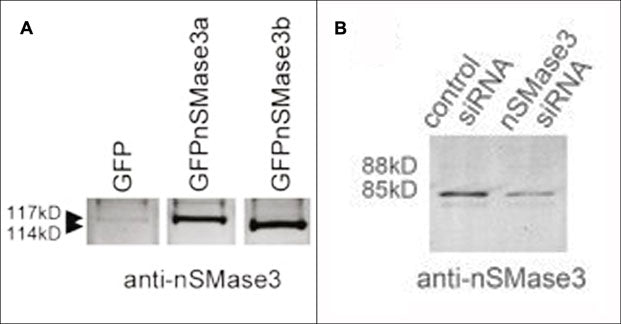
| Specificity | The antibody detects an 85-90 kDa* band corresponding to nSMase3 on SDS-PAGE immunoblots of adult mouse heart and mouse C2C12 cells. The antibody works for western blot, ELISA, immunoprecipitation, and immunocytochemistry. |
Additional Info
| Tissue Specificity | Isoform 1: Expressed in skeletal muscle (at protein level). Isoform 2: Expressed in skeletal muscle but a lower levels than isoform 1 (at protein level). |
| Function | Catalyzes the hydrolysis of membrane sphingomyelin to form phosphorylcholine and ceramide. It has a relevant role in the homeostasis of membrane sphingolipids, thereby influencing membrane integrity, and endoplasmic reticulum organization and function. May sensitize cells to DNA damage-induced apoptosis. In skeletal muscle, mediates TNF-stimulated oxidant production. |
| Protein Name | Sphingomyelin Phosphodiesterase 4Neutral Sphingomyelinase 3Nsmase-3Nsmase3Neutral Sphingomyelinase Iii |
| Database Links | Reactome: R-MMU-9840310 |
| Cellular Localisation | Endoplasmic Reticulum MembraneSingle-Pass Membrane ProteinGolgi Apparatus MembraneNucleus EnvelopeCell MembraneSarcolemma |
| Alternative Antibody Names | Anti-Sphingomyelin Phosphodiesterase 4 antibodyAnti-Neutral Sphingomyelinase 3 antibodyAnti-Nsmase-3 antibodyAnti-Nsmase3 antibodyAnti-Neutral Sphingomyelinase Iii antibodyAnti-Smpd4 antibodyAnti-Kiaa1418 antibody |
Information sourced from Uniprot.org