


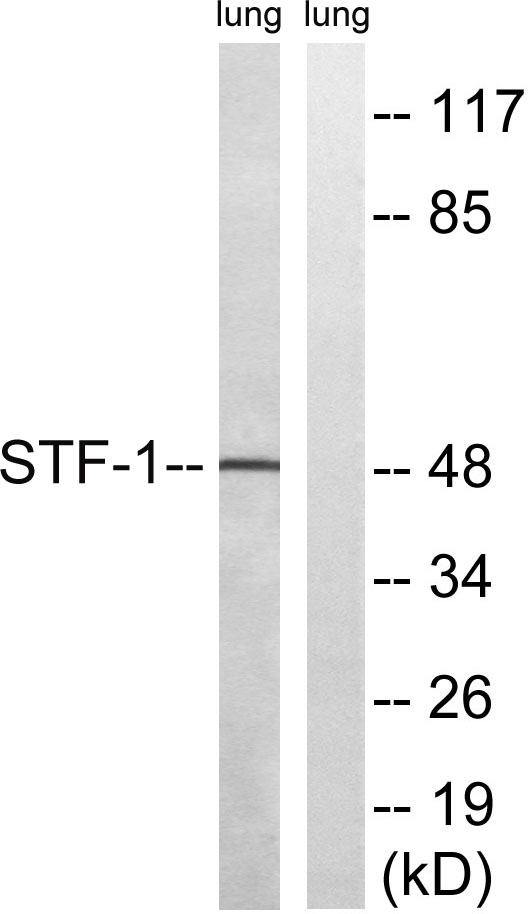
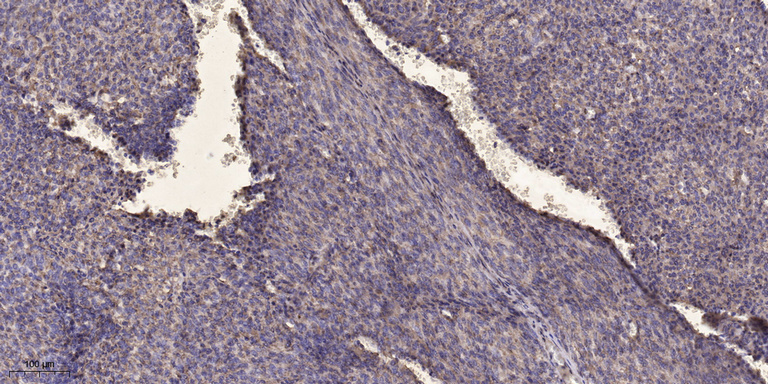

Anti-NR5A1 antibody (169-218 aa) (STJ95626)
SPECIFICATIONS
ClonalityPolyclonal
HostRabbit
ConjugationUnconjugated
IsotypeIgG
ImmunogenThe antiserum was produced against synthesized peptide derived from the human NR5A1 at the amino acid range 169-218
General Information
| Short Description | Rabbit polyclonal anti-Steroidogenic factor 1 (169-218 aa) for use in WB, ELISA and IHC in Human, Mouse and Rat samples. Datasheet included with dilution recommendations, and related reagents. |
| Applications | WB/ELISA/IHC |
| Host | Rabbit |
| Reactivity | Human/Mouse/Rat |
| Note | STRICTLY FOR FURTHER SCIENTIFIC RESEARCH USE ONLY (RUO). MUST NOT TO BE USED IN DIAGNOSTIC OR THERAPEUTIC APPLICATIONS. |
Product Properties
| Clonality | Polyclonal |
| Isotype | IgG |
| Conjugation | Unconjugated |
| Concentration | 1 mg/mL |
| Purification | The antibody was affinity-purified from rabbit antiserum by affinity-chromatography using epitope-specific immunogen. |
| Dilution Range | WB 1:500-2000IHC-P 1:50-300ELISA 2000-20000 |
| Formulation | Liquid in PBS containing 50% Glycerol, 0.5% BSA and 0.02% Sodium Azide. |
| Storage Instruction | Store at-20°C for up to 1 year from the date of receipt, and avoid repeat freeze-thaw cycles. |
Target Information
| Gene Symbol | NR5A1 |
| Gene ID | 2516 |
| Uniprot ID | STF1_HUMAN |
| Immunogen | The antiserum was produced against synthesized peptide derived from the human NR5A1 at the amino acid range 169-218 |
| Immunogen Region | 169-218 aa |
| Specificity | SF-1 Polyclonal Antibody detects endogenous levels of SF-1 protein. |
Additional Info
| Post Translational Modifications | Acetylation stimulates the transcriptional activity. Sumoylation reduces CDK7-mediated phosphorylation on Ser-203. Phosphorylated on Ser-203 by CDK7. This phosphorylation promotes transcriptional activity. |
| Function | Transcriptional activator. Essential for sexual differentiation and formation of the primary steroidogenic tissues. Binds to the Ad4 site found in the promoter region of steroidogenic P450 genes such as CYP11A, CYP11B and CYP21B. Also regulates the AMH/Muellerian inhibiting substance gene as well as the AHCH and STAR genes. 5'-YCAAGGYC-3' and 5'-RRAGGTCA-3' are the consensus sequences for the recognition by NR5A1. The SFPQ-NONO-NR5A1 complex binds to the CYP17 promoter and regulates basal and cAMP-dependent transcriptional activity. Binds phosphatidylcholine. Binds phospholipids with a phosphatidylinositol (PI) headgroup, in particular PI(3,4)P2 and PI(3,4,5)P3. Activated by the phosphorylation of NR5A1 by HIPK3 leading to increased steroidogenic gene expression upon cAMP signaling pathway stimulation. |
| Protein Name | Steroidogenic Factor 1Sf-1Stf-1Hsf-1Adrenal 4-Binding ProteinFushi Tarazu Factor Homolog 1Nuclear Receptor Subfamily 5 Group A Member 1Steroid Hormone Receptor Ad4bp |
| Database Links | Reactome: R-HSA-383280Reactome: R-HSA-4090294Reactome: R-HSA-452723Reactome: R-HSA-9690406 |
| Cellular Localisation | Nucleus |
| Alternative Antibody Names | Anti-Steroidogenic Factor 1 antibodyAnti-Sf-1 antibodyAnti-Stf-1 antibodyAnti-Hsf-1 antibodyAnti-Adrenal 4-Binding Protein antibodyAnti-Fushi Tarazu Factor Homolog 1 antibodyAnti-Nuclear Receptor Subfamily 5 Group A Member 1 antibodyAnti-Steroid Hormone Receptor Ad4bp antibodyAnti-NR5A1 antibodyAnti-AD4BP antibodyAnti-FTZF1 antibodyAnti-SF1 antibody |
Information sourced from Uniprot.org