

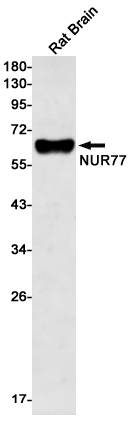

Anti-NR4A1 antibody (16-29 aa) [R02-1C7] (STJA0011714)
SPECIFICATIONS
ClonalityMonoclonal
HostRabbit
ConjugationUnconjugated
IsotypeIgG
ImmunogenA synthetic peptide of human NUR77
General Information
| Short Description | Rabbit monoclonal anti-NUR77 (16-29 aa) for use in WB in Rat samples. Datasheet included with dilution recommendations, and related reagents. |
| Applications | WB |
| Host | Rabbit |
| Reactivity | Rat |
| Note | STRICTLY FOR FURTHER SCIENTIFIC RESEARCH USE ONLY (RUO). MUST NOT TO BE USED IN DIAGNOSTIC OR THERAPEUTIC APPLICATIONS. |
Product Properties
| Clonality | Monoclonal |
| Clone ID | R02-1C7 |
| Isotype | IgG |
| Conjugation | Unconjugated |
| Concentration | 0.3 mg/mL |
| Purification | Affinity Purified |
| Dilution Range | WB 1:500-1:1000 |
| Formulation | 50mM Tris-Glycine (pH7.4) , 0.15M NaCl, 40% Glycerol, 0.01% Sodium azide and 0.05% BSA |
| Storage Instruction | Store at 4°C short term. Aliquot and store at-20°C long term. Avoid freeze/thaw cycles. |
Target Information
| Gene Symbol | NR4A1 |
| Gene ID | 3164 |
| Uniprot ID | NR4A1_HUMAN |
| Immunogen | A synthetic peptide of human NUR77 |
| Immunogen Region | 16-29 aa |
Additional Info
| Tissue Specificity | Fetal muscle and adult liver, brain and thyroid. |
| Post Translational Modifications | Phosphorylated at Ser-351 by RPS6KA1 and RPS6KA3 in response to mitogenic or stress stimuli. Acetylated by p300/CBP, acetylation increases stability. Deacetylated by HDAC1. |
| Function | Orphan nuclear receptor. Binds the NGFI-B response element (NBRE) 5'-AAAGGTCA-3'. Binds 9-cis-retinoic acid outside of its ligand-binding (NR LBD) domain. Participates in energy homeostasis by sequestrating the kinase STK11 in the nucleus, thereby attenuating cytoplasmic AMPK activation. Regulates the inflammatory response in macrophages by regulating metabolic adaptations during inflammation, including repressing the transcription of genes involved in the citric acid cycle (TCA). Inhibits NF-kappa-B signaling by binding to low-affinity NF-kappa-B binding sites, such as at the IL2 promoter. May act concomitantly with NR4A2 in regulating the expression of delayed-early genes during liver regeneration. Plays a role in the vascular response to injury. In the cytosol, upon its detection of both bacterial lipopolysaccharide (LPS) and NBRE-containing mitochondrial DNA released by GSDMD pores during pyroptosis, it promotes non-canonical NLRP3 inflammasome activation by stimulating association of NLRP3 and NEK7. |
| Protein Name | Nuclear Receptor Subfamily 4immunitygroup A Member 1Early Response Protein Nak1Nuclear Hormone Receptor Nur/77Nur77Orphan Nuclear Receptor HmrOrphan Nuclear Receptor Tr3St-59Testicular Receptor 3 |
| Database Links | Reactome: R-HSA-198693Reactome: R-HSA-383280Reactome: R-HSA-5674400 |
| Cellular Localisation | NucleusCytoplasmCytosolMitochondrionNuclear Export To The Cytosol Is Xpo1-Mediated And Positively Regulated By Ifi27Translocation To The Mitochondrion Upon Interaction With Rxra And Upon The Presence Of 9-Cis Retinoic Acid |
| Alternative Antibody Names | Anti-Nuclear Receptor Subfamily 4immunitygroup A Member 1 antibodyAnti-Early Response Protein Nak1 antibodyAnti-Nuclear Hormone Receptor Nur/77 antibodyAnti-Nur77 antibodyAnti-Orphan Nuclear Receptor Hmr antibodyAnti-Orphan Nuclear Receptor Tr3 antibodyAnti-St-59 antibodyAnti-Testicular Receptor 3 antibodyAnti-NR4A1 antibodyAnti-GFRP1 antibodyAnti-HMR antibodyAnti-NAK1 antibody |
Information sourced from Uniprot.org