

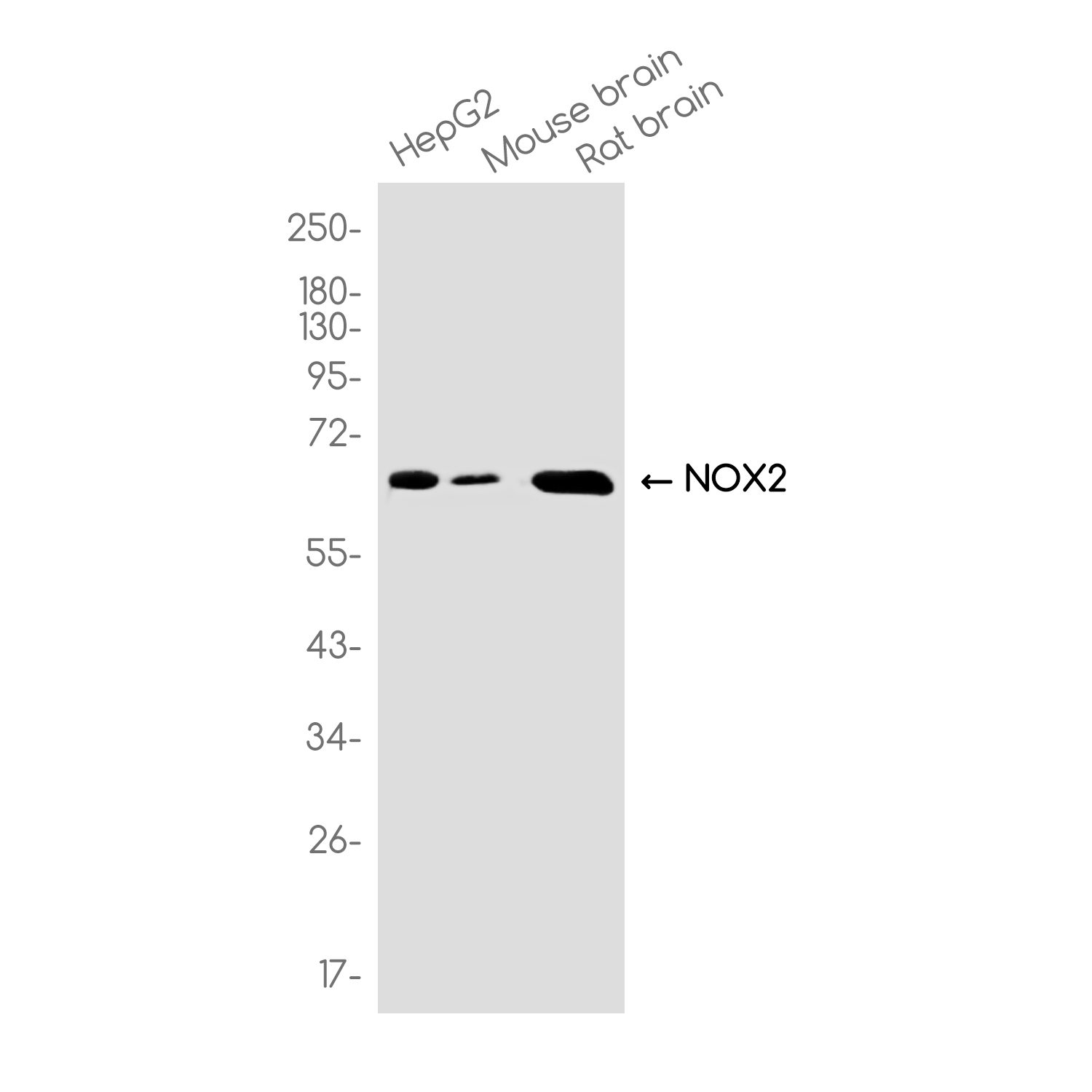

Anti-NOX2 antibody [R04-6J7] (STJA0036073)
SPECIFICATIONS
ClonalityMonoclonal
HostRabbit
ConjugationUnconjugated
IsotypeIgG
ImmunogenA synthesized peptide derived from human CYBB
General Information
| Short Description | Rabbit monoclonal anti-NOX2 for use in WB in Human, Mouse and Rat samples. Datasheet included with dilution recommendations, and related reagents. |
| Applications | WB |
| Host | Rabbit |
| Reactivity | Human/Mouse/Rat |
| Note | STRICTLY FOR FURTHER SCIENTIFIC RESEARCH USE ONLY (RUO). MUST NOT TO BE USED IN DIAGNOSTIC OR THERAPEUTIC APPLICATIONS. |
Product Properties
| Clonality | Monoclonal |
| Clone ID | R04-6J7 |
| Isotype | IgG |
| Conjugation | Unconjugated |
| Purification | Affinity Chromatography |
| Dilution Range | WB 1:500-1:1000 |
| Formulation | Rabbit IgG in phosphate buffered saline, pH 7.4, 150mM NaCl, 0.02% sodium azide and 50% glycerol. |
| Storage Instruction | Store at 4°C short term. Aliquot and store at-20°C long term. Avoid freeze/thaw cycles. |
Target Information
| Gene Symbol | CYBB |
| Gene ID | 1536 |
| Uniprot ID | CY24B_HUMAN |
| Immunogen | A synthesized peptide derived from human CYBB |
Additional Info
| Tissue Specificity | Detected in neutrophils (at protein level). |
| Post Translational Modifications | Glycosylated. Phosphorylated on Ser and Thr residues by PKC during neutrophils activation. Phosphorylation enhances the NADPH oxidase activity and stimulates its interaction with RAC2, NCF2/p67-phox, and NCF1/p47-phox. Undergoes 'Lys-48'-linked polyubiquitination, likely by RNF145, triggering endoplasmic reticulum-associated degradation. |
| Function | Catalytic subunit of the phagocyte NADPH oxidase complex that mediates the transfer of electrons from cytosolic NADPH to O2 to produce the superoxide anion (O2(-)). In the activated complex, electrons are first transferred from NADPH to flavin adenine dinucleotide (FAD) and subsequently transferred via two heme molecules to molecular oxygen, producing superoxide through an outer-sphere reaction (Probable). Activation of the NADPH oxidase complex is initiated by the assembly of cytosolic subunits of the NADPH oxidase complex with the core NADPH oxidase complex to form a complex at the plasma membrane or phagosomal membrane. This activation process is initiated by phosphorylation dependent binding of the cytosolic NCF1/p47-phox subunit to the C-terminus of CYBA/p22-phox. NADPH oxidase complex assembly is impaired through interaction with NRROS. |
| Protein Name | Nadph Oxidase 2Cgd91-PhoxCytochrome B(558 Subunit BetaCytochrome B558 Subunit BetaCytochrome B-245 Heavy ChainHeme-Binding Membrane Glycoprotein Gp91phoxNeutrophil Cytochrome B 91 Kda PolypeptideSuperoxide-Generating Nadph Oxidase Heavy Chain SubunitGp91-1Gp91-PhoxP22 Phagocyte B-Cytochrome |
| Database Links | Reactome: R-HSA-1222556Reactome: R-HSA-1236973Reactome: R-HSA-3299685Reactome: R-HSA-4420097Reactome: R-HSA-5668599Reactome: R-HSA-6798695Reactome: R-HSA-9013149Reactome: R-HSA-9013404Reactome: R-HSA-9013423 |
| Cellular Localisation | Cell MembraneMulti-Pass Membrane ProteinAs Unassembled Monomer May Localize To The Endoplasmic Reticulum |
| Alternative Antibody Names | Anti-Nadph Oxidase 2 antibodyAnti-Cgd91-Phox antibodyAnti-Cytochrome B(558 Subunit Beta antibodyAnti-Cytochrome B558 Subunit Beta antibodyAnti-Cytochrome B-245 Heavy Chain antibodyAnti-Heme-Binding Membrane Glycoprotein Gp91phox antibodyAnti-Neutrophil Cytochrome B 91 Kda Polypeptide antibodyAnti-Superoxide-Generating Nadph Oxidase Heavy Chain Subunit antibodyAnti-Gp91-1 antibodyAnti-Gp91-Phox antibodyAnti-P22 Phagocyte B-Cytochrome antibodyAnti-CYBB antibodyAnti-NOX2 antibody |
Information sourced from Uniprot.org