

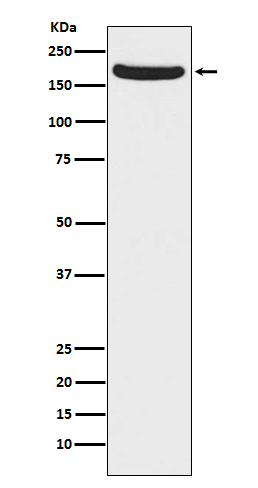

Anti-NMDAR2A antibody [R06-4C4] (STJA0036496)
SPECIFICATIONS
ClonalityMonoclonal
HostRabbit
ConjugationUnconjugated
IsotypeIgG
ImmunogenA synthesized peptide derived from human NMDAR2A
General Information
| Short Description | Rabbit monoclonal anti-NMDAR2A for use in WB in Human, Mouse and Rat samples. Datasheet included with dilution recommendations, and related reagents. |
| Applications | WB |
| Host | Rabbit |
| Reactivity | Human/Mouse/Rat |
| Note | STRICTLY FOR FURTHER SCIENTIFIC RESEARCH USE ONLY (RUO). MUST NOT TO BE USED IN DIAGNOSTIC OR THERAPEUTIC APPLICATIONS. |
Product Properties
| Clonality | Monoclonal |
| Clone ID | R06-4C4 |
| Isotype | IgG |
| Conjugation | Unconjugated |
| Purification | Affinity Chromatography |
| Dilution Range | WB 1:500-1:1000 |
| Formulation | Rabbit IgG in phosphate buffered saline, pH 7.4, 150mM NaCl, 0.02% sodium azide and 50% glycerol. |
| Storage Instruction | Store at 4°C short term. Aliquot and store at-20°C long term. Avoid freeze/thaw cycles. |
Target Information
| Gene Symbol | GRIN2A |
| Gene ID | 2903 |
| Uniprot ID | NMDE1_HUMAN |
| Immunogen | A synthesized peptide derived from human NMDAR2A |
Additional Info
| Function | Component of N-methyl-D-aspartate (NMDA) receptors (NMDARs) that function as heterotetrameric, ligand-gated cation channels with high calcium permeability and voltage-dependent block by Mg(2+). NMDARs participate in synaptic plasticity for learning and memory formation by contributing to the slow phase of excitatory postsynaptic current, long-term synaptic potentiation, and learning. Channel activation requires binding of the neurotransmitter L-glutamate to the GluN2 subunit, glycine or D-serine binding to the GluN1 subunit, plus membrane depolarization to eliminate channel inhibition by Mg(2+). NMDARs mediate simultaneously the potasium efflux and the influx of calcium and sodium. Each GluN2 subunit confers differential attributes to channel properties, including activation, deactivation and desensitization kinetics, pH sensitivity, Ca2(+) permeability, and binding to allosteric modulators. Participates in the synaptic plasticity regulation through activation by the L-glutamate releaseed by BEST1, into the synaptic cleft, upon F2R/PAR-1 activation in astrocyte. |
| Protein Name | Glutamate Receptor Ionotropic - Nmda 2aGlun2aGlutamate Nmda Receptor Subunit Epsilon-1N-Methyl D-Aspartate Receptor Subtype 2aNmdar2aNr2aHnr2a |
| Database Links | Reactome: R-HSA-438066Reactome: R-HSA-6794361Reactome: R-HSA-8849932Reactome: R-HSA-9022699Reactome: R-HSA-9609736Reactome: R-HSA-9617324Reactome: R-HSA-9620244 |
| Cellular Localisation | Cell ProjectionDendritic SpineCell MembraneMulti-Pass Membrane ProteinSynapsePostsynaptic Cell MembraneCytoplasmic Vesicle MembraneExpression At The Dendrite Cell Membrane And At Synapses Is Regulated By Sorcs2 And The Retromer Complex |
| Alternative Antibody Names | Anti-Glutamate Receptor Ionotropic - Nmda 2a antibodyAnti-Glun2a antibodyAnti-Glutamate Nmda Receptor Subunit Epsilon-1 antibodyAnti-N-Methyl D-Aspartate Receptor Subtype 2a antibodyAnti-Nmdar2a antibodyAnti-Nr2a antibodyAnti-Hnr2a antibodyAnti-GRIN2A antibodyAnti-NMDAR2A antibody |
Information sourced from Uniprot.org