

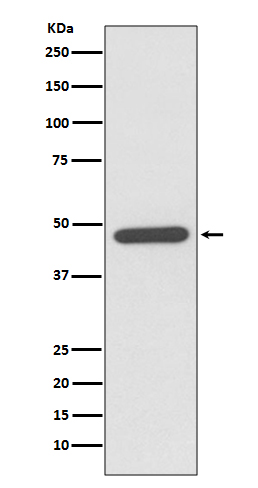

Anti-NeuroD1 antibody [R05-3A9] (STJA0036362)
SPECIFICATIONS
ClonalityMonoclonal
HostRabbit
ConjugationUnconjugated
IsotypeIgG
ImmunogenA synthesized peptide derived from human NeuroD1
General Information
| Short Description | Rabbit monoclonal anti-NeuroD1 for use in WB and IP in Human, Mouse and Rat samples. Datasheet included with dilution recommendations, and related reagents. |
| Applications | WB/IP |
| Host | Rabbit |
| Reactivity | Human/Mouse/Rat |
| Note | STRICTLY FOR FURTHER SCIENTIFIC RESEARCH USE ONLY (RUO). MUST NOT TO BE USED IN DIAGNOSTIC OR THERAPEUTIC APPLICATIONS. |
Product Properties
| Clonality | Monoclonal |
| Clone ID | R05-3A9 |
| Isotype | IgG |
| Conjugation | Unconjugated |
| Purification | Affinity Chromatography |
| Dilution Range | WB 1:500-1:1000IP 1:50 |
| Formulation | Rabbit IgG in phosphate buffered saline, pH 7.4, 150mM NaCl, 0.02% sodium azide and 50% glycerol. |
| Storage Instruction | Store at 4°C short term. Aliquot and store at-20°C long term. Avoid freeze/thaw cycles. |
Target Information
| Gene Symbol | NEUROD1 |
| Gene ID | 4760 |
| Uniprot ID | NDF1_HUMAN |
| Immunogen | A synthesized peptide derived from human NeuroD1 |
Additional Info
| Post Translational Modifications | Phosphorylated. In islet cells, phosphorylated on Ser-274 upon glucose stimulation.which may be required for nuclear localization. In activated neurons, phosphorylated on Ser-335.which promotes dendritic growth. Phosphorylated by MAPK1.phosphorylation regulates heterodimerization and DNA-binding activities. Phosphorylation on Ser-266 and Ser-274 increases transactivation on the insulin promoter in glucose-stimulated insulinoma cells. |
| Function | Acts as a transcriptional activator: mediates transcriptional activation by binding to E box-containing promoter consensus core sequences 5'-CANNTG-3'. Associates with the p300/CBP transcription coactivator complex to stimulate transcription of the secretin gene as well as the gene encoding the cyclin-dependent kinase inhibitor CDKN1A. Contributes to the regulation of several cell differentiation pathways, like those that promote the formation of early retinal ganglion cells, inner ear sensory neurons, granule cells forming either the cerebellum or the dentate gyrus cell layer of the hippocampus, endocrine islet cells of the pancreas and enteroendocrine cells of the small intestine. Together with PAX6 or SIX3, is required for the regulation of amacrine cell fate specification. Also required for dendrite morphogenesis and maintenance in the cerebellar cortex. Associates with chromatin to enhancer regulatory elements in genes encoding key transcriptional regulators of neurogenesis. |
| Protein Name | Neurogenic Differentiation Factor 1NeurodNeurod1Class A Basic Helix-Loop-Helix Protein 3Bhlha3 |
| Database Links | Reactome: R-HSA-210745Reactome: R-HSA-210746 |
| Cellular Localisation | CytoplasmNucleusIn Pancreatic Islet CellsShuttles To The Nucleus In Response To Glucose StimulationColocalizes With Nr0b2 In The Nucleus |
| Alternative Antibody Names | Anti-Neurogenic Differentiation Factor 1 antibodyAnti-Neurod antibodyAnti-Neurod1 antibodyAnti-Class A Basic Helix-Loop-Helix Protein 3 antibodyAnti-Bhlha3 antibodyAnti-NEUROD1 antibodyAnti-BHLHA3 antibodyAnti-NEUROD antibody |
Information sourced from Uniprot.org