

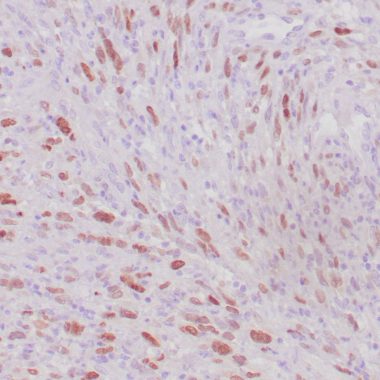

Anti-MyoD1 antibody (1-100aa) [ZR262] (STJ180467)
SPECIFICATIONS
ClonalityMonoclonal
HostRabbit
ConjugationUnconjugated
IsotypeIgG
ImmunogenSynthetic peptide corresponding to residues within aa 1-100 of human MyoD1
General Information
| Short Description | Rabbit monoclonal MyoD1 (1-100aa) antibody for use in IHC-P in human samples. Datasheet included with dilution recommendations, and related reagents. |
| Applications | IHC-P |
| Host | Rabbit |
| Reactivity | Human |
| Note | STRICTLY FOR FURTHER SCIENTIFIC RESEARCH USE ONLY (RUO). MUST NOT TO BE USED IN DIAGNOSTIC OR THERAPEUTIC APPLICATIONS. |
Product Properties
| Clonality | Monoclonal |
| Clone ID | ZR262 |
| Isotype | IgG |
| Conjugation | Unconjugated |
| Purification | Affinity purified |
| Dilution Range | 1:100-200 |
| Formulation | Tris-HCI buffer containing stabilizing protein (BSA) and <0.1% ProClin |
| Storage Instruction | Store at 2‐8°C for up to 24 months. Predilute: Ready to use, no reconstitution necessary. Concentrate: Use dilution range and appropriate lab‐standardized diluent. Stability after dilution: 7 days at 24°C, 3 months at 2‐8°C, 6months at ‐20°C. |
Target Information
| Gene Symbol | MYOD1 |
| Gene ID | 4654 |
| Uniprot ID | MYOD1_HUMAN |
| Immunogen | Synthetic peptide corresponding to residues within aa 1-100 of human MyoD1 |
| Immunogen Region | 1-100aa |
| Specificity | Positive control: Rhabdomyosarcoma |
Additional Info
| Post Translational Modifications | Phosphorylated by CDK9. This phosphorylation promotes its function in muscle differentiation. Acetylated by a complex containing EP300 and PCAF. The acetylation is essential to activate target genes. Conversely, its deacetylation by SIRT1 inhibits its function. Ubiquitinated on the N-terminus.which is required for proteasomal degradation. Methylation at Lys-104 by EHMT2/G9a inhibits myogenic activity. |
| Function | Acts as a transcriptional activator that promotes transcription of muscle-specific target genes and plays a role in muscle differentiation. Together with MYF5 and MYOG, co-occupies muscle-specific gene promoter core region during myogenesis. Induces fibroblasts to differentiate into myoblasts. Interacts with and is inhibited by the twist protein. This interaction probably involves the basic domains of both proteins. |
| Protein Name | Myoblast Determination Protein 1Class C Basic Helix-Loop-Helix Protein 1Bhlhc1Myogenic Factor 3Myf-3 |
| Database Links | Reactome: R-HSA-525793Reactome: R-HSA-9839394 |
| Cellular Localisation | Nucleus |
| Alternative Antibody Names | Anti-Myoblast Determination Protein 1 antibodyAnti-Class C Basic Helix-Loop-Helix Protein 1 antibodyAnti-Bhlhc1 antibodyAnti-Myogenic Factor 3 antibodyAnti-Myf-3 antibodyAnti-MYOD1 antibodyAnti-BHLHC1 antibodyAnti-MYF3 antibodyAnti-MYOD antibody |
Information sourced from Uniprot.org